
A short answer
A kutcheri is the formal name for a Carnatic music concert. It is a structured performance that brings together pre-composed music and spontaneous improvisation. In a typical setting, a lead performer is joined by a melodic accompanist, a percussionist, and a drone. The concert usually follows a specific blueprint that guides the listener through different moods, tempos, and musical forms. It often begins with a brisk opening piece and builds toward a substantial main item before concluding with lighter, melodic songs.ref-1
For a listener, the kutcheri is not just a series of songs. it is a journey that balances discipline with creativity. The format allows the performers to explore the depths of various ragas and talas while maintaining a connection to a shared tradition of compositions. While the specific choice of songs and the length of the concert can vary, the underlying structure remains a reliable guide for anyone sitting in the audience.
Understanding how a kutcheri works can transform the listening experience. Instead of hearing a wall of sound, you begin to recognize the different sections and the roles of each musician. You can notice how a concert gathers energy, how the musicians interact with each other, and how the mood shifts from the technical precision of the opening to the expansive exploration of the main item. This guide is designed to help you navigate that journey with clarity and enjoyment.
It is important to remember that a kutcheri is a live event. While there are common patterns, every performance is unique. The relationship between the musicians, the response of the audience, and the specific choices made by the lead performer all contribute to the final experience. By learning the blueprint, you gain a framework that helps you appreciate the skill and artistry involved in every moment of the concert.
The ensemble and their roles
A Carnatic concert is a collaborative effort. Even when a single singer or instrumentalist is the focus, the performance relies on a small group of musicians working in harmony. This group is often referred to as the ensemble. Each member has a specific role that contributes to the overall sound and structure of the kutcheri.
The lead performer is the central figure. This person could be a vocalist or an instrumentalist, such as a flute player or a veena player. The lead performer is responsible for choosing the repertoire, setting the pace, and leading the improvisations. They decide which raga to explore, which composition to sing, and how much time to spend on each section. Their artistic vision defines the character of the concert.
The melodic accompaniment is usually provided by a violinist. The role of the violinist is to support the lead performer by following their melodic lines and providing responses during improvisations. When the lead performer sings a phrase, the violinist often echoes it, sometimes adding their own subtle interpretations. This interaction creates a dialogue that enriches the musical texture. The violinist also provides a steady melodic foundation during the sections where the lead performer might take a brief pause.
The percussion accompaniment is most commonly provided by the mridangam, a double-headed drum. The mridangam player provides the rhythmic framework for the concert. They do not just keep time; they interact with the melodic phrases, highlighting the rhythmic accents and adding complexity to the tala. In some concerts, other percussion instruments like the ghatam (a clay pot) or the kanjira (a small frame drum) may also be present, working alongside the mridangam to create a rich rhythmic layer.
The drone is the constant background sound that provides the tonal foundation for the entire concert. This is usually provided by a tambura, either a physical stringed instrument or an electronic version. The drone sounds the fundamental note, known as the tonic or shadja, and its fifth, known as panchama. This constant reference point allows the performers and the listeners to stay oriented within the raga. Without the drone, the melodic nuances of Carnatic music would lose their context.
| Role | Primary Instrument | Key Function |
|---|---|---|
| Lead Performer | Voice, Flute, Veena, etc. | Leads the concert, chooses repertoire, and guides improvisation. |
| Melodic Accompaniment | Violin | Supports the lead, echoes phrases, and provides melodic dialogue. |
| Percussion | Mridangam | Provides the rhythmic framework and interacts with the melody. |
| Drone | Tambura | Supplies the constant tonal foundation and reference pitch. |
Each member of the ensemble must be highly attentive to the others. The lead performer signals changes in tempo or mood, and the accompanists must respond instantly. This level of coordination is achieved through years of training and a deep understanding of the musical system. When you watch a kutcheri, you can see the musicians constantly looking at each other, exchanging nods and smiles as they navigate the complexities of the music together.
The ensemble's layout on the stage is also traditional. The lead performer sits in the center, with the violinist to their left and the mridangam player to their right. The tambura player, if present, sits behind the lead performer. This arrangement allows for easy visual communication and ensures that the sound is balanced for the audience. The physical proximity of the musicians reflects the intimate and collaborative nature of the performance.
For the listener, paying attention to these roles can be a great way to engage with the music. You can try to follow the dialogue between the singer and the violinist, or notice how the mridangam player anticipates a rhythmic turn. You can also listen to how the drone provides a steady anchor for the soaring melodies. By understanding the ensemble, you begin to see the kutcheri as a living, breathing conversation between skilled artists.
The ensemble is not just a support system for the lead performer. Each musician is an artist in their own right, and their contributions are essential to the success of the concert. A great kutcheri is one where all the musicians are in sync, pushing each other to new heights of creativity while remaining grounded in the traditions of the form. This synergy is what makes live Carnatic music so compelling and powerful.
The typical sequence of a kutcheri
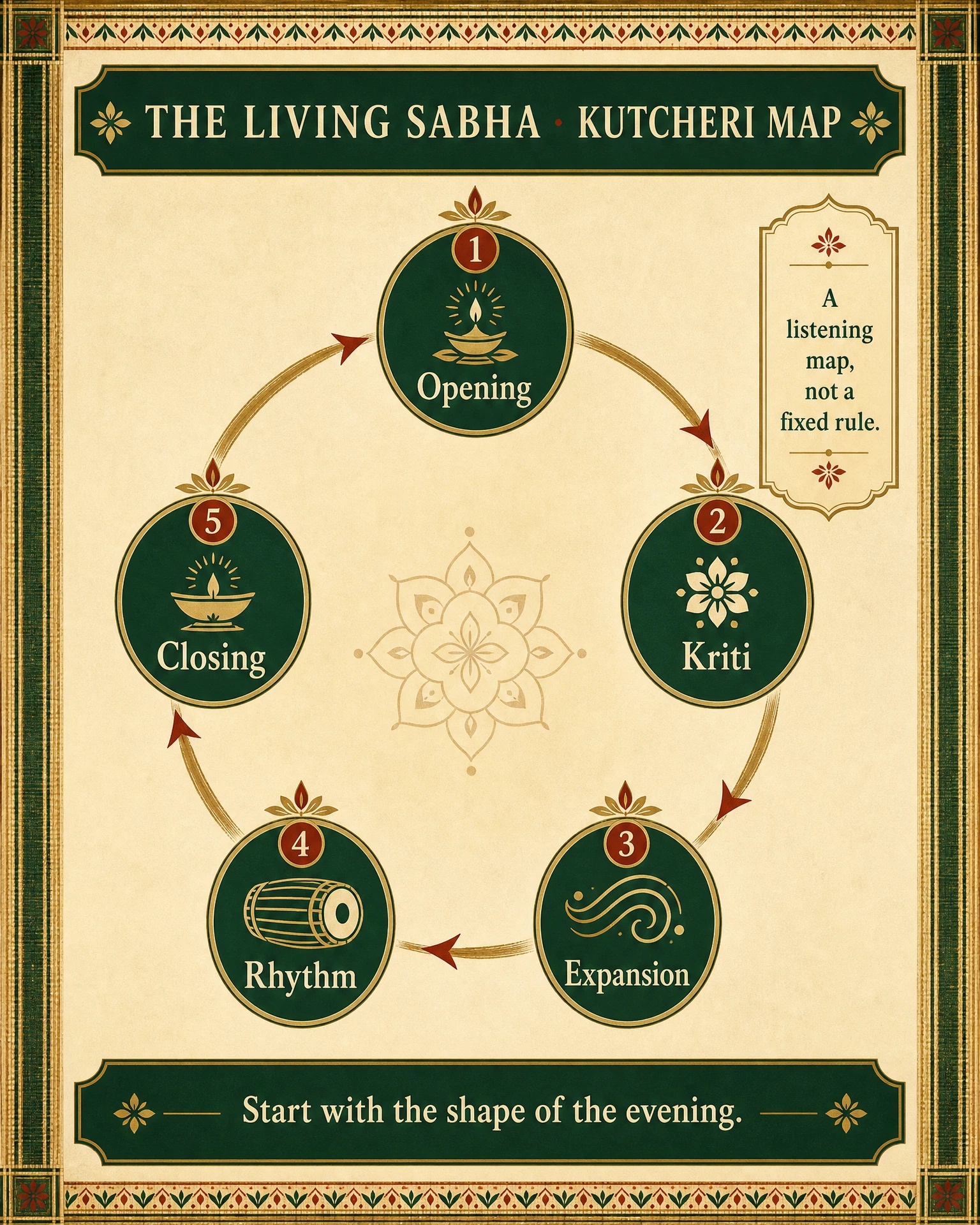
A Carnatic concert is not a random collection of songs. It follows a deliberate sequence that has evolved over many decades. This sequence is designed to engage the listener, showcase the range of the performers, and explore the various facets of the musical system. While every concert is different, most follow a general blueprint that provides a sense of structure and progression.
The concert usually begins with a brisk and energetic opening piece. This is often a varnam, a composition that is technical in nature and helps the musicians warm up. The varnam sets the tone for the performance, establishing the raga and the tala with clarity and precision. It is a way for the musicians to settle into their roles and for the audience to focus their attention on the music.
Following the opening, the lead performer typically presents a series of kritis. A kriti is a major compositional form in Carnatic music. Each kriti is set in a specific raga and tala and has a defined structure. The lead performer may choose kritis by different composers, each offering a unique melodic and lyrical flavor. Some kritis are performed with minimal improvisation, while others serve as a platform for more extensive exploration.
As the concert progresses, the complexity and depth of the music increase. The middle section of the kutcheri is often where the most substantial items are placed. This includes the "main item," which is the centerpiece of the performance. The main item involves an extensive exploration of a raga, followed by a major composition and a significant amount of improvisation. This is the moment where the musicians can truly showcase their creativity and technical mastery.
After the main item, the mood of the concert often shifts. The heavy, classical exploration gives way to lighter and more melodic pieces. These are often referred to as "tukkadas." They might include devotional songs, folk-inspired melodies, or compositions in ragas that are considered more accessible. This section provides a sense of relaxation and variety, allowing the audience to enjoy a different side of the performers' artistry.
The concert concludes with a mangalam, a short piece that marks the end of the performance. The mangalam is a prayer for well-being and a way to thank the divine and the audience. It is a peaceful and auspicious conclusion to the musical journey. After the mangalam, the musicians and the audience share a moment of silence and appreciation before the concert officially ends.
| Phase | Typical Item | Character | Purpose |
|---|---|---|---|
| Opening | Varnam | Brisk, technical, structured. | Warm-up, sets the tone, establishes raga and tala. |
| Build-up | Kritis | Varied, compositional, melodic. | Explores different composers and ragas, builds momentum. |
| Main Item | Raga Alapana, Kriti, Improvisation | Expansive, creative, deep. | The centerpiece, showcases mastery and deep exploration. |
| Rhythmic Solo | Tani Avartanam | Percussive, complex, interactive. | Highlights the percussionist's skill and rhythmic creativity. |
| Concluding | Tukkadas, Lighter pieces | Melodic, accessible, relaxed. | Provides variety and a sense of resolution. |
| Closing | Mangalam | Short, auspicious, peaceful. | Marks the end, expresses gratitude and well-being. |
This sequence is not a rigid set of rules. Performers have the freedom to adapt the format to suit the occasion, the time available, and their own artistic preferences. For example, in a shorter concert, some sections might be compressed or omitted. In a themed concert, the choice of kritis might be restricted to a particular composer or raga. However, the general arc of the performance, moving from a structured opening to a deep exploration and finally to a melodic conclusion, remains a consistent feature of the kutcheri.
For the listener, understanding this sequence helps in anticipating what comes next. You can recognize when the concert is building toward its peak and when it is beginning to wind down. You can also appreciate how the different sections complement each other, creating a balanced and satisfying musical experience. The structure provides a map that allows you to navigate the complexities of the music with confidence.
The transition between sections is often seamless. The lead performer might move from a kriti directly into an improvisation, or from the main item into the rhythmic solo. The musicians communicate these transitions through subtle cues, such as a change in tempo or a specific melodic phrase. As you become more familiar with the format, you will start to notice these cues and appreciate the fluid nature of the performance.
The sequence also reflects the pedagogical and historical roots of Carnatic music. The inclusion of the varnam at the beginning reflects its role as a foundational exercise for students. The prominence of kritis by the "Trinity" of composers (Tyagaraja, Muthuswami Dikshitar, and Syama Sastri) reflects their central role in shaping the repertoire. The development of the main item as a platform for improvisation reflects the importance of individual creativity within the tradition.
Ultimately, the sequence of a kutcheri is a way to organize the vast possibilities of Carnatic music into a coherent and engaging experience. It provides a framework that supports both the performers and the audience, allowing them to share in a journey of musical discovery. By following the blueprint, you can appreciate the logic and beauty that underpin every Carnatic concert.
The opening: The varnam
The start of a Carnatic concert is a significant moment. It is when the musicians and the audience first come together in a shared space. To mark this beginning, many performers choose to start with a varnam. As discussed in our dedicated guide, a varnam is a special kind of composition that is both technical and melodic. It serves as a perfect bridge between the silence before the concert and the rich musical world that is about to unfold.
A varnam is characterized by its brisk pace and its focus on the essential features of a raga. It consists of both lyrics (sahitya) and solfa syllables (swaras). The structure of a varnam is designed to showcase the raga's characteristic phrases and its rhythmic possibilities. When performed at the beginning of a concert, it helps the lead singer or instrumentalist to find their voice or their touch on the instrument. It also allows the accompanists to synchronize their playing with the lead.
For the listener, the varnam is an invitation to focus. The steady pulse and the clear melodic lines provide a helpful entry point. You do not need to know the technical details of the raga or the tala to appreciate the energy and precision of the performance. You can simply listen to the way the words and the syllables interweave, and how the music moves with a sense of purpose and direction.
The choice of varnam can also give you a hint about what is to come. A performer might choose a varnam in a popular raga to immediately engage the audience, or a more rare raga to signal a specialized programme. The tempo of the varnam also sets the initial energy level of the concert. Some varnams are performed in a single, fast speed, while others might involve a change in tempo, adding a layer of rhythmic interest.
One of the most recognizable features of a varnam is the way it repeats certain sections. This repetition is not just for practice; it is a way to establish the raga's identity in the listener's mind. By hearing the same phrases multiple times, you begin to recognize the unique "flavor" of the raga. This familiarity will be helpful later in the concert when the musicians start to improvise and explore the raga in more complex ways.
The varnam also highlights the relationship between the lead performer and the violinist. In many concerts, the violinist follows the lead performer's lines very closely during the varnam. This creates a unified sound that is both powerful and precise. You can listen for the way the two instruments (or the voice and the violin) blend together, creating a rich and resonant melodic texture.
While the varnam is a common opening, it is not the only option. Some performers might choose to start with a short invocation or a simple kriti. However, the varnam remains a popular choice because of its unique ability to energize both the performers and the audience. It is a statement of intent, a way of saying that the concert has begun and that the musicians are ready to explore the depths of their art.
As you listen to the opening varnam, try to notice the physical presence of the musicians. See how they settle into their seats, how they adjust their instruments, and how they begin to communicate with each other. The varnam is a time of preparation and focus, a moment where the ensemble becomes a single, cohesive unit. This sense of unity is essential for the rest of the performance.
The varnam also serves as a rhythmic anchor. The tala is usually very clear and steady, providing a solid foundation for the music. You can try to follow the tala by watching the lead performer's hand movements or by listening to the mridangam. This will help you get into the rhythm of the concert and prepare you for the more complex rhythmic interactions that will occur later.
In summary, the opening varnam is more than just a warm-up. It is a vital part of the kutcheri blueprint, providing a structured and energetic start to the performance. It establishes the raga and the tala, builds a connection between the musicians, and invites the audience into the musical journey. By paying attention to the varnam, you can set yourself up for a deeper and more rewarding listening experience.
The build-up: Kritis and smaller compositions
After the opening varnam has set the stage, the kutcheri moves into a phase of exploration through various compositions known as kritis. This section of the concert is often where the diversity of the Carnatic repertoire is most evident. The lead performer will typically present several kritis, each in a different raga and tala, and often by different composers. This variety keeps the concert engaging and allows the listener to experience a wide range of musical moods and textures.
A kriti is a highly structured composition that consists of three main parts: the pallavi, the anupallavi, and the charanam. The pallavi is the opening theme and serves as a recurring refrain. The anupallavi is a secondary theme that often explores the higher notes of the raga. The charanam is a longer section that provides further melodic and lyrical development. In a typical performance, the lead performer will return to the pallavi after completing the anupallavi and the charanam, creating a sense of circularity and resolution.
During this build-up phase, the lead performer may choose to include smaller improvisations around the kritis. For example, they might start with a short raga alapana, which is a spontaneous exploration of the raga without any rhythmic accompaniment. This helps to establish the mood of the raga before the composition begins. They might also add neraval, which involves improvising on a specific line of the lyrics, or kalpana swaras, which are improvised sequences of solfa syllables that lead back to the main theme.
The choice of kritis is an important part of the lead performer's artistry. They must balance well-known compositions that the audience will recognize with rarer pieces that showcase their specialized knowledge. They must also consider the flow of the concert, ensuring that the ragas and talas are varied and that the energy level is maintained. A well-planned sequence of kritis can build a sense of momentum, leading the audience toward the more substantial items that will follow.
For the listener, this section is a chance to appreciate the beauty and craftsmanship of the compositions themselves. Each kriti is a miniature masterpiece, a perfect marriage of melody, rhythm, and poetry. You can listen for the way the composer has used the raga to express a particular emotion, and how the rhythmic structure supports the lyrical content. You can also notice the subtle variations, or sangatis, that the performer adds to the main themes, which bring a sense of freshness and vitality to the music.
The interaction between the musicians continues to be a key feature during the kritis. The violinist provides a constant melodic shadow, echoing the singer's phrases and adding their own embellishments. The mridangam player provides a steady rhythmic pulse, highlighting the accents of the tala and responding to the melodic turns. This collaborative spirit ensures that even the most structured compositions feel alive and dynamic.
As the concert builds, you might notice that the kritis become longer and more complex. The lead performer might spend more time on the initial raga alapana, or add more extensive improvisations at the end of the composition. This gradual increase in depth and duration prepares the audience for the "main item" of the concert. It is a way of building musical stamina and deepening the listener's engagement with the performance.
The build-up phase also provides an opportunity to learn about different composers. While the Trinity of Tyagaraja, Muthuswami Dikshitar, and Syama Sastri are the most prominent, there are many other great composers whose works are regularly featured in kutcheris. Each composer has a distinct style, and hearing their works in succession can be a fascinating way to explore the history and evolution of Carnatic music.
For a new listener, the best way to approach this section is to simply let the music wash over you. You do not need to identify every raga or understand every word of the lyrics. Instead, focus on the overall mood of each piece. Does it feel joyful, meditative, heroic, or melancholic? Notice how the pace changes from one kriti to the next. By paying attention to these broad characteristics, you can begin to build a personal connection with the music.
In summary, the build-up phase is a crucial part of the kutcheri blueprint. It provides variety, showcases the range of the performers, and builds momentum toward the centerpiece of the concert. Through a carefully chosen sequence of kritis and smaller improvisations, the musicians invite the audience into a deeper and more varied exploration of the Carnatic tradition.
The main item: Elaboration and improvisation
The centerpiece of a Carnatic kutcheri is the "main item." This is the moment where the concert reaches its peak of complexity, depth, and creative exploration. The main item is usually the longest piece in the performance, often lasting forty-five minutes or more. it is the ultimate test of a performer's skill, knowledge, and imaginative power.
The main item typically follows a specific structure that allows for extensive improvisation. It begins with a detailed raga alapana. This is a spontaneous, non-rhythmic exploration of the raga. The lead performer explores the raga's scales, its characteristic phrases, and its emotional nuances, moving from the lower notes to the higher registers. The goal is to create a complete and vivid picture of the raga in the listener's mind. The violinist then provides a shorter response, offering their own interpretation of the raga.
Following the alapana, the lead performer might present a tanam. This is another form of improvisation that has a more rhythmic feel, although it is still not set to a specific tala cycle. Tanam is characterized by its pulsating, rhythmic phrases and is often associated with the sound of the veena. Like the alapana, the tanam allows the performer to explore the raga's melodic possibilities, but with an added layer of rhythmic drive.
The core of the main item is a major composition, often a kriti or a Ragum Tanam Pallavi (RTP). If it is a kriti, it is usually one that is particularly substantial and allows for extensive elaboration. If it is an RTP, the "pallavi" is a specially composed line that serves as the basis for all the subsequent improvisations. The pallavi is set to a specific raga and tala and is designed to be both musically challenging and aesthetically satisfying.
The performance of the composition is followed by extensive neraval and kalpana swaras. Neraval involves improvising on a specific line of the lyrics, maintaining the original melody and rhythm while adding new variations and embellishments. Kalpana swaras are improvised sequences of solfa syllables that lead back to the main theme. These improvisations often involve a dialogue between the lead performer and the violinist, with each musician challenging and inspiring the other.
The main item is where the synergy of the ensemble is most evident. The lead performer, the violinist, and the percussionists must be in perfect sync, responding to each other's cues and maintaining the rhythmic and melodic integrity of the piece. The intensity of the performance builds as the improvisations become more complex and the tempo increases. The audience is often swept up in this creative energy, responding with nods, smiles, and applause.
For the listener, the main item is an opportunity for deep immersion. The extensive exploration of a single raga allows you to truly get to know its character and its secrets. You can follow the performer's journey, noticing how they build a phrase, how they navigate a difficult transition, and how they bring a sense of resolution to their improvisations. It is a demanding but deeply rewarding experience that requires your full attention.
The main item also highlights the importance of individual creativity within the Carnatic tradition. While the raga and the tala provide the framework, the actual music that is created is unique to that moment and those performers. No two performances of a main item are ever the same. This spontaneity is what makes live Carnatic music so exciting and vital. It is a living tradition that is constantly being reinvented by its practitioners.
One of the most impressive aspects of the main item is the technical mastery on display. The performers must have a deep understanding of the raga's structure, the complexities of the tala, and the nuances of the composition. They must also have the physical stamina to sustain a long and demanding performance. Watching a skilled musician navigate the challenges of a main item is evidence of their years of dedicated practice and study.
As the main item draws to a close, the energy level often reaches a fever pitch. The final sequences of kalpana swaras are often fast and exhilarating, leading to a grand conclusion where all the musicians come together in a powerful and unified statement. This is the moment of maximum intensity in the kutcheri, a peak of musical expression that leaves a lasting impression on the listener.
In summary, the main item is the heart of the Carnatic concert. It is an expansive and creative exploration of a raga and a composition, showcasing the full range of the performers' artistry. Through its structured improvisations and its collaborative spirit, the main item provides a deep and immersive musical experience that is the hallmark of the kutcheri format.
The rhythmic heart: Tani avartanam
Following the grand conclusion of the main item's melodic improvisations, the stage is handed over to the percussionists for the tani avartanam. This is a dedicated solo section for the drum players, most notably the mridangam. If there are other percussion instruments present, such as the ghatam or the kanjira, they will also participate, creating a rich and complex rhythmic dialogue. The tani avartanam is a vital part of the kutcheri, highlighting the sophisticated rhythmic system of Carnatic music and the extraordinary skill of its percussionists.
The tani avartanam is not just a random display of drumming. It is a structured exploration of the tala that has been used throughout the main item. The percussionists start by playing simple patterns that establish the basic pulse and the structure of the tala cycle. They then gradually build in complexity, introducing intricate subdivisions, syncopations, and cross-rhythms. The goal is to explore the various mathematical and aesthetic possibilities of the rhythmic cycle while maintaining a constant sense of the underlying beat.
One of the most fascinating aspects of the tani avartanam is the interaction between the different percussionists. If there is more than one drummer, they will often engage in a "call and response" format. The mridangam player might play a complex pattern, and the ghatam player will then try to replicate it or provide a complementary response. This dialogue creates a sense of friendly competition and mutual inspiration, pushing the musicians to new levels of rhythmic creativity. The audience can see the musicians smiling and nodding at each other as they navigate the complexities of the tala together.
The tani avartanam also involves a gradual increase in tempo and intensity. The initial patterns are often played at a moderate pace, allowing the listener to follow the rhythmic logic. As the solo progresses, the speed increases, and the patterns become more dense and challenging. The final section of the tani avartanam, known as the mohra and korvai, is a grand climax where the percussionists play a series of powerful and highly structured sequences that lead back to the main theme of the composition.
For the listener, the tani avartanam is a chance to focus exclusively on the rhythmic dimension of the music. Even if you do not understand the technicalities of the tala, you can appreciate the incredible dexterity, precision, and energy of the drummers. You can listen for the different sounds and textures that the musicians produce from their instruments, the deep, resonant bass of the mridangam, the sharp, metallic ring of the ghatam, and the crisp, snapping sounds of the kanjira.
The tani avartanam also provides a moment of rest for the lead performer and the violinist. They often sit back and listen attentively, sometimes marking the tala with their hands to support the percussionists. This sense of mutual respect and appreciation is a beautiful feature of the kutcheri. It shows that every member of the ensemble, whether melodic or rhythmic, is valued for their unique contribution to the performance.
Watching the audience during a tani avartanam is also an interesting experience. Many listeners will be marking the tala with their hands, following the complex rhythmic cycles with focused intensity. This active participation creates a shared sense of rhythm and energy between the performers and the audience. When the percussionists arrive at the final resolution of a complex pattern, the audience often responds with spontaneous applause and cheers.
The tani avartanam is evidence of the importance of rhythm in Carnatic music. The tala system is one of the most sophisticated in the world, and the tani avartanam is its ultimate showcase. It demonstrates that rhythm is not just a background support for the melody, but a powerful and expressive language in its own right. By paying attention to the tani avartanam, you can gain a deeper appreciation for the mathematical beauty and the physical energy that underpin every Carnatic concert.
In summary, the tani avartanam is the rhythmic heart of the kutcheri. It is a structured and creative exploration of the tala, showcasing the extraordinary skill and collaborative spirit of the percussionists. Through its complex patterns, its interactive dialogue, and its building intensity, the tani avartanam provides a thrilling and essential rhythmic experience that is a highlight of the Carnatic concert format.
The concluding phase: Lighter pieces and mangalam
After the high intensity of the main item and the rhythmic solo, the kutcheri enters its final phase. This section is characterized by a shift in mood toward something more relaxed, melodic, and accessible. The heavy, classical exploration of the earlier sections gives way to a variety of shorter pieces, often referred to as tukkadas. This concluding phase provides a sense of variety and resolution, allowing the audience to enjoy a different side of the performers' artistry before the concert officially ends.
The tukkadas can include a wide range of musical forms. One common type is the padam or javali, which are lyrical and expressive songs often associated with dance. These pieces focus on the emotional nuances of the raga and the poetic content of the lyrics. Another popular choice is the devotional song, such as a bhajan or a kriti by a Haridasa saint. These songs are often in more accessible ragas and have a direct and heartfelt appeal. The lead performer might also include folk-inspired melodies or compositions in "light" ragas that are known for their pleasing and melodic character.
This section is also where the lead performer might fulfill requests from the audience. In a more informal setting, listeners might shout out the names of their favorite songs or ragas, and the performer will try to include them in the tukkada section. This interaction creates a sense of connection and shared enjoyment between the musicians and the audience. It is a reminder that the kutcheri is a live event that is shaped by the presence and the preferences of the listeners.
The tukkadas are often performed with less emphasis on formal improvisation. The focus is on the beauty of the melody and the clarity of the lyrics. The lead performer might add a few subtle touches, but the overall structure of the song is maintained. This provides a contrast to the extensive elaborations of the main item and allows the listener to simply enjoy the melodic flow of the music. The violinist and the percussionists also play in a more supportive and understated manner, enhancing the melodic beauty of the pieces.
One of the highlights of the tukkada section is the tillana. This is a rhythmic and melodic composition that is characterized by its brisk pace and its use of rhythmic syllables. The tillana is often a joyous and energetic piece that showcases the technical agility of the performers. It is a perfect way to build toward the final conclusion of the concert. The audience often responds with great enthusiasm to the lively and infectious rhythm of the tillana.
The concert officially concludes with the mangalam. This is a short, traditional piece that is a prayer for well-being, peace, and prosperity. The mangalam is a way to thank the divine, the gurus, and the audience for a successful performance. It is usually performed in a peaceful and auspicious raga, such as Saurashtram or Madhyamavati. The mood of the mangalam is one of gratitude and serenity, providing a perfect sense of closure to the musical journey.
After the mangalam, the musicians and the audience share a moment of silence. The lead performer might offer a final greeting or a word of thanks. The audience then responds with a final round of applause, expressing their appreciation for the skill and the artistry of the performers. The atmosphere is one of shared satisfaction and musical fulfillment. The journey that began with the opening varnam has now come to a peaceful and auspicious end. It is a moment of shared reflection, where the energy of the performance settles into a quiet sense of accomplishment. The audience often lingers for a few moments, savoring the final notes and the peaceful atmosphere that the mangalam has created. This transition back to the everyday world is a vital part of the experience, allowing the listener to carry the spirit of the concert with them.
For the listener, the concluding phase is a time to relax and reflect on the experience of the concert. The lighter pieces provide a sense of emotional release after the intensity of the main item. You can enjoy the melodic beauty of the songs and the direct appeal of the lyrics. The mangalam provides a sense of spiritual and aesthetic resolution, leaving you with a feeling of peace and well-being.
In summary, the concluding phase is an essential part of the kutcheri blueprint. It provides variety, accessibility, and a sense of resolution through a carefully chosen sequence of tukkadas and the final mangalam. By shifting the mood from the technical and the complex to the melodic and the peaceful, the musicians ensure that the concert ends on a high note of shared enjoyment and gratitude.
Listening context and etiquette
Attending a Carnatic kutcheri is not just about listening to the music; it is also about participating in a shared cultural experience. The concert takes place within a specific social and aesthetic context, and there are certain traditions and etiquettes that help to create a respectful and focused environment for both the musicians and the audience. Understanding this context can enhance your appreciation of the performance and help you feel more at home in the concert hall.
The traditional setting for a kutcheri is a sabha, which is a cultural organization or a music society. Sabhas play a vital role in promoting and preserving Carnatic music, organizing regular concerts and festivals, especially during the famous "Music Season" in Chennai. The atmosphere in a sabha is one of serious and dedicated listening. The audience is often well-versed in the music and follows the performance with great attention. You might see people keeping the tala with their hands, nodding in appreciation of a fine phrase, or even quietly humming along with a familiar melody.
One of the most important aspects of kutcheri etiquette is punctuality. It is considered respectful to arrive at the concert hall before the musicians begin their performance. This allows you to settle into your seat and focus your attention on the opening pieces. If you do arrive late, it is best to wait for a break between songs before finding your seat, so as not to disturb the musicians or the other listeners. Similarly, if you need to leave early, try to do so during a break and as quietly as possible.
Silence is another key element of the listening experience. During the performance, it is expected that the audience remains quiet and avoids unnecessary talking or movement. This allows the subtle nuances of the music to be heard and appreciated. Mobile phones should be turned off or set to silent mode. While spontaneous expressions of appreciation, such as a soft "aha" or a gentle nod, are common and encouraged, loud or disruptive behavior is considered inappropriate.
The interaction between the performers and the audience is a unique feature of the kutcheri. The musicians are very aware of the audience's response and are often inspired by a focused and appreciative crowd. You can express your appreciation through applause at the end of a song or a particularly fine improvisation. In a more traditional setting, you might also see listeners offering a small gesture of respect, such as a slight bow or a hand gesture, toward the musicians.
Dress code in a kutcheri is generally formal and traditional. Many audience members will wear traditional Indian attire, such as a sari for women or a dhoti or kurta for men. While there is no strict rule, dressing respectfully is seen as a way of honoring the music and the tradition. The goal is to create an atmosphere of dignity and grace that complements the beauty of the performance.
Understanding the accompaniment roles is also part of the listening context. As we discussed earlier, the violinist and the percussionists are not just supporting the lead performer; they are active participants in a musical dialogue. Recognizing their contributions and showing them appreciation is an important part of being a good listener. You can listen for the way the violinist echoes a phrase or how the mridangam player navigates a complex rhythmic turn, and acknowledge their skill with a nod or a smile.
The physical layout of the stage also has its own logic. The lead performer sits in the center, with the accompanists arranged around them. This allows for easy communication and ensures a balanced sound. The audience sits on the floor or in chairs, depending on the venue. In a traditional setting, sitting on the floor is common and creates a more intimate connection between the performers and the listeners. If you are sitting on the floor, it is considered polite to sit cross-legged and avoid pointing your feet toward the musicians.
Finally, it is important to remember that a kutcheri is a live event. The musicians are human, and every performance has its own unique character and challenges. Being a patient and supportive listener is one of the best ways to contribute to a successful concert. Even if a particular song or improvisation does not immediately appeal to you, try to remain focused and appreciative of the effort and the skill involved. Your presence and your attention are a vital part of the musical experience. A focused audience provides the musicians with inspiration. In this tradition, the listener is an active participant in a shared creative process. By bringing your full attention to the kutcheri, you contribute to the vitality of this art form. The bond between performer and listener is one of mutual respect and shared discovery.
In summary, the context and etiquette of a kutcheri are designed to create a respectful and focused environment for the appreciation of Carnatic music. By arriving on time, remaining quiet, showing appreciation for all the musicians, and respecting the traditions of the sabha, you can enhance your own listening experience and contribute to the success of the performance. The kutcheri is a shared journey, and being a good listener is an essential part of that journey.
Listening practices for the audience
For many people, a Carnatic kutcheri can initially feel like an overwhelming experience. The long duration, the unfamiliar language, and the complex musical structures can make it difficult to know where to focus your attention. However, by adopting a few simple listening practices, you can transform the concert into a rewarding and deeply engaging journey. These practices do not require any technical knowledge of music; they are simply ways to help you stay present and attentive to the sounds and the interactions on stage.
One of the most effective practices is to focus on a single element at a time. Instead of trying to take in everything at once, choose one aspect of the music to follow for a few minutes. For example, you could focus exclusively on the violinist's response to the lead singer. Notice how they capture the essence of a phrase and how they add their own subtle variations. Or, you could focus on the mridangam player's rhythmic patterns, listening for the different sounds they produce and how they interact with the melodic pulse. By narrowing your focus, you can appreciate the detail and the craftsmanship that might otherwise be lost in the overall sound.
Another helpful practice is to listen for returns. Carnatic music is built on the idea of recurring themes and structures. In a kriti, the pallavi is the main theme that returns after each section. In an improvisation, the performer will often return to a specific melodic phrase or a rhythmic settling point. By listening for these returns, you can gain a sense of orientation within the music. It is like finding landmarks on a map; they help you understand where you are and where the music is going. You can even keep a mental note of how many times a particular phrase returns and how it changes each time.
Engaging with the tala is also a powerful way to connect with the music. Even if you do not know the specific name of the tala, you can often feel the underlying pulse. Try to follow the rhythm by watching the lead performer's hand movements or by listening to the mridangam's steady beat. You can even try to gently mark the tala with your own hand, as many experienced listeners do. This physical engagement helps to internalize the rhythm and makes you feel more like a participant in the performance. If you lose the count, do not worry; just stop and wait for a clear beat to start again.
Paying attention to the transitions between sections can also be very revealing. Notice how the lead performer moves from a raga alapana into a composition, or from a kriti into a sequence of kalpana swaras. These transitions are often signaled by a change in tempo, a specific melodic cue, or a nod to the accompanists. By noticing these moments, you can appreciate the fluid and organic nature of the kutcheri. You can see how the different parts of the blueprint are connected and how the musicians navigate the flow of the concert with ease and confidence.
Comparative listening is another excellent practice, especially when you are listening to recordings. Choose a well-known composition and listen to several different versions by different performers. Notice how each artist interprets the raga, how they handle the improvisations, and how the ensemble interaction varies. This practice helps you to appreciate the individual creativity and the diverse styles within the Carnatic tradition. It also helps you to recognize the essential features of a composition that remain consistent across different performances.
In a live concert, observing the musicians' interactions can be just as rewarding as listening to the music. Watch how the lead performer communicates with the violinist and the percussionists through eye contact, nods, and smiles. Notice the sense of mutual respect and inspiration that flows between them. These non-verbal cues are a vital part of the performance, revealing the collaborative spirit and the shared joy of making music. By watching the musicians, you can gain a deeper understanding of the human element that makes every kutcheri a unique and living event.
It is also helpful to carry a small notebook to the concert. Use it to jot down the names of ragas, talas, or compositions that you find particularly appealing. You can also record your own observations and questions: "The raga in the second song felt very peaceful," or "How did the mridangam player know when to speed up?" These notes can be a valuable resource for further exploration after the concert. They help you to build a personal record of your listening journey and to deepen your understanding of the music over time.
Finally, the most important practice is to remain patient and open-minded. Carnatic music is a vast and complex system, and it takes time to become familiar with its nuances. Do not feel discouraged if you find some parts of the concert difficult to follow. Instead, simply return to the sounds and the rhythms, and let the music speak to you in its own way. The goal of listening is not to achieve a perfect technical understanding, but to experience the beauty, the energy, and the emotional depth of the performance. By staying present and attentive, you can allow the kutcheri to unfold its secrets at its own pace.
In summary, these listening practices, focusing on single elements, listening for returns, engaging with the tala, noticing transitions, comparative listening, observing interactions, keeping a notebook, and remaining patient, are simple but powerful ways to enhance your appreciation of a Carnatic kutcheri. They help you to move beyond a passive listening experience and to become an active and engaged participant in the musical journey. By adopting these habits, you can discover the rich and rewarding world of the kutcheri blueprint for yourself.
Comparing credited performances
One of the most rewarding ways to deepen your understanding of the kutcheri format is to compare different performances of the same composition or the same raga. Because Carnatic music is a combination of fixed compositions and spontaneous improvisation, no two performances are ever identical. Comparing credited versions allows you to see how different artists interpret the same blueprint, highlighting both the consistency of the tradition and the brilliance of individual creativity.
When comparing performances, it is important to use credited versions from reliable sources. This ensures that you have accurate information about the performer, the composition, the raga, and the tala. Specialist cultural-education resources and official recordings by established artists are excellent places to start. Avoid using anonymous or poorly labeled clips, as they can lead to confusion and incorrect conclusions. Having a clear record of who is performing and what they are performing is the foundation of a meaningful comparison.
Start by looking at the opening varnam. Listen to two different performers rendering the same varnam in the same raga. Notice the differences in their initial tempo, the way they handle the melodic ornaments (gamakas), and the energy of their presentation. Does one version feel more brisk and technical, while the other feels more melodic and sustained? Notice how the violin accompaniment varies between the two versions. This comparison can reveal how a single composition can serve as a different kind of warm-up for different artists.
Next, compare the raga alapana in the main item. Choose a raga that you have heard several times and listen to how two different performers explore it. Notice the phrases they choose to emphasize, the way they move between the registers, and the overall mood they create. One performer might focus on the raga's heroic and powerful aspects, while another might highlight its meditative and soulful qualities. This comparison shows how the same raga can offer a vast range of expressive possibilities to a creative musician.
The improvisation sections, such as neraval and kalpana swaras, are also fascinating to compare. Listen for the dialogue between the lead performer and the violinist. Notice how they challenge each other with complex rhythmic patterns or melodic twists. One ensemble might have a very close and echoing relationship, while another might be more adventurous and interactive. This comparison highlights the importance of the collaborative spirit and the unique synergy of every ensemble.
You can also compare the overall structure and flow of two different kutcheris. Look at the choice of kritis, the placement of the main item, and the selection of tukkadas. One performer might build a concert that is very classical and rigorous, while another might create a more varied and accessible programme. Notice how the energy levels shift throughout the two concerts. This comparison helps you to see the kutcheri blueprint as a flexible framework that can be adapted to suit different artistic visions and audience preferences.
When making these comparisons, avoid the temptation to decide which version is "better" or "more correct." The goal is not to judge the performers, but to appreciate the diversity and the richness of the tradition. Every artist brings their own unique training, experience, and personality to the music. A better approach is to use modest and specific language: "In this version, the raga alapana felt more expansive," or "This performance highlighted the rhythmic complexity of the tillana."
Comparative listening also helps you to become a more attentive listener. By hearing the same material in different contexts, you start to recognize the essential features that define a raga or a composition. You become more aware of the subtle nuances and the creative choices that make a performance special. This increased awareness carries over into your experience of live concerts, allowing you to appreciate the skill and the artistry of the musicians with greater depth and clarity.
In summary, comparing credited performances is a powerful practice for anyone interested in the kutcheri blueprint. It reveals the balance between tradition and creativity, highlights the importance of ensemble interaction, and deepens your understanding of the musical forms. By approaching these comparisons with an open mind and a focus on specific details, you can discover the endless variety and the enduring beauty of Carnatic music.
What this guide does not claim
It is important to be clear about the scope and the limitations of this guide. While we have explored the typical blueprint of a Carnatic kutcheri, this guide does not claim to be an exhaustive or a universal description of every concert. The Carnatic tradition is vast and diverse, and there are many variations and exceptions to the patterns we have discussed.
First, this guide does not claim that the sequence of items described here is mandatory or universal. While the varnam-kriti-main item-tukkada flow is very common, performers have the freedom to choose their own repertoire and structure. A concert might start with a kriti instead of a varnam, or it might feature multiple main items. The length of the concert can also vary significantly, from a short one-hour recital to a marathon four-hour performance. The blueprint is a helpful guide, not a rigid set of rules.
Second, this guide does not provide a historical or technical analysis of the musical forms. We have focused on the listener's perspective, explaining what to listen for and how to engage with the music. We have not covered the complex history of how these forms evolved or the technical details of raga and tala theory. For a deeper understanding of those topics, we recommend consulting specialized academic texts and studying with a qualified teacher.
Third, this guide does not claim to replace guru-led study or practical training. Listening is a vital part of the Carnatic tradition, but it is not a substitute for the dedicated study of notation, diction, and performance practice. If you are interested in learning to perform Carnatic music, it is essential to seek guidance from a qualified guru. This guide is intended to enhance your experience as a listener, not to provide a curriculum for a student.
Fourth, this guide does not offer a definitive ranking or evaluation of individual performers or performances. As we discussed in the section on comparative listening, the beauty of the kutcheri lies in its diversity and its individual creativity. We have used general terms to describe the roles of the ensemble and the character of the different sections, but these should not be used to judge the quality of a particular artist's work. Every performance is a unique expression of a living tradition.
Finally, this guide does not claim that a listener can fully understand a raga or a tala from a single hearing. The depth and the complexity of the Carnatic system mean that it takes years of attentive listening and study to become truly familiar with its nuances. This guide is a starting point, an invitation to begin your own journey of discovery. We encourage you to remain patient, to listen widely, and to enjoy the music for its own sake.
By being clear about these limitations, we hope to provide a guide that is both helpful and honest. The kutcheri blueprint is a powerful framework for understanding and enjoying Carnatic music, but it is only one part of a much larger and richer story. We invite you to use this guide as a map for your own listening journey, while remaining open to the endless possibilities and the wonderful surprises that every new concert can bring.
Source desk
This guide is based on a selection of directly verified research sources that document the contemporary format and the pedagogical foundations of Carnatic music. We have prioritized specialist cultural-education resources and peer-reviewed musicological studies to ensure that the information provided is both accurate and reliable.
The primary description of the kutcheri format and ensemble roles is drawn from Darbar, a specialist cultural-education resource that provides detailed accounts of the performance format for Carnatic concerts.ref-1 Darbar's work is widely recognized for its clarity and its focus on helping international audiences understand the complexities of Indian classical music. Their descriptions of the ensemble roles and the typical sequence of a concert have been a foundational source for this guide.
The contemporary concert flow and the inclusion of concluding pieces are further supported by Sruti, a specialist music publication that has been documenting the Carnatic scene for decades.ref-2 Sruti's "Pocket Guide to Carnatic Music" provides a practical overview of the kutcheri, highlighting the balance between composed and improvised music and the role of lighter pieces in providing variety and resolution. Their insights into the current practices of the "Music Season" in Chennai have been invaluable.
The pedagogical value of compositions in establishing raga and tala frameworks is a recognized aspect of Carnatic music training. While this guide is focused on the listener, understanding that these forms are also foundational for students helps to explain why they are so central to the kutcheri format and why they provide such a reliable structure for the performance. This institutional context is used only as a broad reference for Indian music practice, not as a rule for every concert ref-4.
We have also considered the common questions asked by new listeners in public forums to ensure that the listening practices and the etiquette sections of this guide address the most relevant concerns. While these public discussions are not used as factual evidence, they help to frame the guide in a way that is useful for the contemporary audience. This ensures that the guide remains practical and responsive to the needs of those who are new to the kutcheri format.
It is important to note that we have used public discussions and forum questions only as a way to understand the common questions and the context of new listeners. These discussions have not been used as evidence for factual claims about the music or the concert format. Our goal has been to provide a guide that is grounded in verified research while remaining accessible and relevant to a broad audience.
The source desk serves as a reminder that the information in this guide is not just a collection of opinions, but a reflection of a well-documented and living tradition. By relying on these verified sources, we aim to provide a framework that you can trust as you explore the rich and rewarding world of the Carnatic kutcheri.
Frequently asked questions
How long does a typical Carnatic kutcheri last? A typical kutcheri can last anywhere from two to three hours, although some performances may be shorter or longer depending on the occasion and the venue. The main item usually takes up a significant portion of this time, often forty-five minutes or more.
Do I need to know the language of the lyrics to enjoy the music? No, you do not need to understand the language to appreciate the beauty and the energy of the music. While the lyrics are important, the melodic and rhythmic dimensions of the music are equally powerful. Many listeners find that focusing on the raga and the tala is a rewarding way to engage with the performance.
What is the role of the drone in a kutcheri? The drone, usually provided by a tambura, provides the constant tonal foundation for the entire concert. It sounds the fundamental note (the tonic) and its fifth, allowing the musicians and the audience to stay oriented within the raga. Without the drone, the melodic nuances of Carnatic music would lose their context.
Can I clap during the performance? It is traditional to show appreciation through applause at the end of a song or a particularly fine improvisation. However, during the performance itself, it is best to remain quiet and focused. You might see some listeners nodding or making small gestures of appreciation, which are common and encouraged.
What is a tani avartanam? The tani avartanam is a dedicated solo section for the percussionists, usually following the main item. It is a structured exploration of the tala, showcasing the skill and the creativity of the drum players through complex rhythmic patterns and interactive dialogue ref-3.
Why does the violinist often echo the lead performer's phrases? The role of the violinist is to provide melodic accompaniment and support for the lead performer. By echoing the phrases, the violinist creates a musical dialogue that enriches the texture of the performance and provides a second hearing of the melodic material for the audience. The linked masterclass is used only as attributable practitioner context, not as a universal model for every ensemble ref-5.
What should I do if I get lost in a long improvisation? If you find yourself losing track of the music during a long improvisation, simply stop and focus on the sounds and the rhythms. Listen for a recurring phrase or a return to the main theme, which will help you find your way again. Being a patient and open-minded listener is part of the experience.
Is there a specific dress code for attending a kutcheri? While there is no strict rule, it is traditional to dress respectfully and formally for a kutcheri. Many audience members wear traditional Indian attire, such as a sari or a dhoti, as a way of honoring the music and the tradition.
How can I learn more about the ragas and talas being performed? You can start by reading the programme notes or the concert announcement, which often list the ragas and talas. You can also use this guide's related reading links to explore our dedicated guides on raga and tala. Carrying a small notebook to record your observations and questions is also a great way to learn over time.
What is a mangalam? The mangalam is a short, traditional piece that marks the end of the concert. It is a prayer for well-being and peace, and a way to thank the divine and the audience for a successful performance. It provides a sense of auspicious closure to the musical journey.
References
- Darbar guide to sections of a Carnatic kutcheri
- Sruti pocket guide to the kutcheri
- Music Academy Journal on tani avartanam
- Sangeet Natak Akademi music overview
- Sudha Ragunathan Carnatic Music Masterclass
ref-1 Darbar. "Performance Format for Carnatic Concerts: Sections of a Kutcheri." Cultural-education resource. https://darbar.org/performance-format-for-carnatic-concerts-sections-of-a-kutcheri/
ref-2 Sruti. "Pocket Guide to Carnatic Music: The Kutcheri." Specialist music publication. https://www.sruti.com/articles/spotlight/pocket-guide-to-carnatic-music-the-kutcheri
ref-3 Music Academy Journal. "Form and Process in the Tani Avartanam." Source-led discussion of the rhythmic solo context. https://musicacademymadras.in/catalogue/files/jindex/Vol%2086_2015-74-87.pdf
ref-4 Sangeet Natak Akademi. "Music." Institutional context for Indian music traditions. https://www.sangeetnatak.gov.in/sections/music
ref-5 Sudha Ragunathan. "Carnatic Music Masterclass." Attributable practitioner teaching context. https://www.youtube.com/watch?v=mFow3Up_ba4