
The Difference Between Laya and Tala
Before exploring the mechanics of keeping time, it is helpful to distinguish between two fundamental concepts: laya and tala. These terms are often used interchangeably in casual conversation, but they refer to different aspects of rhythm.
Laya refers to the tempo or the overall flow of time in a musical piece. It is the steady pulse that underlies the music. A composition can be sung in a slow laya (vilambita), a medium laya (madhyama), or a fast laya (druta). Laya is continuous and unbroken.
Tala, on the other hand, is a metric cycle with a specific number of beats that recur in the same pattern 1. It is the structural framework that organizes laya into measurable units. If laya is the flow of a river, tala is the series of markers placed along the bank to measure the distance. Shruti (pitch) and laya are considered the core pillars of Carnatic music 2. Together, they provide the foundation upon which the melody and rhythm are built. For a broader understanding of how these elements fit into a full performance, you can review our active listening sequence. If you are interested in the melodic aspect, you can also learn about recognizing the raga.
Why Carnatic Audiences Tap Their Thighs
At a Western classical concert, the audience sits still and silent. The conductor keeps time for the orchestra. In a Carnatic concert, the musicians and the audience share the responsibility of keeping time. The rhythmic cycle is a shared framework, and physical gestures are the tools used to navigate it.
Carnatic audiences tap their thighs to maintain the tala. This physical action serves several purposes. First, it helps the listener internalize the rhythm. By physically enacting the cycle, the listener connects more deeply with the music. Second, it provides a visual reference for the musicians. While the primary percussionist, usually playing the mridangam, maintains the rhythm, the visible engagement of the audience creates a feedback loop of energy and focus.
The gestures are not random. They follow a strict system that corresponds to the structure of the specific tala being performed. Learning these gestures is the first step to actively participating in the concert experience.
The Anatomy of a Rhythm Cycle
To understand the hand gestures, you must first understand the structure of the rhythm cycle they represent. The Carnatic rhythmic system is highly organized, built from smaller units into larger cycles.
Aksharam: The Basic Unit of Time
The fundamental unit of musical time in Carnatic music is the aksharam 3. It is the basic pulse or beat. Every tala is defined by the total number of aksharams in one complete cycle. For example, an 8-beat cycle contains 8 aksharams.
Laghu, Drutam, and Anudrutam
The 35 Sulaadi talas are systematically organized using specific building blocks called shadangas 4. The three most common building blocks used today are the laghu, the drutam, and the anudrutam.
The laghu is a variable unit. It consists of a clap followed by a specific number of finger counts. The number of finger counts depends on the class (jati) of the tala. The drutam is a fixed unit of 2 beats, executed as a clap followed by a wave (turning the hand over). The anudrutam is a fixed unit of 1 beat, executed as a single clap.
By combining these building blocks in different ways, the complex system of talas is created. You can see this system applied in historical compositions by exploring the multi-tala Suladi form.
Decoding the Hand Gestures
The physical gestures used to keep tala are direct representations of the building blocks described above. They are simple movements, but they must be executed with precision and steady timing.
The Downbeat (Clap)
The most important gesture is the clap, which marks the downbeat. The downbeat is the first beat of the cycle, known as the samam. It is the point of resolution, where the rhythmic tension of the cycle is released. Finding the downbeat is crucial for following the music.
The clap is executed by striking the right palm against the right thigh, or against the left palm. It should be a clear, distinct movement. The clap is used to mark the beginning of a laghu, a drutam, and an anudrutam.
Finger Counts and Waves
Following the initial clap of a laghu, the remaining beats are counted using the fingers. The standard practice is to start with the pinky finger and move inward toward the index finger. Each finger tap represents one beat.
The wave is used as the second beat of a drutam. After the initial clap, the hand is turned over, palm facing up, and the back of the hand lightly strikes the thigh. This wave is a visual and physical contrast to the clap, helping to distinguish the different parts of the cycle.
Adi Tala: The 8-Beat Foundation
The most common tala in Carnatic music is Adi Tala. It is an 8-beat cycle 3. If you learn only one tala, it should be Adi Tala. It serves as the foundation for a vast portion of the repertoire.
Adi Tala is composed of one laghu of 4 beats, followed by two drutams of 2 beats each. The total cycle is 4 + 2 + 2 = 8 beats.
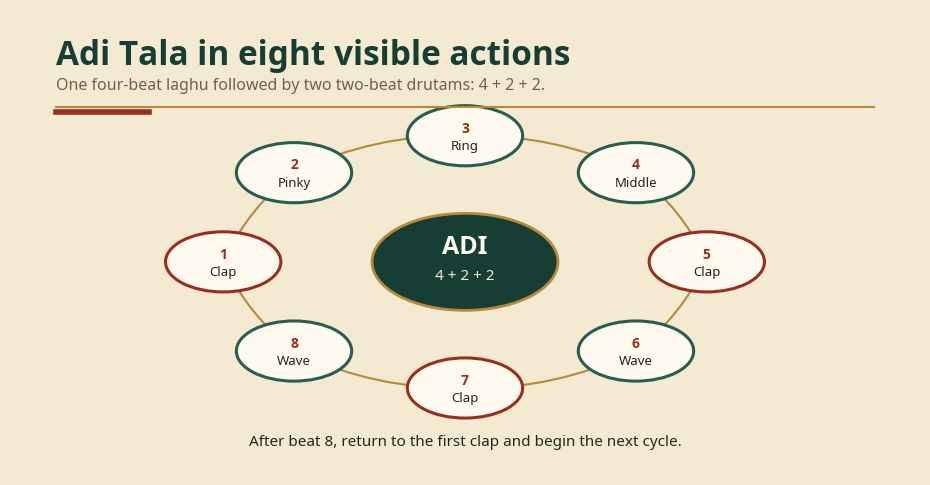
The sequence of gestures for Adi Tala is as follows:
- Beat 1: Clap (Start of the laghu)
- Beat 2: Tap pinky finger
- Beat 3: Tap ring finger
- Beat 4: Tap middle finger
- Beat 5: Clap (Start of the first drutam)
- Beat 6: Wave
- Beat 7: Clap (Start of the second drutam)
- Beat 8: Wave
After the eighth beat, the cycle immediately begins again with the clap on beat one. Practicing this 8-beat sequence until it becomes automatic is the best way to prepare for a concert.
Navigating the Tani Avartanam (Percussion Solo)
The Tani Avartanam is the percussion solo that occurs during the main piece of a Carnatic concert. It is a showcase of rhythmic virtuosity, where the mridangam player and other percussionists explore complex mathematical patterns. Listeners frequently struggle to maintain tala during these complex percussion solos 5.
What to Listen For
During the Tani Avartanam, the melodic instruments fall silent. The percussionists take over, improvising within the framework of the tala. They will often play intricate cross-rhythms and syncopated patterns that seem to obscure the basic beat.
Your goal as a listener is to maintain the steady cycle of the tala while the percussionists weave their complex patterns around it. Listen for the underlying pulse. The percussionists will periodically return to the main beat, often landing emphatically on the samam (the downbeat) to resolve a complex sequence.
How to Find the Beat When You Get Lost
It is completely normal to lose the beat during a complex Tani Avartanam. When this happens, do not panic. Stop tapping and simply listen.
Look at the musicians on stage. The vocalist or the violinist will often continue to keep the tala quietly with their hands. You can use their gestures as a guide to find your place in the cycle.
Listen for the rhythmic cadences, known as korvais or tihais. These are structured rhythmic phrases that are repeated three times and designed to resolve exactly on the downbeat. As you hear the pattern repeating, you can anticipate the resolution and rejoin the cycle on the samam.
Listen for Shape Before You Count
During a tani avartanam, it is reasonable to lose the count. A useful next step is to hear changes in shape rather than to calculate every internal phrase. David Nelson’s Music Academy Journal lecture-demonstration describes varied tani processes and a closing architecture, while making clear that individual terminology and practice can differ: Form and Process in the Tani Avartanam.
- Hear the earlier passages as exploration within the cycle.
- Notice when material begins to tighten or recur more clearly.
- When a cadence feels conclusive, wait for the melody to return.
These are flexible listening cues. They are not a universal formula for every tani.
Understanding Nadai (Subdivisions of the Beat)
Once you are comfortable with the basic beats of the tala, you can begin to listen for the subdivisions within each beat. This concept is known as nadai.
Nadai refers to the number of sub-beats or pulses within a single main beat 2. The most common nadai is chaturasra, which divides each beat into 4 equal pulses. Other common subdivisions include tisra (3 pulses), khanda (5 pulses), misra (7 pulses), and sankirna (9 pulses).
Musicians use specific rhythmic syllables to vocalize these subdivisions. For example, a 4-pulse subdivision is often vocalized as "Ta ka di mi," while a 3-pulse subdivision is vocalized as "Ta ki ta." Recognizing these subdivisions adds another layer of depth to your listening experience. It allows you to appreciate the intricate textures the percussionists create within the steady framework of the tala.
Beginner Practice Exercises at Home
The best way to improve your ability to follow tala is to practice at home. You do not need any special equipment, just a willingness to listen actively.
- Start with a Metronome: Set a metronome to a slow, steady tempo (around 60 beats per minute). Practice the hand gestures for Adi Tala along with the clicks. Focus on making your movements precise and even.
- Listen to Simple Compositions: Find recordings of simple varnams or kritis set to Adi Tala. You can explore official recordings to find clear examples. Practice keeping the tala while listening to the melody.
- Focus on the Downbeat: As you listen, try to identify the samam (the first beat) of each cycle. Notice how the melody and the percussion patterns resolve on this beat.
- Attend Live Concerts: There is no substitute for the live experience. Check for upcoming concerts in your area. Sit where you can see the musicians clearly and try to follow their hand gestures.
Glossary of Rhythmic Terms
- Aksharam: The basic unit of musical time or pulse.
- Anudrutam: A fixed rhythmic unit of 1 beat, executed as a single clap.
- Drutam: A fixed rhythmic unit of 2 beats, executed as a clap followed by a wave.
- Laghu: A variable rhythmic unit consisting of a clap followed by a specific number of finger counts.
- Laya: The tempo or overall flow of time in a musical piece.
- Mridangam: The primary double-sided drum used in Carnatic music.
- Nadai: The subdivision of a main beat into smaller pulses (e.g., 3, 4, 5, 7, or 9).
- Samam: The first beat (downbeat) of a rhythmic cycle.
- Tala: A metric cycle with a specific number of beats that recur in the same pattern.
- Tani Avartanam: The extended percussion solo in a Carnatic concert.
A Modest First Listening Target
For one session, choose a single return point rather than trying to calculate every subdivision. Notice when the composition settles at samam, then replay that short stretch. This modest exercise keeps the focus on a documented rhythmic relationship and avoids treating one recording as a rule for every tala or performance.
Frequently Asked Questions (FAQ)
What is the basic unit of rhythm in Carnatic music? The basic unit of rhythm is the aksharam, which represents a single pulse or beat within the larger cycle.
How do you keep talam during a Tani Avartanam? Maintain a steady physical count using the standard hand gestures. If you lose the beat, watch the musicians on stage for visual cues and listen for repeating rhythmic patterns that resolve on the downbeat.
What is the difference between laya and tala? Laya refers to the continuous tempo or flow of the music, while tala is the structured, repeating cycle of beats that organizes that flow.
Why do Carnatic audiences tap their thighs during a concert? Audiences tap their thighs to physically internalize the rhythmic cycle and to provide a shared visual reference for the musicians and other listeners.
How many beats are in Adi Tala? Adi Tala is an 8-beat cycle, consisting of a 4-beat laghu followed by two 2-beat drutams.
Conclusion: From Counting to Feeling the Rhythm
Following tala at a Carnatic concert is a skill that develops over time. It begins with learning the mechanics of the hand gestures and understanding the structure of the cycles. As you practice, the counting becomes less conscious. You move from analyzing the rhythm to feeling it.
The goal is not to perform complex mathematical calculations in your head, but to internalize the pulse of the music. When you can maintain the tala effortlessly, you become an active participant in the performance. You share the rhythmic journey with the musicians, anticipating the resolutions and appreciating the intricate dialogue between melody and rhythm. This shared experience is at the heart of Carnatic music.
Related Listening and Articles
Use these links to connect tala practice with the next listening skill and with Dr. Vidyabhushana’s official recordings.
- How to Listen to Carnatic Music: A Beginner's Field Guide
- How to Recognize a Raga: Phrases, Gamaka, and Musical Memory
- What Is a Suladi? Inside the Haridasa Form That Moves Through Several Talas
- Haridasa Repertoire Notes
- Upcoming Concerts
- Official Recordings
A recovery map for the percussion solo
When a listener loses the cycle during a tani, the most useful response is often to stop calculating for a moment. David Nelson’s Music Academy Journal lecture-demonstration offers one practitioner-scholar’s way of hearing form in a tani. He distinguishes flowing rhythmic material from calculated design and treats solkattu as an analytic tool. His terms are useful listening aids, not a universal vocabulary for every school of percussion.
Nelson describes a closing architecture in which a periya mora and a final korvai are important signs of approach to the return. Where more than one percussionist is present, a kuraippu can precede the close. A listener does not have to name these devices at the first hearing. The practical value lies in hearing change: material that once felt open begins to repeat, narrow, or point toward a landing.
| What you hear | A cautious way to respond |
|---|---|
| Many varied phrases | Keep a comfortable pulse, or simply listen without tapping. |
| A phrase returning in threes | Wait for its final landing rather than rushing to rejoin. |
| Shorter exchanges between percussionists | Notice the reduction in span. This may be a kuraippu, but terminology can vary. |
| A strong final cadence | Watch for the melodic return and begin the next cycle there. |
Solkattu can help advanced listeners make the pattern audible in the mind, but it is not a requirement for concert enjoyment. Nelson’s account is especially useful because it shows that a sounding gap and an unsounded gap can play different structural roles. That detail explains why a phrase may feel like it has paused even when the hands are still active.
For the broader relationship between a tani and the rest of the programme, see How to Listen to Carnatic Music. This guide stays with rhythm. It does not attempt to identify the raga being played.
Source note: This section reports one named framework from David Nelson’s 2011 lecture-demonstration. It does not claim that every tani uses the same sequence or terminology.
The Analytic Function of Solkattu in Rhythmic Decoding
The practice of following tala at a Carnatic concert involves more than the simple physical act of tapping the thigh or clapping the hands. It requires a cognitive engagement with the rhythmic syntax that governs the music. One of the most effective tools for this engagement is solkattu, the system of vocalized rhythmic syllables used in Indian classical music. As noted in the Music Academy Journal 2011, solkattu serves as a powerful analytic tool for both practitioners and listeners. It allows the mind to vocalize and thus internalize the patterns that the hands are keeping and the percussionists are playing.
Solkattu is not merely a set of sounds. It is a structured language where specific syllables correspond to specific rhythmic weights and durations. For a listener, learning even the basic syllables can transform an abstract series of beats into a clear, audible structure. When a percussionist plays a complex phrase on the mridangam, they are often thinking in terms of these syllables. By learning to recognize them, the listener can begin to "hear" the underlying logic of the improvisation. This is particularly useful during the tani avartanam, where the melodic instruments are silent and the rhythmic dialogue takes center stage.
The use of solkattu as an analytic tool helps to bridge the gap between the physical count of the tala and the musical expression of the rhythm. While the tala provides the steady framework, the solkattu provides the texture and the detail. A listener who can mentally vocalize the basic subdivisions of the beat is far less likely to lose their place during a complex solo. This practice of internal vocalization creates a secondary layer of rhythmic awareness that supports the primary physical count.
| Syllable Count | Common Solkattu Phrases | Rhythmic Weight |
|---|---|---|
| 3 Beats | Ta Ki Ta | Focused, sharp resolution |
| 4 Beats | Ta Ka Di Mi | Balanced, steady flow |
| 5 Beats | Ta Ka Ta Ki Ta | Syncopated, driving pulse |
| 7 Beats | Ta Ki Ta Ta Ka Di Mi | Complex, elongated structure |
| 9 Beats | Ta Ka Di Mi Ta Ka Ta Ki Ta | Extended, sophisticated cycle |
To use solkattu effectively as a listener, one should start by vocalizing the basic pulses of the tala. If the music is in Adi Tala, which has eight beats, the listener can mentally say "Ta Ka Di Mi" twice for every cycle, or "Ta Ka Ju Nu" if they prefer a different texture. This internal chanting acts as a metronome that is synchronized with the physical gestures. As the listener becomes more comfortable, they can begin to vocalize the subdivisions, or nadai, that the percussionist is exploring. This creates a deep connection between the listener's internal sense of time and the external performance.
For those who wish to deepen their understanding of how these rhythmic units fit into the broader concert structure, reviewing the performance format for Carnatic concerts can provide valuable context. Understanding when and why these rhythmic explorations occur helps the listener stay focused throughout the two or three hours of a typical kutcheri.
Source note: This section treats solkattu as an analytic tool based on the framework described by David Nelson in the Music Academy Journal 2011. It emphasizes the cognitive and internal aspects of rhythmic tracking.
Structural Components of the Tani Avartanam Closing Architecture
The tani avartanam, or the extended percussion solo, is often the most challenging part of a concert for a listener to follow. However, it is not a random collection of rhythmic patterns. Instead, it follows a structured progression that leads toward a definitive resolution. David Nelson, in his lecture-demonstration for the Music Academy, identifies a specific closing architecture that signals the end of the solo and the return to the main composition. Recognizing these structural components allows the listener to anticipate the landing and rejoin the tala cycle with confidence.
The closing sequence typically begins with a shift in the nature of the rhythmic material. Earlier in the solo, the percussionist may explore varied phrases and open-ended improvisations. As the solo nears its conclusion, the material becomes more calculated and designed. The two primary components of this closing architecture are the periya mora and the final korvai. The periya mora is a large-scale rhythmic structure that often involves a reduction in the length of the phrases, creating a sense of mounting tension. This is followed by the final korvai, a structured cadence that is repeated three times and designed to resolve exactly on the samam, or the first beat of the next cycle.
For the listener, the key is to listen for change rather than to attempt to count every internal beat. When the percussionist begins to play phrases that feel more repetitive and structured, it is a sign that the closing architecture is being established. The periya mora often sounds like a series of questions and answers that get progressively shorter. This leads into the korvai, which has a distinct, recognizable shape. By identifying the start of the korvai, the listener can prepare for the three-fold repetition and the final landing.
| Closing Component | Listener Cue | Rhythmic Function |
|---|---|---|
| Periya Mora | Progressive shortening of phrases | Building tension and momentum |
| Kuraippu | Dialogue between multiple drummers | Systematic reduction of the rhythmic span |
| Final Korvai | A structured phrase repeated three times | Definitive resolution on the downbeat |
| Samam Landing | The return of the melodic theme | Release of tension and start of new cycle |
Navigating this closing architecture requires a combination of active listening and rhythmic intuition. If you find yourself lost during the earlier parts of the tani, the periya mora is your first opportunity to find your bearings. The repetitive nature of the closing phrases provides a clear signal that the end is near. Once the final korvai begins, the listener should focus entirely on the resolution point. This is the moment where the percussionists, the vocalists, and the audience all come together on a single, unified beat.
This process of resolution is a central feature of Carnatic music, not just in the percussion solo but in every aspect of the performance. Whether it is a vocalist completing a series of kalpanaswaram phrases or a violinist mirroring a melodic line, the goal is always a graceful return to the samam. Understanding the specific closing architecture of the tani avartanam provides the listener with a map to navigate one of the most complex and rewarding parts of the concert experience.
Source note: The descriptions of periya mora, final korvai, and the closing architecture are based on David Nelson’s practitioner-scholar account in the Music Academy Journal 2011. These terms are presented as one useful framework for understanding rhythmic form.
Navigating Multi-Drummer Kuraippu Sequences
In many Carnatic concerts, the rhythmic accompaniment is not limited to a single mridangam. It often includes a second or even a third percussionist playing instruments such as the ghatam (a clay pot), the kanjira (a small frame drum), or the morsing (a jaw harp). When multiple percussionists are present, the tani avartanam takes on an additional layer of complexity known as the kuraippu. As documented in the Music Academy Journal 2011, the kuraippu is a systematic reduction process where the percussionists engage in a rhythmic dialogue, gradually shortening the length of their exchanges until they reach a point of unified resolution.
For the listener, the kuraippu is one of the most exciting parts of the percussion solo, but it can also be the most disorienting. The key to following it is to recognize the pattern of reduction. A typical kuraippu might begin with each percussionist playing a phrase that spans four full cycles of the tala. After a few rounds, they will reduce the span to two cycles, then to one cycle, then to half a cycle, and so on. This creates a sense of accelerating momentum, even though the underlying tempo of the tala remains constant. The physical gestures of the tala become a vital anchor during this process, providing a steady reference point against the rapidly changing phrases of the drummers.
The dialogue in a kuraippu is not just about speed. It is about the creative interpretation of the rhythmic space. Each percussionist brings the unique voice of their instrument to the exchange. The mridangam provides the deep, resonant foundation. The ghatam adds a sharp, metallic ring. The kanjira offers a flexible, bending tone. As the phrases get shorter, the interaction becomes more intense, requiring the drummers to be in perfect synchronization with each other and with the tala.
| Exchange Length | Listener Experience | Rhythmic Goal |
|---|---|---|
| 4 Cycles | Broad exploration of patterns | Establishing the rhythmic theme |
| 2 Cycles | Increased intensity and focus | Beginning the reduction process |
| 1 Cycle | Rapid-fire dialogue | Building toward the climax |
| Half Cycle | Dense, interlocking sounds | Achieving unified synchronization |
| Final Landing | Total resolution on the samam | Completing the kuraippu sequence |
To follow a kuraippu effectively, a listener should focus on the primary percussionist first. Usually, the mridangam player leads the exchange, setting the length and the complexity of the phrases. The other percussionists then respond, often mirroring the lead phrase or providing a complementary variation. By watching the lead drummer, the listener can anticipate the moment when the exchange length will be reduced. This anticipation is part of the joy of listening to Carnatic rhythm. It turns the listener from a passive observer into an active participant in the rhythmic drama.
If you find yourself losing the count during the rapid exchanges of a kuraippu, the best strategy is to look at the main vocalist or the violinist. They will often continue to keep the tala with their hands, providing a visual metronome for the entire ensemble. You can also listen for the specific tonal characteristics of each instrument to help you distinguish between the different parts of the dialogue. For more information on how the different instruments in a Carnatic ensemble interact, you can read our guide on how to listen to Carnatic music.
Source note: The description of the kuraippu as a systematic reduction process involving multiple drummers is based on the practitioner-scholar account by David Nelson in the Music Academy Journal 2011. The terminology and specific sequences described are one way of understanding this complex rhythmic interaction.
The Conceptual Boundary Between Flowing Time and Calculated Design
A fundamental distinction in the study of Carnatic rhythm, as proposed by David Nelson in his 2011 Music Academy Journal article, is the difference between time-flow and calculated design. This distinction is crucial for any listener who wishes to move beyond simple counting and toward a deeper appreciation of rhythmic form. Time-flow refers to the continuous, ongoing pulse of the tala. It is the steady, unbroken stream of time within which the music exists. Calculated design, on the other hand, refers to the structured, mathematical patterns that are superimposed upon that flow.
In the context of a tani avartanam, much of the earlier part of the solo is focused on time-flow. The percussionist explores different textures and patterns that feel organic and fluid. These phrases may not have a clear beginning or end that aligns perfectly with the tala cycle. They are meant to create a sense of movement and exploration. However, as the solo progresses toward its conclusion, the emphasis shifts toward calculated design. The phrases become more structured, with clear mathematical relationships to the tala cycle. The listener begins to hear patterns that are designed to resolve at specific points, most notably the samam.
Understanding this boundary helps the listener to manage their attention during a concert. When the music is focused on time-flow, the listener can relax their count and simply feel the pulse. They do not need to analyze every phrase. But when the music shifts toward calculated design, the listener needs to be more alert. This is the moment when the percussionist is building a complex rhythmic puzzle that will eventually be resolved. The pleasure for the listener comes from recognizing the design and following it to its conclusion.
| Rhythmic Aspect | Time-Flow Characteristics | Calculated Design Characteristics |
|---|---|---|
| Primary Focus | Continuous pulse and texture | Mathematical structure and resolution |
| Phrase Structure | Open-ended and fluid | Closed and predictable |
| Listener Strategy | Feeling the pulse | Analyzing the pattern |
| Resolution | Organic and gradual | Emphatic and precise |
| Musical Role | Exploration and atmosphere | Architecture and climax |
One of the most interesting aspects of this distinction is the role of silence, or what Nelson calls gaps. In time-flow, a gap may simply be a pause in the sound. But in calculated design, a gap is a structural element. It is a specific duration of time that is part of the overall mathematical pattern. A listener who understands this will not be confused when a percussionist stops playing for a few beats. Instead, they will recognize that the silence is a vital part of the design, leading toward the final resolution.
This conceptual framework can be applied to all aspects of Carnatic music, not just rhythm. For example, in a melodic improvisation like an alapana, the vocalist explores the raga in a way that is focused on flow and texture. But in a structured composition like a kriti, the focus shifts toward the calculated design of the melody and the tala. By recognizing these different modes of musical expression, the listener can develop a more sophisticated and nuanced understanding of the art form.
Source note: The distinction between time-flow and calculated design, as well as the role of sounding and unsounded gaps, is based on the theoretical framework presented by David Nelson in the Music Academy Journal 2011. This framework is used as a tool for analyzing rhythmic form from a listener's perspective.
A Systematic Recovery Map for the Lost Listener
Losing one's place in the rhythmic cycle is a common experience for even seasoned listeners of Carnatic music. The complexity of the percussion solo, with its cross-rhythms and syncopations, is designed to challenge the listener's perception of time. When the count is lost, the natural reaction is often one of panic or frustration. However, a systematic approach to recovery can help the listener rejoin the cycle without missing a beat. This recovery map, inspired by the practitioner-scholar insights in the Music Academy Journal 2011, provides a step-by-step protocol for finding the pulse and re-establishing the count.
The first step in recovery is to stop counting entirely. Trying to calculate your way back into a complex cycle while the music is still moving is often counterproductive. Instead, shift your focus from the count to the pulse. The pulse is the underlying heartbeat of the music, the steady laya that persists even when the tala gestures are not being made. By simply listening to the pulse for a few cycles, you can re-internalize the tempo. Once the pulse is clear, look for a landmark. The most important landmark in any tala is the samam, the downbeat that marks the beginning of the cycle.
Landmarks can be found in several ways. The most reliable visual landmark is the hand gestures of the lead vocalist or the violinist. They are responsible for maintaining the tala for the entire ensemble, and their gestures are usually clear and steady. A second landmark is the rhythmic cadence of the percussionist. As discussed in the section on closing architecture, percussionists often use structured phrases that resolve on the samam. By listening for the start of a repeating pattern, you can anticipate the resolution point and rejoin the cycle there.
| Recovery Step | Listener Action | Cognitive Shift |
|---|---|---|
| 1. Suspend Counting | Stop all physical tapping and mental calculations. | From analysis to pure observation. |
| 2. Locate the Pulse | Focus on the steady, underlying beat of the mridangam. | From complex rhythm to simple pulse. |
| 3. Identify a Landmark | Look at the vocalist's hands or listen for a rhythmic cadence. | From internal search to external cue. |
| 4. Anticipate the Samam | Wait for the resolution of the current phrase or cycle. | From past confusion to future landing. |
| 5. Re-establish Gestures | Rejoin the cycle with a clear clap on the next samam. | From observation back to participation. |
This recovery protocol is not just a way to fix a mistake. It is a way to deepen your listening skills. By learning to find the beat when it is hidden, you develop a more resilient and flexible sense of rhythm. You learn to trust the pulse of the music and the structure of the tala. This resilience is what allows a listener to enjoy the most complex parts of a concert without feeling overwhelmed. It transforms the experience from a struggle to maintain a count into a game of rhythmic hide-and-seek.
For those who are new to this process, it can be helpful to practice recovery at home. Listen to a recording of a tani avartanam and intentionally stop tapping for a few cycles. Then, use the recovery map to find your way back. This practice builds the cognitive muscles needed for real-time recovery during a live performance. It also helps to familiarize yourself with the common rhythmic cues that percussionists use to signal a landing. Over time, the process of recovery becomes second nature, allowing you to navigate even the most intricate rhythmic landscapes with ease.
Source note: This recovery map is based on the principles of rhythmic analysis and listening strategies described by David Nelson in the Music Academy Journal 2011. It emphasizes the importance of pulse, landmarks, and resolution points in maintaining rhythmic awareness.
Multi-Tala Structures and the Suladi Form
While most Carnatic compositions are set to a single tala that remains constant throughout the piece, there is a specialized form known as the Suladi that challenges this convention. The Suladi is a historical form, particularly significant in the Haridasa tradition of Karnataka, where a single composition may move through several different talas. As documented in the Music Academy Journal 2015, the study of Suladi notations in ancient manuscripts reveals a sophisticated system of rhythmic organization that predates much of the modern concert repertoire.
Following a Suladi requires a high degree of rhythmic agility. The listener must be prepared for the tala to change at the end of each stanza. This means that the physical gestures must also change, shifting from an 8-beat cycle to a 7-beat cycle, or from a 5-beat cycle to a 4-beat cycle, depending on the structure of the piece. The 2015 study of the Thanjavur Sarasvati Mahal manuscripts highlights the use of twenty-four different Kannada Suladi notations, each with its own unique rhythmic path. These manuscripts provide a rare glimpse into the historical practice of multi-tala compositions and the challenges they presented to both performers and listeners.
The structure of a Suladi typically includes several stanzas, each set to a different tala, followed by a final section known as a jate. The jate is a rhythmic finale that often involves a more complex or faster tempo, providing a climactic conclusion to the piece. For the listener, the transition between stanzas is the most critical moment. There is often a brief pause or a change in the melodic phrasing that signals the shift to a new tala. By recognizing these cues, the listener can adjust their hand gestures and stay in synchronization with the music.
| Suladi Component | Rhythmic Function | Listener Focus |
|---|---|---|
| Stanza (Charana) | Exploration of a specific tala and raga theme. | Maintaining the current tala gestures. |
| Tala Transition | Shift from one rhythmic cycle to another. | Identifying the new cycle and gesture set. |
| Refrain (Pallavi) | Recurring melodic theme that anchors the piece. | Re-establishing the primary pulse. |
| Mudra | The composer's signature, often near the end. | Noting the identity of the creator. |
| Jate | Rhythmic finale with increased complexity. | Following the final resolution of the piece. |
The Suladi form is evidence of the rhythmic depth of the Haridasa tradition. It shows that the concept of tala was not just a static framework but a dynamic tool for musical expression. For a modern listener, exploring the Suladi form is a way to connect with the historical roots of Carnatic music and to challenge their own rhythmic skills. It requires a level of focus and adaptability that goes beyond what is needed for a standard kriti or varnam.
To learn more about the specific compositions and composers of the Haridasa tradition, you can visit our section on Haridasa repertoire notes. Understanding the historical and devotional context of these pieces adds another layer of meaning to the rhythmic experience. The Suladi is not just a technical exercise. It is a form of worship where the changing rhythms reflect the multifaceted nature of the divine. By following these changes, the listener participates in a tradition that has been preserved through centuries of oral and written transmission.
Source note: The information regarding the Suladi form, the Thanjavur Sarasvati Mahal manuscripts, and the use of multi-tala structures is based on the research published in the Music Academy Journal 2015. This section highlights the historical and structural complexity of the Suladi as a unique rhythmic form.
Historical Context and Advanced Rhythmic Mechanics
The rhythmic sophistication of modern Carnatic music is deeply rooted in a combination of historical legacy and advanced physical mechanics. The Haridasa tradition of Karnataka, as documented by the Tirumala Tirupati Devasthanams Dasa Sahitya Project, was a major force in the development of the musical forms and rhythmic structures we see today. The Haridasas used complex talas to set their devotional songs, creating a foundation that modern scholars like T. K. Govinda Rao have preserved through tuning and notation. This historical context is essential for understanding how the fundamental principles of tala have been used to express deep spiritual truths over centuries.
Complementing this historical foundation is the physical act of keeping tala through hand gestures, a system of rhythmic internalization that connects the listener's body to the temporal structure of the music. The gestures (claps, finger counts, and waves) provide tactile feedback that helps the brain maintain a steady pulse. As noted in the research on Indian rhythmic cycles, the systematic organization of these gestures into units like the laghu, drutam, and anudrutam provides a comprehensive framework for navigating time. This physical engagement is further enhanced by the logic of rhythmic cadences, such as the korvai, which David Nelson describes in the Music Academy Journal 2011 as a form of calculated design that provides a definitive conclusion to rhythmic exploration.
| Rhythmic or Historical Element | Function and Role | Listener Focus |
|---|---|---|
| Haridasa Padas | Standardization of the tala framework. | Core repertoire of the Carnatic concert. |
| Laghu and Drutam | Physical mapping of the rhythmic cycle. | Maintaining the steady gestures of the tala. |
| Korvai Theme | The basic rhythmic phrase of a cadence. | Identifying the unique shape of the phrase. |
| Arudi (Landing) | The final resolution on the samam. | Anticipating the landing and rejoining the cycle. |
| Melodic Interaction | Rhythmic response to vocal phrases. | Appreciating the balance of melody and rhythm. |
The interaction between rhythm and melody is most evident during sections such as niraval and kalpanaswaram, where the percussionist must follow the vocalist's phrases with sensitivity. As noted in the HCL Concerts blog on the role of the violin, the accompanist's task is to closely follow the lead performer's phrases and pitch. This principle applies to the percussionist as well, who must adapt their rhythmic patterns to complement the melodic variations. This dynamic interplay, where each influences the other, is what makes a Carnatic concert a shared dialogue between the musicians and the audience.
To master these mechanics and appreciate the historical context, one must develop a sense of laya that is independent of the music being heard. This involves practicing the standard hand gestures of Adi Tala (clap, pinky, ring, middle, clap, wave, clap, wave) until they are automatic. By learning to recognize the specific syllables that signal the start of a cadence, such as "Ta Ki Ta," the listener can begin to predict when a resolution is approaching. This anticipation transforms the listener from a passive observer into an active participant in the rhythmic drama, connecting them to a tradition that has been preserved through centuries of practice.
Source note: The information regarding the Haridasa tradition and the work of T. K. Govinda Rao is based on official project descriptions. The discussion of the accompanist's role is based on the HCL Concerts blog. The mechanics of gestures and cadences are based on "Sets, Scales and Rhythmic Cycles" and David Nelson’s account in the Music Academy Journal 2011.
Rhythmic Practice and Advanced Listening Strategies
To bridge the gap between theoretical understanding and concert-ready skills, a listener should engage in a series of practical exercises and employ advanced listening strategies. These tools are designed to be used both at home and during live performances, building the cognitive and physical foundations needed to follow tala effortlessly and appreciate the sophisticated artistry of the percussionists.
Practical Exercises for Rhythmic Mastery
- Metronome Syncing: Set a metronome to 60 BPM. Practice the Adi Tala gestures (clap, 3 finger taps, clap, wave, clap, wave). Focus on the precision of the clap and the fluidity of the wave. Once comfortable, increase the speed to 80 BPM and 100 BPM. This builds pulse stability.
- Solkattu Vocalization: While keeping the Adi Tala gestures at a steady tempo, vocalize the basic 4-pulse subdivision: "Ta Ka Di Mi, Ta Ka Di Mi" for each beat. Then switch to a 3-pulse subdivision: "Ta Ki Ta, Ta Ki Ta." This builds subdivision awareness and prepares the ear for different nadais.
- Landmark Identification: Listen to a recording of a varnam. Instead of tapping the whole cycle, try to identify only the samam (the first beat). Clap only on the samam and stay silent for the rest of the cycle. This builds the ability to identify key landmarks in the music.
- Recovery Drill: Listen to a complex tani avartanam. Intentionally stop tapping for two cycles, then use the recovery map to find the beat and rejoin the cycle on the next samam. Repeat this several times to build rhythmic resilience.
- Multi-Tala Practice: Find a recording of a Suladi. Try to identify the moment the tala changes between stanzas. Practice switching your hand gestures from one tala to another without losing the pulse. This builds the flexibility needed for historical and complex forms.
Advanced Listening Strategies for Complex Solos
For the listener who wishes to dive deeper into the complexities of the tani avartanam, several advanced listening strategies can be employed. These strategies go beyond simple counting and focus on the structural and creative aspects of the percussion solo. By using these tools, a listener can appreciate the sophisticated artistry of the percussionists and follow their rhythmic journey with greater clarity.
One such strategy is to focus on the "shape" of the rhythmic phrases rather than their individual beats. Percussionists often use phrases that have a distinct melodic quality, even on a drum like the mridangam. By listening for the rising and falling "pitch" of the phrases, a listener can identify recurring themes and variations. This is particularly useful during the exploration phase of the solo, where the percussionist is building a rhythmic narrative.
Another strategy is to listen for the "gaps" or silences within the phrases. As David Nelson notes in the Music Academy Journal 2011, silence is a structural element in calculated design. By paying attention to the duration and placement of the gaps, a listener can anticipate the resolution of a phrase. A gap is not just a pause; it is a vital part of the rhythmic pattern that leads toward the final landing.
| Advanced Strategy | Listener Action | Musical Insight |
|---|---|---|
| Phrase Shaping | Listening for the melodic contour of the drum patterns. | Identifying recurring rhythmic themes and motifs. |
| Gap Analysis | Paying attention to the duration and placement of silences. | Anticipating the resolution of structured cadences. |
| Texture Observation | Noting the change in drum sounds (bass vs treble). | Understanding the emotional and dynamic shifts in the solo. |
| Cross-Rhythm Tracking | Following the interaction between the drum and the tala. | Appreciating the tension and release of syncopation. |
| Resolution Anticipation | Listening for the cues that signal a closing architecture. | Rejoining the cycle with confidence and precision. |
These strategies require a high degree of focus and a solid foundation in the basic principles of tala. They are not intended for the beginner but for the listener who has already mastered the hand gestures and the basic count. By using these tools, the listener can engage with the music on a more intellectual and aesthetic level, appreciating the mathematical precision and the creative brilliance of the percussionists. This deeper engagement is what makes the study of Carnatic rhythm so rewarding.
To further explore the relationship between rhythm and the overall performance, you can refer to our guide on how to listen to Carnatic music. Understanding the broader context of the concert helps to place these advanced listening strategies in their proper perspective. The goal is not just to count the beats but to experience the full beauty and complexity of the rhythmic dialogue.
Source note: These advanced listening strategies are based on the theoretical framework and practitioner insights provided by David Nelson in the Music Academy Journal 2011. They are presented as tools for deepening the listener's engagement with rhythmic form and process.
This addendum provides an analytical framework for the listener who has mastered the fundamental hand gestures of Adi Tala and seeks a deeper understanding of the structural transitions within a percussion solo. The following sections build upon the core principles of laya and tala by introducing the scholar-performer framework developed by David Nelson. This approach treats rhythmic vocalization as a critical tool for structural analysis. By distinguishing between the continuous flow of time and the deliberate design of rhythmic patterns, a listener can maintain a sense of orientation during complex sections of a concert.
The Analytic Utility of Solkattu
While the primary guide introduces the physical gestures of the clap and the wave, a more advanced engagement with the rhythm involves the mental or silent use of solkattu. Solkattu refers to the system of rhythmic syllables that correspond to the strokes played on the mridangam. In the framework identified by David Nelson, solkattu serves as an analytic tool that allows the listener to bridge the gap between the physical pulse and the complex melodic-rhythmic patterns. Instead of merely counting beats, the listener can use these syllables to identify the internal structure of a phrase.
When a percussionist performs a sequence, the listener who understands solkattu can perceive the underlying logic of the design. This is useful when the percussionist employs syncopation or cross-rhythms that seem to depart from the steady pulse. By vocalizing or mentally tracking the syllables, the listener maintains a cognitive link to the tala. This practice transforms the listening experience into an active participation in the rhythmic architecture. It is a method of parsing the music that complements the active listening sequence described in our general guide. The use of solkattu ensures that the listener remains grounded in the structural reality of the performance.
Time-Flow and Calculated Design
A critical distinction in the study of Carnatic rhythm is the difference between time-flow and calculated design. Time-flow represents the steady progression of the rhythmic cycle. In contrast, calculated design refers to the specific patterns and structures that the performer chooses to execute within that flow. David Nelson emphasizes that while the time-flow remains constant, the design can be highly variable. This distinction is vital for understanding how a performer can appear to be playing outside the rhythm while remaining synchronized with the underlying cycle.
For the listener, recognizing this distinction is the key to maintaining orientation. The time-flow is what you track with your hand gestures: the clap, the finger counts, and the wave. The calculated design is what you hear coming from the mridangam. During a tani avartanam, the design may become so intricate that it seems to challenge the existence of the time-flow. However, the design always eventually resolves back into the flow. Understanding that the percussionist is intentionally playing with this tension allows the listener to remain calm when the downbeat seems elusive. This conceptual framework is essential for anyone wishing to follow the multi-tala Suladi form or other complex compositions.
The Architecture of the Tani Avartanam Closing
The closing sequence of a tani avartanam is a structured progression that signals the return of the main melody. David Nelson identifies a typical closing sequence that serves as a roadmap. This sequence involves a transition from exploratory phrases to rigid, calculated structures that build toward a conclusion.
The Periya Mora
The periya mora is a structural landmark in the closing of a solo. It is a rhythmic pattern that is often more complex than the phrases that preceded it. The arrival of the periya mora indicates that the percussionist is moving toward a resolution. For the listener, this is a signal to focus on the tala gestures, as the rhythmic density is likely to increase. The periya mora serves as a bridge between the improvisational sections and the final structured cadences.
The Role of Kuraippu
In performances involving more than one drummer, the closing sequence often includes a section known as kuraippu. This is a structured dialogue where the percussionists exchange phrases of decreasing length. The kuraippu creates a sense of accelerating momentum. It is an example of calculated design where performers mirror and challenge each other within the steady time-flow. The listener should listen for the shortening of the phrases, which builds the tension released in the final cadence.
The Final Korvai
The tani avartanam culminates in the final korvai. A korvai is a rhythmic composition that is typically repeated three times and designed to resolve precisely on the samam, or the first beat of the next cycle. The final korvai is the most definitive statement of the solo. It acts as a bridge that brings the percussion solo to a close and cues the lead artist to rejoin the performance. By recognizing the start of a korvai, the listener can anticipate the exact moment of resolution and prepare for the transition back to the melodic portion of the kriti.
Tala Recovery and Resolution Map
When the rhythmic complexity of a performance leads to a loss of orientation, the listener can employ a systematic approach to recover the beat. This protocol is designed to move the listener from a state of confusion back to a state of synchronized participation. It involves a three-phase process that focuses on identification, recognition, and resolution.
The first phase is Pulse Identification. The listener should stop counting and focus on the underlying pulse, often maintained by the lead performer’s hand or the mridangam’s lower head. This re-establishes a connection with the laya. The second phase is Cue Recognition. The listener looks for structural cues like rhythmic cadences or the start of a new melodic phrase. In a tani avartanam, waiting for a repeated phrase or emphatic strokes can serve as a cue to place oneself within the tala. The final phase is Samam Resolution. The listener rejoins the tala on the samam, the most recognizable beat. By waiting for a rhythmic sequence to conclude and the melodic theme to return, the listener restarts their gestures on the downbeat. This process is a vital skill for the active listening sequence.
Practical Rhythmic Observation Checklist
This checklist is intended for use during a live concert or while listening to a recording to help the listener track the structural developments of the rhythm. Each step encourages an active and focused engagement with the performance.
- Identify the Laya: Determine if the tempo is slow, medium, or fast to provide context for rhythmic observations.
- Establish the Tala Gestures: Begin the appropriate sequence of claps, finger counts, and waves for the cycle being performed.
- Monitor the Nadai: Listen for subdivisions within each beat, noting if the pulse is in groups of four, three, or other counts.
- Observe the Transition to Tani: Note when the melodic instruments stop and the percussion solo begins to shift focus.
- Track the Closing Sequence: Listen for the arrival of the periya mora and the start of the kuraippu dialogue.
- Anticipate the Final Korvai: Identify the three-fold repetition that signals the end of the solo.
- Verify the Resolution: Ensure the percussion solo and melodic return align on the downbeat.
Comparison of Rhythmic Concepts
The following table summarizes the key distinctions between the fundamental elements of the rhythmic framework as discussed in the ledger and the primary guide. These concepts form the basis for a sophisticated understanding of Carnatic rhythm.
| Concept | Primary Focus | Listener's Role | Analytic Utility |
|---|---|---|---|
| Time-Flow | Continuous pulse and steady progression. | Maintain steady hand gestures and internalize the laya. | Provides the essential foundation for all rhythmic activity. |
| Calculated Design | Intentional patterns and structural sequences. | Recognize the architecture of phrases and anticipate resolutions. | Allows for the parsing of complex solos and korvais. |
| Solkattu | Rhythmic syllables and vocalized patterns. | Use syllables as a mental tool to decode the mridangam strokes. | Bridges the gap between physical pulse and complex design. |
| Samam | The first beat and point of resolution. | Identify the downbeat to ensure synchronization with the musicians. | Serves as the primary landmark for re-establishing the cycle. |
Source Notes
This addendum is derived from the verified sources in the Journal Enrichment Ledger. The discussion of the tani avartanam, including the periya mora, kuraippu, and the distinction between time-flow and calculated design, is based on the practitioner-scholar account of David Nelson. His lecture-demonstration, "Form and Process in the Tani Avartanam," published in the Music Academy Journal in two thousand and eleven, provides the structural framework. Context regarding laya, tala, and Adi Tala gestures is drawn from the primary guide, "How to Follow Tala at a Carnatic Concert." The use of solkattu as an analytic tool is a recognized method for understanding rhythmic relationships. Readers may consult the Source-led Notes and the archive of All Journal guides for further information on recognizing the raga and other performance aspects.
A Small Record After Each Listening Session
The value of a listening record is not that it proves a technical conclusion. It gives a returning listener a way to separate what was clearly heard from what was merely guessed. After one short section of a concert or recording, write down only three observations: the pulse you could hold, the point where the music seemed to settle, and one moment that you could not yet follow. This keeps the record honest. It also makes the next listening session more focused.
| Prompt | A useful short answer | What not to claim from it |
|---|---|---|
| What stayed steady? | “I could return to one pulse after losing the count.” | The exact internal calculation of every phrase. |
| What changed? | “The exchange became shorter or denser near the end.” | That every reduction follows one fixed pattern. |
| Where did it settle? | “The melody returned after a firm rhythmic cadence.” | That the cadence identifies a particular tala without further evidence. |
| What will I revisit? | “I will replay the last minute and follow the visible hand gesture.” | That a second hearing guarantees an immediate answer. |
This record can be made without naming a tala, a nadai, or a percussion phrase. It is a listening aid, not a test. If the hand gesture is visible, use it as one reference. If it is not visible, wait for a clear return rather than forcing a count. The earlier sections on pulse, closure, and recovery give the same principle from different angles: pause, locate a reliable cue, and join again when the music offers a stable landing. The companion guide on listening to Carnatic music places this rhythm-first attention within the larger concert programme.
Source note: This practice record is an editorial listening tool built from the source-limited discussion of pulse, landmarks, and resolution in this guide. It does not assign labels to a performance or replace study with a teacher or practitioner.
References
The sources below support the tala definitions, gesture sequence, and concert-listening guidance used in this article.