
Introduction: The Rhythmic Architecture of the Haridasas
A Suladi is a complex musical composition from the Haridasa tradition of Karnataka. Unlike a standard devotional song that maintains a single rhythmic cycle from beginning to end, a Suladi changes its rhythm for every section. This structure requires the singer to master multiple rhythmic cycles, known as talas, within a single performance.
The Haridasa movement, which flourished between the 15th and 17th centuries, produced thousands of devotional songs in the Kannada language. These compositions served as a "mobile university" for Dvaita philosophy, bringing complex spiritual ideas to the general public through music 6. While many listeners are familiar with the standard Devaranama, the Suladi represents a more demanding architectural achievement. It stands as a historical bridge between ancient musical structures and the modern Carnatic repertoire.
Understanding the Suladi helps listeners appreciate the depth of Haridasa musical thought. It shows that these composers were not just writing simple devotional lyrics. They were building sophisticated musical frameworks that tested the limits of rhythmic control. To fully grasp this form, one must look at how it differs from other compositions and how it uses the concept of changing talas.
Defining the Suladi: More Than Just a Song
In Carnatic music, a Suladi is defined as a lengthy composition set to specific ragas (melodic frameworks) and multiple talas 1. The word itself is thought to derive from "Suda," an ancient musical term referring to a specific type of composition. A Suladi is not a casual song. It is a structured, multi-part work designed to showcase both devotional fervor and technical precision.
The defining characteristic of a Suladi is its use of a talamalika structure. "Tala" refers to the rhythmic cycle, and "malika" means a garland. Therefore, a talamalika is a garland of rhythms. In a Suladi, each stanza or section is composed in a different tala. This constant shifting of the rhythmic foundation makes the Suladi a unique challenge for both the performer and the listener.
While a Suladi can be sung in a single raga, it is often presented as a ragamalika, where the melody also changes with each section. However, the changing talas remain the most crucial defining feature. This structural complexity sets the Suladi apart from the more common forms of Haridasa Sahitya (literature of the Haridasas).
The Heterometric Structure: Moving Through Multiple Talas
The term "heterometric" describes music that uses varying meters or rhythmic cycles. In the context of Indian classical music, Suladis are heterometric songs because their sections are set to different talas 2. This is the core structural definition of the form.
Imagine a song that begins in a cycle of 14 beats. After the first section concludes, the next section immediately shifts to a cycle of 10 beats. The third section might move to a cycle of 6 beats. This is how a Suladi operates. The singer must seamlessly transition between these different rhythmic frameworks without losing the underlying pulse or the emotional thread of the lyrics.
This heterometric design requires a deep understanding of laya (tempo and rhythm). The performer must anticipate the changing cycles and adjust their phrasing accordingly. For the listener, following a Suladi requires active listening in Carnatic music. One must pay close attention to the rhythmic cues provided by the singer and the percussionist to navigate the shifting landscape of the composition.
Suladi vs. Ugabhoga vs. Devaranama: Understanding the Differences
To truly understand what a Suladi is, it helps to compare it with two other prominent Haridasa forms: the Devaranama and the Ugabhoga.
A Devaranama, also known as a Dasarapada, is the most common type of Haridasa composition. It typically features a pallavi (refrain), an anupallavi (sub-refrain), and multiple charanas (stanzas). Crucially, a Devaranama maintains a single tala throughout the entire song. The rhythmic cycle established at the beginning remains constant until the end.
An Ugabhoga, on the other hand, is a freestyle form. It consists of a single stanza sung in a raga of the performer's choice, without any strict rhythmic cycle or tala 5. The singer focuses entirely on melodic elaboration and lyrical expression, free from the constraints of a repeating beat. A clear musical rendition of an Ugabhoga demonstrates this flowing, unmeasured approach 7.
The Suladi sits between these two extremes, combining strict structure with constant variation.
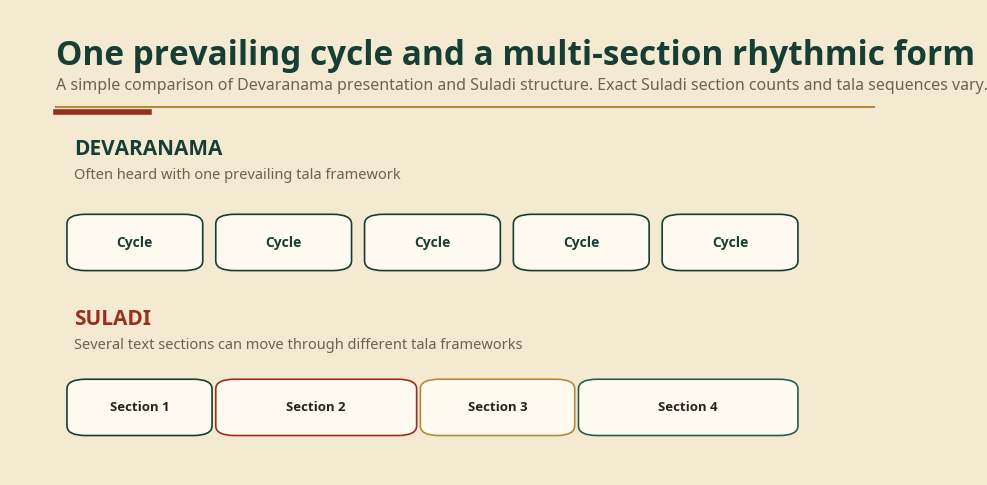
| Form | Rhythmic Structure | Melodic Structure | Primary Focus |
|---|---|---|---|
| Devaranama | Single, constant tala | Fixed raga | Devotional message and accessible melody |
| Ugabhoga | No strict tala (freestyle) | Raga chosen by performer | Expressive elaboration of lyrics |
| Suladi | Multiple changing talas | Fixed raga or ragamalika | Rhythmic mastery and complex architecture |
The 35 Sulaadi Talas: A Mathematical Framework
The concept of the Suladi is closely tied to the foundational rhythmic system of Carnatic music, known as the 35 Sulaadi talas. This system provides a mathematical framework for organizing rhythmic cycles using specific building blocks 4.
The system is based on seven principal talas: Dhruva, Matya, Rupaka, Jhampa, Triputa, Ata, and Eka. Each of these seven talas can be modified by changing the length of its primary component, the laghu. The laghu can have five different lengths (jathis): 3, 4, 5, 7, or 9 beats. By multiplying the seven principal talas by the five possible laghu lengths, the system generates 35 distinct rhythmic cycles (7 x 5 = 35).
This systematic organization is named after the Suladi form, highlighting the strong connection between the Haridasa composers and the formalization of Carnatic rhythm. When a singer performs a Suladi, they are often navigating through a selection of these very talas, demonstrating their practical application. For those interested in the mechanics of these cycles, understanding the cycles of tala is an essential next step.
Purandara Dasa and the Pedagogical Power of the Suladi
Purandara Dasa (1484–1564) is the most famous composer of the Haridasa tradition. He is widely credited with systematizing the teaching methods of Carnatic music. As part of his vast output, Purandara Dasa composed numerous Suladis 3. Traditional belief holds that he composed 475,000 songs, though this is a matter of faith rather than verifiable historical record.
Purandara Dasa used the Suladi not just as a vehicle for devotion, but as a pedagogical tool. By composing songs that moved through multiple talas, he created advanced exercises for his students. A student who could successfully render a Suladi had proven their mastery over the complex rhythmic system.
These compositions served as a practical test of a musician's ability to maintain focus and precision while the underlying rules constantly changed. The pedagogical power of the Suladi lies in its demand for absolute rhythmic clarity. It forces the singer to internalize the mathematics of the 35 talas and apply them in real time.
The Manuscript Evidence: Tracing Original Notations
One of the most significant challenges in studying Haridasa music is the loss of original tunes. For centuries, these songs were passed down through oral tradition, and the original melodies and rhythms were often forgotten or altered. This raises the question of the history of Haridasa song tunes.
However, the Suladi provides a rare exception. Historical evidence of original musical settings for Suladis exists in manuscripts preserved at the Thanjavur Maharaja Serfoji's Sarasvati Mahal Library (TMSSML) 2. These manuscripts contain notations that specify the ragas and talas for various Suladis.
The TMSSML manuscripts are crucial for understanding how these complex forms were originally intended to be performed. They confirm the heterometric structure of the Suladi and provide a tangible link to the musical practices of the past. The existence of these notations demonstrates that the Suladi was a highly formalized composition, not a loose collection of verses.
Reading an Archive with Care
An archive index and a contemporary rendition answer different questions. Arati Rao’s MusicResearchLibrary index records suladi songs found in named Thanjavur manuscript holdings, IGNCA microfilms, and the Sangitasampradayapradarsini. It is a useful route to documentary evidence.
- A catalogue can confirm that an item is recorded in a stated collection.
- It cannot, by itself, prove a complete transcription or an uninterrupted performance lineage.
- A modern stage version should be described as a present interpretation unless its musical source is separately documented.
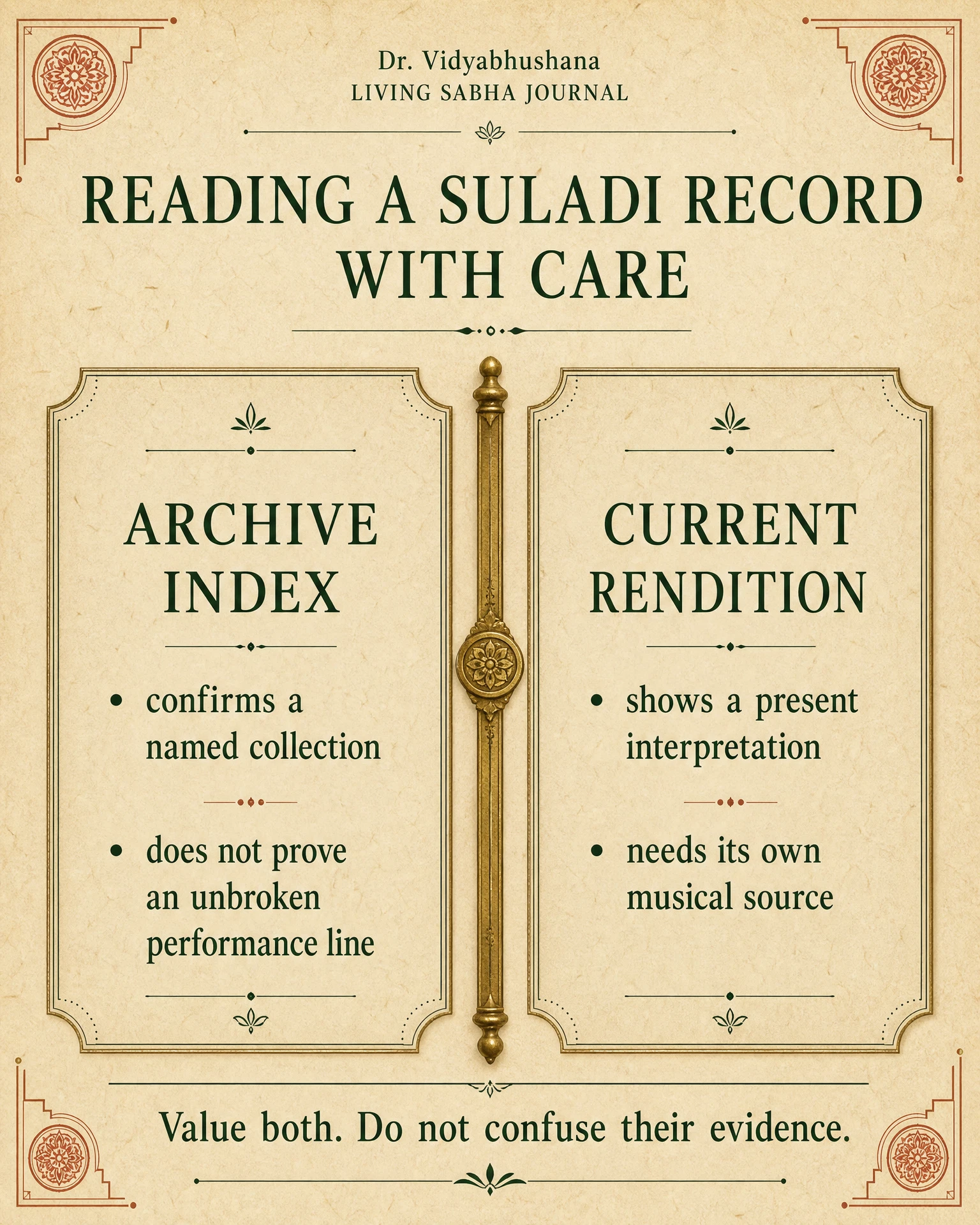
This distinction helps preserve the value of both archival work and living performance.
Why the Suladi Faded from the Modern Concert Stage
Despite their historical importance and architectural brilliance, Suladis are rarely performed in modern Carnatic concerts. They are not part of present-day Carnatic repertoires 2. Several factors contributed to the decline of this complex form.
First, the sheer difficulty of performing a Suladi makes it inaccessible to many musicians. Memorizing the lyrics is only the first step; the singer must also memorize the sequence of changing talas and execute the transitions flawlessly. This requires a level of specialized practice that is difficult to maintain alongside a standard concert repertoire.
Second, the modern concert format, established in the 20th century, favors a different balance of compositions. The typical katcheri (concert) focuses on kritis (a later compositional form) and extensive improvisational sections. The rigid, multi-part structure of the Suladi does not easily fit into this modern aesthetic.
Finally, the loss of the original oral tradition meant that many Suladis survived only as text. Without the accompanying musical knowledge, performers were hesitant to attempt these complex works. While scholars and specialists continue to study and occasionally perform Suladis, they remain a specialized historical form rather than a staple of the concert stage.
Glossary of Haridasa Musical Terms
- Carnatic music: The classical music system of southern India.
- Dasarapada: Another term for a Devaranama; a devotional song composed by a Haridasa.
- Devaranama: A standard Haridasa devotional song set to a single raga and a single tala.
- Dvaita philosophy: A dualistic school of Hindu philosophy championed by Madhvacharya, which formed the theological basis of the Haridasa movement.
- Haridasa Sahitya: The devotional literature composed by the Haridasas, primarily in the Kannada language.
- Heterometric: A musical structure that uses varying meters or rhythmic cycles within a single piece.
- Laya: The concept of tempo and rhythm in Indian classical music.
- Raga: The melodic framework or scale used in Indian classical music.
- Suladi: A complex, multi-part Haridasa composition where each section is set to a different tala.
- Tala: The rhythmic cycle or meter in Indian classical music.
- Talamalika: A "garland of rhythms"; a composition that features multiple changing talas.
- Ugabhoga: A freestyle Haridasa vocal form sung without a strict rhythmic cycle.
Frequently Asked Questions (FAQ)
What is the definition of a Suladi in Carnatic music? A Suladi is a lengthy, complex composition from the Haridasa tradition where each section or stanza is set to a different rhythmic cycle (tala).
How does a Suladi differ from a Devaranama? A Devaranama maintains a single, constant tala throughout the entire song. A Suladi changes its tala for every section.
What is the difference between Suladi and Ugabhoga? An Ugabhoga is sung freestyle without any strict rhythmic cycle. A Suladi is highly structured and uses multiple strict rhythmic cycles.
How many talas are typically used in a single Suladi composition? A Suladi typically uses between five and seven different talas, often drawn from the principal seven talas of the Carnatic system.
Did Purandara Dasa compose Suladis? Yes, Purandara Dasa composed numerous Suladis and used them as advanced pedagogical tools to teach the complexities of rhythm.
Are there surviving original notations for Haridasa Suladis? Yes, historical manuscripts preserved at the Thanjavur Maharaja Serfoji's Sarasvati Mahal Library (TMSSML) contain original notations for several Suladis.
Why are Suladis rarely performed in modern Carnatic concerts? They faded from the modern stage due to their extreme technical difficulty, the loss of oral tradition, and changes in concert formats that favored other types of compositions.
Conclusion: The Enduring Legacy of Complex Devotion
The Suladi stands as a remarkable achievement in the history of Indian music. It proves that the Haridasa composers were not only spiritual poets but also master architects of rhythm. By demanding that a singer navigate multiple changing talas within a single piece, the Suladi tests the limits of musical concentration and skill.
While it may no longer dominate the modern concert stage, the Suladi remains a vital part of the Haridasa Sahitya tradition. The survival of manuscript notations allows scholars and dedicated musicians to reconstruct these complex works, preserving a crucial link to the past. For those exploring Dr. Vidyabhushana's academic work and the broader history of Carnatic music, the Suladi offers a fascinating glimpse into a time when devotion and rigorous mathematical structure were perfectly aligned.
Start with one listening goal. Notice the tala change first. Return to the text after the rhythmic shift becomes clear. Listen again tomorrow.
Related Listening and Reading
To further explore the world of Haridasa music and the concepts discussed in this article, consider the following resources:
- Explore official recordings of Haridasa compositions to hear the devotional poetry brought to life.
- Read our guide on active listening in Carnatic music to develop your ear for complex structures.
- Learn more about understanding the cycles of tala to grasp the rhythmic foundations of the Suladi.
- Discover the history of Haridasa song tunes and how oral traditions have shaped the music we hear today.
A careful manuscript reading path
The 2015 Music Academy Journal study by Arati N. Rao gives a more precise way to approach evidence in named Thanjavur manuscripts. It discusses two paper copies of palm-leaf material, B 11575 and B 11577, and records twenty-four Kannada Suladi notations. The study notes that the manuscripts can contain unclear Kannada lyrics, missing or uncertain raga and tala names, and questionable tala markings. That caution is part of the evidence, not a weakness to hide.
| What to locate | What it can support | What it cannot settle by itself |
|---|---|---|
| Raga label | The melodic name written for that notation. | A complete account of every later performance practice. |
| Tala at a stanza opening | The stated rhythmic setting for that stanza. | A guarantee that all manuscript markings are free of scribal error. |
| Refrain marker | A clue to a repeated segment in that source. | A universal rule for every Suladi. |
| Mudra or ankita | A documented signature or devotional reference. | An automatic identification of a composer when the source itself is uncertain. |
| Jate label or short final stanza | A possible indication of the concluding section. | A claim that every final section is marked the same way. |
Rao’s paper is particularly helpful because it shows that several musical questions remain open even when notation survives. A reader can separate what the document visibly says from what a later editor, performer, or listener infers. That distinction also matters in the related guide on Haridasa song tunes, where a modern setting should not be described as an original historic melody without direct evidence.
Source note: All manuscript details in this section are limited to the named Thanjavur material studied in the 2015 Music Academy Journal article. They are not presented as a description of every Suladi source or rendition.
The Rhythmic Transition Protocol: Navigating Heterometric Shifts
The transition between rhythmic cycles is the most technically demanding aspect of performing a Suladi. In a standard Devaranama, the singer establishes a steady pulse (laya) that remains unchanged throughout the composition. However, the Suladi requires a deliberate and precise shift from one tala to another at the conclusion of each stanza. This process is not merely a change in the number of beats but a fundamental reconfiguration of the rhythmic subdivisions (angas) that define the cycle. A performer must maintain a consistent underlying tempo (kalapramana) while the external framework of the tala evolves. This demands a high degree of mental focus and rhythmic agility, as the singer must anticipate the start of the new cycle while completing the final phrases of the previous one. The complexity is further heightened when the singer must handle internal rhythmic shifts within the melody, ensuring that the lyrical stresses align with the new tala's structure without losing the overall flow of the composition. The performer must be acutely aware of the 'eduppu' or the starting point of the melody within the new tala, which may not always coincide with the first beat.
The protocol for navigating these shifts involves a three-stage process: resolution, anticipation, and re-establishment. During the resolution phase, the singer completes the melodic phrase of the current stanza, ensuring that the final syllable aligns perfectly with the concluding beat of the tala. This is often accompanied by a slight melodic flourish that signals the end of the section, providing a clear marker for the listener. The anticipation phase occurs in the brief silence or transition point between stanzas, where the singer mentally prepares for the structure of the incoming tala. This involves recalling the specific sequence of beats and finger counts that define the new cycle, as well as the 'yati' or the rhythmic shape of the phrases. Finally, the re-establishment phase involves the clear articulation of the new tala's first beat (sama), setting the foundation for the next section of the Suladi. This systematic approach prevents rhythmic drift and ensures that the heterometric nature of the piece is clearly audible to the listener. In practice, this means the singer must have a deep internal clock that continues to tick at the same rate even as the external counting changes from, for example, a fourteen-beat cycle to a six-beat cycle.
For those looking to deepen their understanding of these rhythmic structures, our guide on how to follow tala provides the necessary foundation for recognizing these shifts in real time. The ability to track the changing cycles is essential for appreciating the technical brilliance of the Haridasa composers, who used these transitions to create a sense of dynamic progression within their devotional works. The transition is not just a technical hurdle but a musical opportunity to shift the emotional landscape of the piece, moving from a slow, expansive rhythmic feel to something more driving and urgent. This ability to manipulate the listener's perception of time through rhythmic change is a key feature of the Suladi form. The performer's role is to act as a guide, leading the audience through these shifting rhythmic terrains while maintaining the spiritual focus of the lyrics, ensuring that the technical complexity never overshadows the devotional message.
| Phase of Transition | Action Required by Performer | Rhythmic Objective | Detailed Practice Step |
|---|---|---|---|
| Resolution | Completion of the current stanza's final melodic phrase. | Ensuring the lyrical and rhythmic alignment with the current tala's end. | Sing the final three syllables with a clear descent to the tonic note. |
| Anticipation | Mental preparation for the structure and angas of the next tala. | Calculating the new subdivisions while maintaining the underlying pulse. | Silently count the first four beats of the incoming cycle before starting. |
| Re-establishment | Clear articulation of the first beat (sama) of the new tala. | Establishing the rhythmic foundation for the subsequent section. | Use a firm hand clap or finger tap to mark the beginning of the new cycle. |
| Maintenance | Consistent application of the new tala throughout the stanza. | Preventing rhythmic drift or reversion to the previous cycle. | Keep a steady pulse in the non-dominant hand while singing. |
| Flow Control | Managing the transition between different laya speeds. | Ensuring a smooth change in the perceived speed of the music. | Gradually increase or decrease the density of melodic notes. |
| Lyrical Alignment | Adapting the syllable placement to the new rhythmic grid. | Maintaining the clarity of the Kannada text during the shift. | Ensure each important word falls on a primary beat of the new tala. |
| Recovery | Correcting any rhythmic errors immediately without stopping. | Maintaining the continuity of the performance. | Use the next sama point to realign the melody with the tala. |
| Eduppu Management | Identifying the starting point of the melody in the new tala. | Ensuring the melody starts at the correct fractional beat. | Practice starting the phrase half a beat after the sama clap. |
This transition protocol is particularly relevant when considering the pedagogical role of the Suladi. By forcing students to navigate these shifts, teachers could assess a student's mastery of the rhythmic system. The transition is the point where errors are most likely to occur, making it a critical focus for both practice and performance. A successful transition is seamless, where the change in tala feels like a natural evolution of the music rather than a jarring interruption. It requires the singer to internalize the mathematics of the 35 talas to such an extent that the change in cycle becomes second nature, allowing them to focus on the devotional expression of the lyrics even as the rhythmic ground shifts beneath them. The true test of a Suladi performance is whether the listener can feel the change in rhythm as a shift in the music's heartbeat, a subtle but profound transformation of the musical space that reflects the composer's spiritual journey.
Source note: The rhythmic transition concepts and the heterometric structure are based on the definitions of Suladi as a multi-tala form in Arati Rao’s "Suladi Songs of Haridasa Composers" [2] and the structural analysis of rhythmic cycles in "Sets, Scales and Rhythmic Cycles" [4].
Structural Components of the Suladi: From Pallavi to Jate
A Suladi is built from several distinct structural components, each serving a specific musical and devotional purpose. Unlike the more common Devaranama, which follows a pallavi-anupallavi-charana structure, the Suladi is organized into a series of stanzas (often called charanas or padas) that culminate in a final, shorter section known as the jate. Each of these components is set to a different tala, creating a sequence of rhythmic variations that define the overall architecture of the piece. The number of stanzas can vary, but most Suladis consist of five to seven sections, each exploring a different facet of the composer's devotional theme. This multi-part structure allows for a more sustained and complex exploration of a philosophical idea than a single-tala song could provide, making the Suladi a true epic in the world of devotional music, capable of conveying deep theological insights through its evolving form.
The pallavi of a Suladi serves as the opening statement, establishing the primary raga and the initial tala. It often contains the central philosophical or devotional message of the composition, acting as a thesis statement for the work that is returned to in spirit, if not always in letter, throughout the piece. Subsequent stanzas expand on this message, often using different rhythmic cycles to evoke different emotional states or to present different aspects of a theological argument. For instance, a stanza set to a long Dhruva tala might be used for a detailed description of a deity's attributes, while a shorter Rupaka tala might be used for a more urgent plea for grace. The changing talas act as a form of musical punctuation, marking the transition from one idea to the next and keeping the listener engaged through constant rhythmic variation. The final section, the jate, is a unique feature of the Suladi. It is typically shorter than the preceding stanzas and is set to a fast-paced tala, often the Eka tala. The jate serves as a rhythmic resolution, bringing the complex multi-tala structure to a decisive and energetic conclusion. Understanding these components is vital for anyone studying Haridasa Sahitya, as it reveals the sophisticated planning and structural integrity that went into these works.
The following list outlines the typical structural elements found in a traditional Suladi, as documented in historical manuscripts and musicological studies.
- Pallavi: The opening section that sets the melodic and rhythmic foundation. It often introduces the main theme and the signature (mudra) of the composer. It is the anchor for the entire composition, providing the initial context for the devotional offering.
- Intermediate Stanzas (Charanas): A series of sections, each set to a different tala. These stanzas develop the devotional narrative and showcase the composer's rhythmic ingenuity. They often vary in length and density of lyrics, reflecting the evolving mood of the piece.
- Anupallavi (Optional): In some Suladis, a sub-refrain may follow the pallavi, though this is less common than in the Devaranama form. It serves to reinforce the main theme and provide a melodic bridge to the stanzas.
- Jate (Conclusion): The final, brief section set to a fast rhythmic cycle. It provides a sense of closure and rhythmic climax to the entire composition. It is often sung in a higher tempo (durita kala) to create a sense of spiritual excitement and resolution.
- Mudra (Signature): The composer's unique pen name, which is typically woven into the final stanza or the jate to authenticate the work. It is a vital piece of evidence for historical attribution and reflects the composer's personal relationship with the divine.
- Phalashruti (Optional): Some Suladis include a concluding verse that describes the benefits of listening to or singing the composition, such as spiritual merit, peace of mind, or the removal of obstacles.
- Raga-Mudra (Optional): In some cases, the name of the raga itself is woven into the lyrics, further anchoring the composition in its musical framework and helping to preserve the original melodic intent.
- Sahitya Vinyasa: The specific arrangement of lyrics within the rhythmic grid, ensuring that the most important words receive the appropriate rhythmic emphasis.
The jate is particularly significant because it represents the culmination of the rhythmic journey. While the earlier stanzas may use complex and lengthy talas like Dhruva or Ata, the jate often brings the music back to a simpler, more direct pulse. This transition from complexity to simplicity provides a powerful musical resolution, mirroring the spiritual journey from complex philosophical inquiry to simple, direct devotion. The jate is the final garland in the talamalika, tying all the previous rhythmic threads together into a single, cohesive ending. It is the moment where the technical rigor of the piece yields to a final, ecstatic outburst of faith, leaving the listener with a sense of completion and spiritual uplift. The jate is not just an ending; it is a transformation of the musical energy into a final offering of pure devotion, a clear and ringing conclusion to a complex musical argument.
Source note: The structural breakdown of the Suladi, including the role of the jate and the sequence of stanzas, is derived from the manuscript studies conducted by Arati Rao in the 2015 Music Academy Journal [13] and the general definitions provided by Shastriyakannada.org [1].
The Role of the Ranganayaka Mudra in Manuscript Identification
The identification of composers in the Haridasa tradition often relies on the presence of a mudra, or signature, within the lyrics of a song. In the case of the Suladi, these mudras are crucial for distinguishing between the works of different Haridasas, especially when multiple composers used similar themes or ragas. A significant discovery in recent years is the identification of Suladis featuring the Ranganayaka mudra, which is associated with the composer Sri Vadiraja Tirtha. The study of these specific notations has provided new insights into the musical practices of the 16th century and the ways in which Suladis were recorded and preserved. The mudra acts as a seal of authenticity, ensuring that the spiritual and musical legacy of the composer is correctly attributed and that their specific devotional voice is heard across the centuries, providing a clear link to the historical Vadiraja lineage.
The 2015 study by Arati Rao in the Music Academy Journal highlights the discovery of twenty-four Kannada Suladi notations in two specific Thanjavur Sarasvati Mahal manuscripts, B 11575 and B 11577. These manuscripts are particularly valuable because they include not only the lyrics but also the raga and tala names for each section. The presence of the Ranganayaka mudra in several of these notations allowed researchers to attribute them to Vadiraja Tirtha with a high degree of confidence. This discovery underscores the importance of archival research in reconstructing the history of Haridasa song tunes and understanding the original musical intentions of the composers. It also reveals that Vadiraja Tirtha, a contemporary of Purandara Dasa, was equally committed to the complex Suladi form, using it to express his unique theological perspectives and his mastery of the rhythmic systems of his time.
The identification process involves several key steps, which are summarized in the following protocol for manuscript analysis, ensuring a rigorous approach to historical attribution.
- Transcription of Lyrics: The first step is to carefully transcribe the Kannada lyrics from the manuscript, noting any scribal errors or ambiguities in the text. This requires a deep knowledge of the archaic Kannada script and the ability to distinguish between similar-looking characters.
- Identification of the Mudra: The researcher looks for the composer's signature, such as "Purandara Vittala" or "Ranganayaka," which is usually found in the final stanza. The placement of the mudra can vary, but it is almost always present in a complete and authentic work.
- Correlation with Raga and Tala Labels: The musical labels provided in the manuscript are compared with the structure of the lyrics to ensure they align correctly. The researcher checks if the number of stanzas matches the number of tala labels and if the rhythmic meter of the words fits the stated tala.
- Comparison with Known Works: The identified Suladi is compared with other known works by the same composer to verify stylistic consistency. This includes analyzing the vocabulary, the philosophical themes, and the typical rhythmic choices of the composer, as well as their preferred ragas.
- Documentation of Ambiguities: Any unclear markings, missing labels, or questionable tala indications are noted as part of the evidentiary record. This ensures that future researchers are aware of the limitations of the source material and can build upon the existing work.
- Raga Verification: Checking if the raga assigned in the manuscript matches the historical usage of that raga during the composer's era. This helps to confirm the authenticity of the notation and provides clues to the musical aesthetic of the time.
- Cross-Referencing with Other Manuscripts: Comparing the Thanjavur notations with other surviving copies to identify any variations or errors in transmission, which can help to reconstruct the most accurate version of the composition.
- Analysis of Scribal Notes: Examining any marginalia or notes added by the scribes, which may provide additional context about the source of the manuscript or the performance practice of the time.
The use of the Ranganayaka mudra is not just a marker of authorship; it is also a sign of the deep devotional connection between the composer and their chosen deity. For Vadiraja Tirtha, the Ranganayaka mudra represents his devotion to Lord Ranganatha. When this mudra appears in a complex form like the Suladi, it signifies that the mathematical and rhythmic complexity of the music is being offered as a form of high-level spiritual practice. The discovery of these notations in the Thanjavur manuscripts provides a tangible link to this tradition of complex devotion, where the intellectual challenge of the music is inseparable from its spiritual purpose. It also highlights the role of the Thanjavur library as a critical repository for Haridasa musical heritage, preserving works that might otherwise have been lost to time and providing a foundation for the modern study of these ancient forms.
Source note: The details regarding the Ranganayaka mudra and the Thanjavur manuscripts B 11575 and B 11577 are based on Arati Rao’s 2015 Music Academy Journal article, "Discovery of Suladi Notations with Ranganayaka Mudra" [13].
Mathematical Foundations and the Evolution of Laya
The Suladi is intrinsically linked to the 35 tala system of Carnatic music, a mathematical framework that organizes rhythmic cycles into a logical and exhaustive structure. This system is built upon seven principal talas, known as the Sapta Talas: Dhruva, Matya, Rupaka, Jhampa, Triputa, Ata, and Eka. Each of these talas is defined by a specific sequence of rhythmic components (angas), such as the laghu (a beat followed by finger counts), the drutam (a beat followed by a wave), and the anudrutam (a single beat). The genius of the 35 tala system lies in the variability of the laghu, which can take five different lengths or jathis: Tisra (3), Chaturasra (4), Khanda (5), Misra (7), and Sankeerna (9). This systematic approach allows for a vast array of rhythmic possibilities, all within a strictly defined mathematical space, providing a comprehensive language for rhythmic expression that remains the cornerstone of South Indian music.
In the context of a Suladi, the composer selects a sequence of these talas to create the heterometric structure of the piece. This selection is not random; it is often designed to demonstrate the composer's command over the full range of the rhythmic system and to mirror the emotional arc of the devotional lyrics. A student learning a Suladi would therefore be required to understand the underlying mathematics of these 35 cycles to perform the piece accurately, making it a critical part of their technical education. For a more detailed look at how these cycles are counted, see our guide on understanding the cycles of tala. Furthermore, the concept of laya, or tempo, in the Suladi tradition is not a static one. While the underlying pulse remains consistent, the way in which that pulse is subdivided and experienced changes as the tala shifts, creating a sense of rhythmic evolution within the piece that adds to its dynamic appeal.
The following table illustrates the beat counts for the seven principal talas across the five different laghu jathis, providing a clear overview of the mathematical scope of the system.
| Principal Tala | Anga Structure | Tisra (3) | Chaturasra (4) | Khanda (5) | Misra (7) | Sankeerna (9) |
|---|---|---|---|---|---|---|
| Dhruva | l O l l | 11 beats | 14 beats | 17 beats | 23 beats | 29 beats |
| Matya | l O l | 8 beats | 10 beats | 12 beats | 16 beats | 20 beats |
| Rupaka | O l | 5 beats | 6 beats | 7 beats | 9 beats | 11 beats |
| Jhampa | l U O | 6 beats | 7 beats | 8 beats | 10 beats | 12 beats |
| Triputa | l O O | 7 beats | 8 beats | 9 beats | 11 beats | 13 beats |
| Ata | l l O O | 10 beats | 12 beats | 14 beats | 18 beats | 22 beats |
| Eka | l | 3 beats | 4 beats | 5 beats | 7 beats | 9 beats |
Note: 'l' represents a laghu, 'O' represents a drutam, and 'U' represents an anudrutam. The beat counts are calculated by adding the values of the individual angas based on the jathi of the laghu. The laghu's value is determined by the jathi, while the drutam is always 2 beats and the anudrutam is always 1 beat. This table represents the 'theoretical' beat count; in practice, the way these beats are grouped and stressed can vary significantly depending on the composer's intent.
The application of this mathematical framework in the Suladi form is what distinguishes it from other devotional genres. While a Devaranama might use a common tala like Chaturasra Adi (which is a variant of Triputa tala), a Suladi might move through more obscure cycles like Misra Jathi Jhampa or Sankeerna Jathi Matya, showcasing the full breadth of the system. This variety not only tests the performer's skill but also serves to illustrate the infinite possibilities within the rhythmic system, reflecting the infinite nature of the divine. The 35 tala system is essentially the alphabet of Carnatic rhythm, and the Suladi is the epic poem that uses that alphabet to its fullest extent. As the stanzas progress, the laya often moves from a slow, expansive feel to a more compact and rapid one, reflecting a journey from contemplation to ecstasy. This progression is not just a musical device but a spiritual one, mirroring the deepening intensity of the devotee's prayer and their ultimate union with the divine. The mathematics of the tala provides the structure, but the evolution of the laya provides the soul and the emotional resonance of the Suladi.
Source note: The mathematical structure of the 35 talas and the beat counts for each jathi are based on the classification provided in "Sets, Scales and Rhythmic Cycles" [4] and the foundational principles of Carnatic music theory.
Comparative Morphology: Suladi vs. Talamalika and Ragamalika
In the broader landscape of Carnatic music, the Suladi is often compared to other multi-part forms such as the talamalika and the ragamalika. While these forms share certain structural similarities, specifically the use of multiple rhythmic or melodic frameworks within a single piece, they have distinct origins, purposes, and defining characteristics that reflect their unique places in the musical tradition. A talamalika, as the name suggests, is a garland of rhythms, where each section of the composition is set to a different tala, creating a diverse rhythmic landscape. A ragamalika is a garland of ragas, where the melody changes with each section, offering a rich range of melodic colors. The Suladi is unique because it is primarily defined by its talamalika structure, although it is often performed as a ragamalika as well, making it a form of extreme complexity that challenges even the most accomplished musicians.
The primary difference between a Suladi and a modern talamalika lies in their historical and devotional context, which shapes their respective identities. The Suladi is a product of the Haridasa movement and is inextricably linked to the Kannada language and Dvaita philosophy, serving as a vehicle for spiritual teaching. Its structure is strictly governed by the 35 tala system and often concludes with a jate, a feature not typically found in other forms. In contrast, a modern talamalika may be composed in any language and may use a wider variety of talas beyond the traditional 35, reflecting the broader aesthetic trends of contemporary Carnatic music. Furthermore, the Suladi was originally designed as a pedagogical tool and a vehicle for complex devotion, whereas the modern talamalika is often a concert piece designed to showcase a composer's creativity or a performer's virtuosity. The Suladi's emphasis on rhythmic mastery as a form of spiritual discipline is a key distinguishing factor that defines its character.
The following list highlights the key distinctions between these related musical forms, providing a framework for comparative analysis and deeper understanding.
- Historical Origin: The Suladi originated in the 15th-16th century Haridasa tradition in Karnataka, while the talamalika and ragamalika are broader categories that evolved over several centuries across the entire South Indian classical tradition, becoming more prominent in the 18th and 19th centuries.
- Language and Content: Suladis are almost exclusively in Kannada and focus on Haridasa devotional themes and Dvaita philosophy. Talamalikas and ragamalikas can be in various languages (Sanskrit, Telugu, Tamil) and cover a wider range of subjects, including secular, romantic, and purely aesthetic themes.
- Rhythmic Framework: The Suladi is strictly tied to the 35 Sulaadi talas, serving as a practical demonstration of that system. A talamalika may use these talas but is not limited to them, often incorporating more modern, folk-inspired, or experimental rhythms.
- Structural Conclusion: The presence of a jate is a defining feature of the Suladi, providing a specific type of rhythmic resolution that marks the end of the composition. Other malika forms may conclude with a standard refrain, a specialized closing section, or a return to the opening raga/tala to create a sense of symmetry.
- Pedagogical Role: The Suladi served as a specific training manual for rhythmic mastery in the Haridasa lineage, a role not typically associated with the general talamalika form. It was a required step in a musician's formal education, testing their readiness for advanced performance.
- Melodic Flexibility: While Suladis can be ragamalikas, their primary identity is rhythmic. In contrast, the ragamalika's primary identity is melodic, with the rhythmic cycle often remaining constant to allow the listener to focus on the changing ragas.
- Philosophical Depth: Suladis are often vehicles for complex theological arguments and philosophical debates, whereas talamalikas are more focused on the interplay of rhythmic patterns and the display of technical skill.
- Performance Context: Suladis were originally performed in devotional gatherings and as part of spiritual practice, while modern talamalikas are primarily intended for the concert stage.
Understanding these morphological differences is essential for students of Carnatic music theory. It allows them to appreciate the Suladi not just as a song with many rhythms but as a specific, highly formalized genre with its own unique rules and history. The Suladi represents a specialized branch of the talamalika tradition, one that is deeply rooted in the cultural and spiritual soil of Karnataka and the intellectual legacy of the Haridasa movement. It serves as a reminder that the evolution of musical forms is often driven by a combination of artistic innovation and spiritual necessity, resulting in works that are both technically demanding and spiritually profound. By comparing the Suladi to its modern counterparts, we can see how the Haridasa composers laid the groundwork for the rhythmic complexity that defines contemporary Carnatic music, ensuring that their influence continues to be felt in every concert hall and music school today. The Suladi is the ancestor of the modern malika forms, evidence of the enduring influence of the Haridasa movement on the broader Indian classical tradition and a masterpiece of rhythmic engineering.
Source note: The comparative analysis between Suladi, talamalika, and ragamalika is based on the structural definitions in "Suladi Songs of Haridasa Composers" [2] and the musicological outlines provided by Sreenivasaraos.com [5].
Pedagogical Lineage: The Suladi as a Training Manual
Purandara Dasa, often hailed as the Pitamaha (grandfather) of Carnatic music, recognized the Suladi's potential as a powerful pedagogical tool that could bridge the gap between simple exercises and complex performance. In his efforts to systematize music education, he integrated the Suladi into the advanced stages of a student's training, creating a structured path to mastery. After mastering the basic exercises (sarali varisais, alankaras) and simpler compositions (geethams), a student would be introduced to the Suladi as their first major challenge. This transition marked a significant leap in technical difficulty, as it required the student to apply their knowledge of multiple talas in a continuous, complex performance, testing their concentration and rhythmic memory. The Suladi served as a practical examination, testing the student's ability to maintain rhythmic integrity while navigating shifting meters, ensuring they were ready for the demands of the concert stage.
The pedagogical value of the Suladi lies in its demand for absolute clarity and precision in every aspect of performance. A student could not simply feel the rhythm; they had to understand the mathematical structure of each tala and the exact points where the transitions occurred, as well as the correct placement of the lyrics. This rigorous training ensured that Haridasa musicians were not just devotional singers but also technically proficient performers, capable of handling the most demanding rhythmic challenges with ease and grace. The use of the Suladi as a training manual also helped to preserve the 35 tala system, as each composition served as a living example of how these talas could be applied in practice, ensuring the system remained relevant for future generations. For more on the educational methods of this era, see our discussion on Purandara Dasa and the pedagogical power of the Suladi. The Suladi was, in effect, a comprehensive rhythmic textbook set to music, a bridge between theory and practice that defined the standards of the tradition.
The following practice protocol outlines how a student in the Haridasa tradition might approach learning a new Suladi, a process that could take months or even years of dedicated study to master fully.
- Lyrical Memorization: The student first memorizes the Kannada lyrics of each stanza, ensuring correct pronunciation and understanding of the philosophical meaning. This is the essential foundation of the performance, as the music serves the text.
- Rhythmic Mapping: For each stanza, the student identifies the assigned tala and its anga structure. They practice counting the tala (putting the talam) while reciting the lyrics in a steady monotone, focusing entirely on the rhythmic grid.
- Transition Drills: The student focuses specifically on the points where one tala ends and the next begins. They practice transitioning between the two cycles without breaking the underlying pulse, repeating the transition hundreds of times until it becomes second nature.
- Melodic Integration: Once the rhythmic framework is secure, the student adds the melodic component (raga), ensuring that the musical phrases align perfectly with the rhythmic subdivisions of the tala and the emotional tone of the lyrics.
- Full Rendition: The student performs the entire Suladi from start to finish, including the jate, under the supervision of their teacher (guru). This is a test of both memory and technical skill, requiring sustained focus for an extended period.
- Refinement: The teacher provides feedback on rhythmic precision, melodic expression, and the seamlessness of the transitions. The student works on individual sections to address any weaknesses and to polish their delivery.
- Speed Variation: Practicing the Suladi at different speeds (kalas) to ensure rhythmic stability under all conditions. This includes performing the entire piece in double speed (durita kala) and half speed (vilamba kala) to test their control.
- Devotional Infusion: Finally, the student works on bringing out the emotional and spiritual depth of the lyrics, ensuring that the technical mastery serves the devotional purpose of the piece, turning the technical exercise into a spiritual offering.
- Mudra Awareness: Learning the significance of the composer's mudra and how to emphasize it correctly within the final stanza to honor the composer's legacy.
This systematic approach to learning ensured that the complexities of the Suladi were mastered in a logical and sustainable way, building the student's confidence alongside their skill. It also reinforced the connection between music and devotion, as the student's technical progress was seen as a reflection of their spiritual discipline and their commitment to the path of the Haridasa. The Suladi was not just a song to be sung; it was a discipline to be mastered, a mobile university that taught both music and philosophy through the medium of rhythm, shaping the character of the musician as much as their voice. Even today, for a student of Carnatic music, the study of a Suladi represents a significant milestone in their rhythmic education, a bridge between the foundational exercises and the most advanced forms of improvisational music, evidence of the enduring pedagogical genius of Purandara Dasa and the Haridasa tradition.
Source note: The pedagogical role of Purandara Dasa and the use of Suladis in music education are based on the historical accounts in "Introduction to Dasa Sahitya & Life works of Sri Purandara Dasaru" [6] and the "Purandara Daasaru Collection" [3].
Scribal Challenges and the Reconstruction of Oral Tradition
The study of Suladis is heavily dependent on the survival of historical manuscripts, yet these documents present their own set of challenges for modern scholars that require a careful and critical approach. The Thanjavur Sarasvati Mahal manuscripts, B 11575 and B 11577, are primary examples of the documentary evidence available, but they are not without flaws that can lead to misinterpretation if not handled correctly. As noted by Arati Rao in her 2015 study, these manuscripts often contain unclear Kannada lyrics, missing or uncertain raga and tala names, and questionable rhythmic markings that do not always align with the rules of the system. These scribal ambiguities are a natural consequence of the manuscript tradition, where works were often copied and re-copied over centuries, sometimes by scribes who were not themselves musicians and thus did not fully understand the technical details they were recording. This means that a manuscript cannot be taken as an absolute, error-free record of a composition, but rather as a complex piece of evidence that requires expert analysis.
Furthermore, the Suladi was primarily an oral tradition for much of its history, with the music being passed down from teacher to student through direct imitation. This reliance on oral transmission has significant implications for how we understand and perform these works today, as it means that much of the musical nuance was never recorded in writing. Unlike Western classical music, where the score is intended to be the definitive record of the composer's intent, in Carnatic music, the notation is often a secondary aid to the living performance, providing only the most basic structural information. For the Suladi, the loss of the oral lineage for many compositions means that the original tunes and rhythmic nuances have been lost to time, leaving only the skeletal structure of the lyrics and the tala names in the manuscripts. This gap between the written record and the living tradition creates a significant challenge for modern musicians who wish to perform Suladis, as they must find ways to bridge the divide between what is written and what was once a vibrant, living music.
The following table categorizes the common types of scribal challenges found in Haridasa manuscripts and the methods used by scholars to address them, illustrating the multidisciplinary nature of this research.
| Challenge Type | Description of the Issue | Scholarly Response / Method | Detailed Example |
|---|---|---|---|
| Lyrical Ambiguity | Unclear or misspelled Kannada words in the stanzas. | Comparison with other textual sources and linguistic analysis of the dialect. | Identifying a misspelled deity name by looking at the composer's usual patterns and common epithets. |
| Missing Labels | Absence of raga or tala names for specific sections. | Inference based on the rhythmic meter of the lyrics and melodic context. | Deducing a Rupaka tala by counting the syllable density and word placement of a stanza. |
| Notation Errors | Incorrect rhythmic markings that do not align with the stated tala. | Correction based on the mathematical rules of the 35 tala system. | Adjusting a laghu count that was incorrectly recorded as 4 instead of 3 to match the jathi. |
| Incomplete Mudras | A signature that is partially obscured or missing from the text. | Stylistic comparison with known works by the suspected composer. | Attributing a work to Purandara Dasa based on the specific use of the word 'Vittala' in the final stanza. |
| Fragmentary Text | Manuscripts that only contain portions of a complete Suladi. | Searching for concordances in other archives or oral traditions. | Piecing together a full Suladi from three different manuscript fragments found in different libraries. |
| Dialect Variation | Differences in Kannada dialect across different manuscripts. | Contextual analysis to determine the most likely original reading. | Choosing the 16th-century dialect over a later 18th-century modification found in a newer copy. |
| Musical Notation | Ambiguous symbols used for melodic ornamentation (gamaka). | Interpretation based on surviving oral traditions of the same raga. | Deciphering a specific squiggle as a requirement for a slow oscillation of a particular note. |
| Ink Degradation | Fading of the ink over centuries, making the text hard to read. | Using advanced imaging techniques (multi-spectral imaging) to reveal the text. | Recovering a lost tala name that had become invisible to the naked eye. |
The existence of these challenges does not diminish the value of the manuscripts; rather, it highlights the importance of critical scholarship and the need for a collaborative approach between musicians, linguists, and historians. By documenting these ambiguities, researchers like Arati Rao provide a more honest and nuanced view of the history of Haridasa music, acknowledging the limits of our knowledge while celebrating the wealth of information that has survived. They remind us that the transition from manuscript to performance is not a simple one and that the original version of a Suladi may always remain somewhat elusive, a mystery to be solved through careful study. This scholarly caution is a vital part of the evidence, ensuring that modern interpretations are grounded in a realistic understanding of the documentary record and the complexities of its transmission. It also underscores the importance of the history of Haridasa song tunes and the role of the performer in keeping the tradition alive through informed and creative reconstruction. The manuscript is the starting point, but it is the musician's voice that brings the music to life, bridging the centuries through the power of sound.
Source note: The discussion of scribal challenges and the specific manuscript references are based on the findings reported in Arati Rao’s 2015 Music Academy Journal article [13] and the general principles of musical reconstruction discussed in "Suladi Songs of Haridasa Composers" [2].
The Historical Bridge: Suladi’s Influence on Modern Carnatic Forms
The Suladi serves as a critical historical bridge between the ancient musical structures of India and the modern Carnatic repertoire, providing a link to a lost world of rhythmic complexity. While the form itself is rarely performed today, its influence can be seen in the rhythmic sophistication and structural complexity of later compositions that form the core of the current repertoire. The Haridasa composers, through their systematic use of the 35 tala system in the Suladi, helped to formalize the rhythmic foundations that would later be adopted and expanded upon by the great composers of the 18th and 19th centuries, such as Tyagaraja, Muthuswami Dikshitar, and Syama Sastri. The Suladi's emphasis on multi-part architecture and changing talas paved the way for the development of the talamalika and ragamalika as recognized concert forms, showing that a single composition could encompass multiple rhythmic and melodic worlds. It represents a transition from the rigid, long-form structures of the medieval period to the more flexible and expressive forms of the modern era, marking a turning point in the history of South Indian music.
One of the most significant ways in which the Suladi influenced modern music is through its impact on the development of the kriti, the primary form of modern Carnatic music. While the kriti is typically a single-tala form, the rhythmic discipline required to compose and perform a Suladi set a high standard for musical technicality that influenced all subsequent forms. The Haridasa movement's focus on integrating complex rhythm with devotional poetry also helped to shape the aesthetic of the Carnatic concert, where technical virtuosity and emotional expression are seen as two sides of the same coin, neither being complete without the other. For anyone exploring Dr. Vidyabhushana's academic work, understanding this historical link is essential for grasping the full scope of the Haridasa contribution to Indian music and the ways in which ancient traditions continue to inform modern practice. The Suladi is not just a relic of the past; it is a foundational element of the musical present, a hidden structure that supports the modern repertoire and provides a sense of continuity across the centuries.
The following list summarizes the key ways in which the Suladi form influenced the evolution of Carnatic music, illustrating its lasting legacy and its role in shaping the modern aesthetic.
- Formalization of Rhythm: The Suladi provided a practical application for the 35 tala system, helping to establish it as the standard rhythmic framework for Carnatic music and turning theoretical concepts into a living tradition.
- Structural Complexity: The multi-stanza, multi-tala design of the Suladi influenced the later development of other complex forms like the talamalika and the ragamalika, showing that a single piece could contain a variety of rhythmic and melodic experiences.
- Pedagogical Standards: The use of the Suladi as an advanced training tool set a precedent for high technical standards in music education, ensuring that musicians were technically as well as spiritually prepared for their roles.
- Integration of Poetry and Rhythm: The Haridasa success in combining complex rhythmic cycles with Kannada lyrics served as a model for later composers in other languages, such as Telugu and Sanskrit, who sought to integrate deep meaning with sophisticated rhythm.
- Preservation of Ancient Rhythms: By incorporating older rhythmic concepts into the Suladi, the Haridasas helped to preserve musical knowledge that might otherwise have been lost during the transition to the modern era, acting as custodians of the tradition.
- Development of the Jate: The rhythmic resolution provided by the jate influenced the way later compositions handled their concluding sections, leading to the development of the mangalam and other closing forms that provide a sense of finality.
- Rhythmic Nuance: The subtle shifts in laya and subdivision explored in the Suladi paved the way for the complex rhythmic improvisations (tani avartanam) that are a staple of modern concerts, where the percussionist takes center stage.
- Philosophical Continuity: The use of music to convey deep philosophical truths, a hallmark of the Suladi, remains a central feature of the Carnatic tradition, ensuring that the music is always more than just entertainment.
The Suladi's legacy is thus woven into the very fabric of Carnatic music, a silent but powerful influence that continues to shape the way music is taught, composed, and performed. Even when a modern listener is not hearing a Suladi performed, they are experiencing the rhythmic and structural innovations that the form helped to pioneer and preserve. The Suladi represents a moment in history when the mathematical precision of the tala system was perfectly aligned with the emotional intensity of the Haridasa movement, resulting in a form that is both intellectually stimulating and spiritually moving. It stands as evidence of the enduring power of complex devotion and the ability of music to bridge the gap between the ancient and the modern, the technical and the spiritual, the human and the divine. By studying the Suladi, we gain a deeper appreciation for the architectural brilliance of the Haridasa composers and their lasting impact on the world of Indian classical music, ensuring that their voices continue to resonate in the hearts and minds of all who love this ancient art form. It is the silent foundation upon which the modern concert stage is built, a masterpiece of rhythmic engineering and spiritual fervor that continues to inspire and challenge musicians today.
Source note: The historical influence of the Suladi on modern Carnatic forms is based on the musicological analysis in "Sets, Scales and Rhythmic Cycles" [4] and the historical context provided in "Introduction to Dasa Sahitya" [6].
References
The sources below support the form, tala sequence, historical setting, and listening guidance used in this article.