
Opening Answer
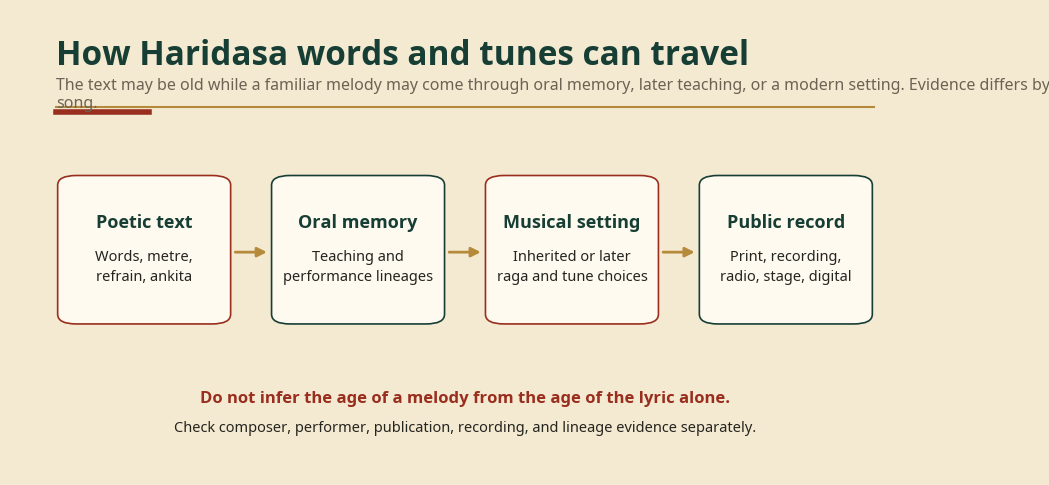
When you listen to a popular Haridasa song today, you are hearing ancient words set to modern music. The original melodies composed by Purandara Dasa and his contemporaries in the sixteenth century have largely been lost to time. The tunes heard in modern Carnatic concerts are later settings created by twentieth century musicians.
This reality often surprises listeners who assume that a song has remained unchanged since its creation. The lyrics have survived intact through written manuscripts and careful memorization. However, the musical settings have changed because melodies were passed down through an oral tradition that broke over the centuries.
Understanding this history helps listeners appreciate both the timeless spiritual poetry of the Haridasas and the creative brilliance of the modern musicians who brought these songs back to the concert stage. It also explains why different artists might sing the exact same poem in completely different ways.
The Difference Between Words and Music
To understand who composed the tunes, we must first separate the words from the music. In Indian classical music, the lyrics of a composition are called sahitya. The musical framework is defined by the raga (melody) and tala (rhythm).
The Haridasas were wandering saints and poets who composed thousands of devotional songs in the Kannada language. Their primary goal was to spread spiritual and moral teachings to the common people. The sahitya they wrote was rich in meaning, devotion, and philosophical depth.
When a modern musician performs a Haridasa song, they are singing the original sahitya. The words remain exactly as the poet wrote them. However, the raga and tala used to present those words are usually modern choices. The musician or their teacher has selected a melody that fits the mood of the poem, rather than singing the melody the poet originally intended.
The Vaggeyakara Tradition
Purandara Dasa is widely recognized as a foundational figure in Carnatic music. He was not just a poet; he was a Vaggeyakara. A Vaggeyakara is a person who composes both the sahitya (words) and the dhatu (music) of a song 1.
Historical records and academic consensus confirm that Purandara Dasa composed original tunes for his lyrics. He systematized the early teaching methods of Carnatic music and created a structured curriculum that is still used today. He chose specific ragas and talas for his compositions to convey the exact emotional and spiritual message he intended.
Therefore, Purandara Dasa did compose tunes for his songs. The problem is not that the tunes never existed. The problem is that those specific musical settings did not survive the journey from the sixteenth century to the present day.
The Break in the Chain
The loss of the original Haridasa melodies was a gradual process. For several centuries after Purandara Dasa lived, his songs were sung by followers and wandering mendicants. However, without a standardized system of written musical notation, the exact melodies were vulnerable to change and forgetting.
By the time audio recording technology arrived in the twentieth century, the original tunes for the vast majority of Haridasa compositions were gone 2. Musicians and scholars realized that while the texts were preserved in palm leaf manuscripts and printed books, the musical instructions were either missing or impossible to interpret accurately.
Expert musicians, such as Vidya Subramanian, have confirmed that the current tunes we hear for Haridasa songs are likely not the original ones 3. The chain of transmission was broken. The lyrics survived, but the music faded away.
Oral Tradition and Memory
The loss of these melodies is a direct result of how Indian classical music is taught and preserved. Carnatic music relies heavily on an oral tradition known as the guru-shishya parampara (teacher-disciple lineage) 4.
In this system, music is not learned primarily from books or sheet music. It is learned by listening to a teacher and repeating what they sing. This method develops kelvi gnanam, which means learning by listening 5. A student absorbs the nuances, gamakas (ornamentations), and emotional depth of a raga directly from the master.
While the oral tradition is excellent for preserving the style and soul of the music, it is fragile over long periods. If a generation of teachers dies without passing a specific song to their students, the melody is lost forever. Unlike the lyrics, which could be written down and stored safely, the music existed only in the memory and voices of the singers.
The Surviving Exceptions
While the vast majority of original Haridasa tunes are lost, there are a few rare exceptions. The most famous of these are the pillari geethas.
The pillari geethas are simple, foundational songs composed by Purandara Dasa in the raga Malahari. They are among the very first songs taught to a Carnatic music student. Because they are the starting point of the curriculum, they have been taught continuously, without interruption, from teacher to student for centuries.
Musicologists generally agree that the tunes of the pillari geethas we hear today are very close to, if not exactly, the original melodies composed by Purandara Dasa 2. Their continuous use in daily teaching protected them from the break in the oral tradition that claimed the rest of his repertoire.
Setting the Modern Stage
If the original tunes were lost, where do the modern melodies come from? The answer lies in the twentieth century revival of Haridasa literature.
As musicians and scholars rediscovered the rich sahitya of the Haridasas, they wanted to bring these songs to the concert stage. To do this, leading Carnatic musicians took the ancient lyrics and set them to new music. They acted as modern composers, choosing ragas and talas that they felt matched the meaning and emotion of the words.
These twentieth century masters created the tunes that are now considered standard. When a listener hears a popular Haridasa song today, they are hearing a collaboration across time: sixteenth century lyrics powered by twentieth century musical genius.
Why One Song Has Many Tunes
Because the original tunes are lost, modern musicians have the freedom to choose how they want to present a Haridasa song. This freedom explains why a listener might hear the exact same lyrics sung in completely different ways by different artists.
When setting a tune, a musician must decide which raga best expresses the poem. One artist might feel a song is deeply sad and choose a melancholic raga. Another artist might read the same lyrics as a plea for hope and choose a brighter raga. Both interpretations are valid because the original musical instruction is gone.
This variety is a feature of modern Carnatic performance, not a mistake. It allows artists to bring their own creativity and emotional understanding to the ancient texts. It also means that active listening in Carnatic music involves paying attention to how the artist's musical choices interact with the poet's words.
An Evidence Ladder for Tune Questions
When a listener asks whether a familiar setting is original, separate the evidence before reaching a conclusion. A Universitat Pompeu Fabra study of Carnatic forum discussion shows that public conversations can reveal recurring terms and questions, but they are not historical proof: Sordo et al., ISMIR 2012.
- Begin with the text, poet signature, and available source editions.
- Then ask whether notation or a documented oral lineage can be shown.
- Describe a present concert setting as a current artistic choice unless earlier musical evidence is available.
This method keeps an open question open when the surviving record cannot support a stronger claim.
An attribution ladder for tune questions
A useful answer about a Haridasa tune begins by naming the kind of evidence in view. The Tirumala Tirupati Devasthanams Dasa Sahitya Project lists publications, commentary, hymns with notation, glossaries, recordings and educational activity. These are important living resources. They do not, by themselves, establish an original historical tune for every text.
The official site of T. K. Govinda Rao also records work in tuning Dasapadas and publishing notation. Such editorial work is valuable because it gives performers a documented modern setting. It should be credited as a modern setting rather than silently moved back into the period of the poet.
| Evidence rung | Careful description |
|---|---|
| Text source | A lyric, its ankita, or a documented edition identifies the literary work. |
| Historical notation | A named manuscript or early notation can support a limited musical claim for that document. |
| Modern setting | A musician or editor has supplied or documented a tune for present practice. |
| Recorded rendering | A particular artist has performed a named setting in a particular recording. |
This ladder gives a listener a simple question to ask of a programme note or video description: which rung is being claimed? It protects both the older text and the later musician. For manuscript-specific limits, see What Is a Suladi?. For the language that survives through these changes, see Why Kannada Devotional Poetry Is Hard to Translate.
Source note: The institutional and editorial examples in this section support present-day publication, notation and tuning work. They do not claim to recover original tunes for an entire historical repertoire.
Dr. Vidyabhushana's Approach
Dr. Vidyabhushana is one of the most prominent modern voices of the Haridasa tradition. His approach to tuning and performing these songs prioritizes the meaning of the text and the emotional connection with the listener.
In his performances and recordings, Dr. Vidyabhushana emphasizes authentic bhava (emotion and expression) 6. He believes that the primary purpose of the music is to deliver the spiritual message of the sahitya. The raga and tala are tools to enhance the words, not to overshadow them.
His tune settings are designed to be accessible and deeply moving. He focuses on clear pronunciation and emotional resonance, ensuring that the timeless spiritual value of the lyrics reaches the modern audience. His work demonstrates how the Haridasa Sahitya tradition continues to live and breathe through thoughtful musical interpretation.
Glossary
- Bhava: Emotion, expression, and the feeling conveyed by a musical performance.
- Carnatic music: The classical music system of southern India.
- Guru-shishya parampara: The traditional teacher-disciple lineage through which knowledge is passed down orally.
- Haridasa Sahitya: The devotional literature composed by the Haridasa saints of Karnataka.
- Kelvi gnanam: Knowledge acquired through listening; a crucial skill in oral traditions.
- Laya: Rhythm or tempo in music.
- Pillari geethas: Foundational beginner songs in Carnatic music, composed by Purandara Dasa.
- Raga: The melodic framework in Indian classical music.
- Sahitya: The lyrics or literary content of a musical composition.
- Shruti: Musical pitch or the foundational drone.
- Tala: The rhythmic cycle or meter in Indian classical music.
- Vaggeyakara: A person who composes both the lyrics (sahitya) and the music (dhatu) of a song.
FAQ
Did Purandara Dasa compose the tunes we hear today? No. With the exception of basic lessons like the pillari geethas, the original melodies composed by Purandara Dasa have been lost. The tunes heard today are modern settings.
What is the difference between sahitya and a modern tune setting? Sahitya refers to the original lyrics written by the poet. A modern tune setting is the melody (raga) and rhythm (tala) chosen by a later musician to sing those lyrics.
Why were the original Haridasa melodies lost? They were lost because they were passed down through an oral tradition without standardized written notation. Over centuries, the chain of memory broke, and the specific melodies were forgotten.
Are there any original Haridasa tunes that survived? Yes, a few basic teaching songs, such as the pillari geethas, have survived because they have been taught continuously to beginners for centuries.
Why do different artists sing the same Haridasa song in different ragas? Because the original tune is lost, modern musicians are free to choose a raga that they feel best expresses the emotion of the lyrics. Different artists may interpret the poem differently.
Conclusion
The history of Haridasa song tunes is a story of loss and revival. While it is true that the original melodies of Purandara Dasa and his peers have faded into history, their words have proven indestructible. The survival of the sahitya allowed twentieth century musicians to breathe new life into the poetry.
Today, when we listen to these songs, we are not hearing a museum piece from the sixteenth century. We are hearing a living tradition. The modern tunes serve as a vehicle for ancient wisdom, proving that the spiritual power of the Haridasas does not depend on a single melody, but on the enduring truth of their words.
Related Listening
Hear these official recordings to follow the relationship between Haridasa words, later tune settings, and individual performance choices.
- Official Recordings - Hear Dr. Vidyabhushana's specific tune settings for classic Haridasa compositions.
Related Articles
These guides extend the article’s historical and musical questions into practical listening steps.
- How to Listen to Carnatic Music: A Beginner's Field Guide
- How to Recognize a Raga: Phrases, Gamaka, and Musical Memory
- What Is a Suladi? Inside the Haridasa Form That Moves Through Several Talas
- Why Kannada Devotional Poetry Is Hard to Translate
- Dr. Vidyabhushana's cultural work
The Institutional Framework of the TTD Dasa Sahitya Project
The preservation and dissemination of Haridasa literature in the modern era owe much to organized institutional efforts, most notably the Tirumala Tirupati Devasthanams (TTD) Dasa Sahitya Project. This initiative serves as a central hub for the systematic collection, publication, and teaching of the vast repertoire of Kannada devotional poetry. By providing a structured framework for both academic study and devotional practice, the project addresses the gap left by the fragmented oral traditions of previous centuries. The project focuses on publishing literature accompanied by detailed commentary, which helps contemporary readers and musicians understand the philosophical nuances of the sahitya before attempting a musical interpretation. This depth of understanding is essential because the Haridasa poets often embedded complex theological concepts within seemingly simple verses. Without the project's scholarly intervention, much of this subtext might be overlooked by the modern performer who is primarily focused on the melodic aspect of the song.
One of the primary contributions of the TTD Dasa Sahitya Project is the publication of hymns with standardized notation. While these notations do not claim to be the original sixteenth century melodies, they provide a reliable and consistent musical framework for students and bhajan groups. This standardization is crucial for the survival of the tradition, as it allows for collective singing and ensures that the lyrics are not lost even if the specific concert melodies vary between performers. The project also maintains glossaries and rare works that might otherwise have remained hidden in private collections or decaying manuscripts. Through its support of teaching programs and bhajan practice, the project ensures that Haridasa Sahitya remains a living tradition rather than a purely archival subject. These teaching programs often extend into rural areas, where the oral tradition is still vibrant but requires the structural support of printed materials to maintain its integrity across different districts.
The table below outlines the primary outputs of the TTD Dasa Sahitya Project and their roles in the modern ecosystem of Haridasa music.
| Publication Type | Description | Practical Use for Musicians |
|---|---|---|
| Literature with Commentary | Printed editions of poems with linguistic and philosophical explanations. | Understanding the bhava and intent of the poet before selecting a raga. |
| Hymns with Notation | Musical transcriptions in standard Carnatic notation for selected compositions. | Providing a baseline melody for group singing and individual practice. |
| Specialized Glossaries | Collections of archaic Kannada terms and technical musical vocabulary. | Ensuring accurate pronunciation and comprehension of complex metaphors. |
| Rare Works Collections | Compilations of lesser-known Haridasa compositions from diverse lineages. | Expanding the concert repertoire beyond the most popular songs. |
| Educational Manuals | Instructional materials designed for bhajan mandalis and music students. | Training new generations in the foundational techniques of Dasa Sahitya. |
| Research Journals | Periodic publications featuring academic papers on Haridasa history and musicology. | Keeping track of new discoveries in manuscript research and tune attribution. |
| Audio Archives | Collections of field recordings and professional renderings of rare compositions. | Serving as a reference for the authentic pronunciation and emotional delivery of the text. |
It is important for listeners and researchers to recognize that while these publications are authoritative in their own right, they do not establish an original historical tune for every composition. Instead, they represent a carefully curated modern consensus that balances historical text with contemporary musical needs. By providing these resources, the TTD project allows for a more informed engagement with the repertoire, even as the search for original melodies continues through manuscript research. The project's role is thus one of stewardship, protecting the textual foundation while enabling a diverse range of musical expressions to flourish in the present day.
Source note: The institutional framework and publication details described in this section are based on the official Tirumala Tirupati Devasthanams Dasa Sahitya Project documentation, which emphasizes the project's role in teaching, bhajan practice, and the publication of notation and commentary.
Modern Editorial Contributions and the Legacy of T. K. Govinda Rao
The transition of Haridasa compositions from the bhajan hall to the formal concert stage was facilitated by the dedicated work of several twentieth century musicians and editors. Among these figures, T. K. Govinda Rao stands out for his extensive efforts in tuning and documenting the Dasapadas. His work represents a significant bridge between the literary preservation of the texts and the musical requirements of the modern Carnatic performance. By applying a deep knowledge of raga lakshana and the emotional requirements of the sahitya, Govinda Rao created musical settings that have since become staples of the repertoire. His approach was characterized by a profound respect for the poet's intent, often spending years researching the specific context of a song before assigning it a raga.
The editorial process involves more than just selecting a raga; it requires a meticulous mapping of the lyrics to a rhythmic structure that respects the natural flow of the Kannada language. Govinda Rao’s official site and his published collections record the extensive work involved in tuning these songs. His planned Purandaradasa collection, for example, aimed to provide a comprehensive resource for performers, including notation that captures the essential gamakas and phrasing of his settings. This work is valuable because it gives performers a documented modern setting to follow, reducing the ambiguity that often arises when a song is learned purely through informal oral transmission. Furthermore, his work helped to elevate the status of Haridasa Sahitya within the Carnatic community, demonstrating that these devotional poems were worthy of the same rigorous musical treatment as the kritis of the Trinity.
The following list highlights the key editorial milestones and principles that define this modern tuning tradition:
- Systematic Notation Development: The creation of clear, readable notation that includes specific instructions for tala and raga transitions, allowing for consistent reproduction by different artists.
- Context-Driven Raga Selection: Choosing ragas that align with the specific ankita (signature) and the overarching theme of the composition, whether it be shringara (love), bhakti (devotion), or vairagya (detachment).
- Preservation of Poetic Prosody: Ensuring that the musical setting does not compromise the poetic meter and the natural stresses of the Kannada lyrics, which is essential for maintaining the clarity of the message.
- Documentation of Modern Lineage: Attributing specific tune settings to their respective modern composers to maintain transparency in the attribution ladder and to honor the creative labor involved.
- Educational Accessibility for Students: Creating versions of the songs that are accessible to intermediate students while remaining challenging enough for professional vocalists to perform on the concert stage.
- Cross-Regional Collaboration: Working with scholars and musicians from different linguistic backgrounds to ensure that the Kannada texts are understood and performed accurately across the Carnatic world.
When a performer uses a setting by T. K. Govinda Rao, they are engaging with a specific editorial lineage. This should be credited as a modern setting rather than being presented as the original historical tune of the poet. Such transparency respects the creative contribution of the modern editor while acknowledging the historical reality of the lost sixteenth century music. This distinction is vital for maintaining the integrity of musicological research and for providing the audience with a clear understanding of the song's history. By acknowledging these modern contributions, we celebrate the ongoing vitality of the Haridasa tradition.
Source note: The information regarding editorial work and notation publications is derived from the T. K. Govinda Rao official site, which documents his contributions to tuning Dasapadas and his efforts to publish comprehensive collections of Haridasa music.
Manuscript Evidence and the Structural Evolution of the Suladi
While many Haridasa tunes were lost, certain complex forms like the Suladi provide unique insights into the historical intersection of text and music. A Suladi is a sophisticated compositional form that typically features several stanzas, each set to a different tala. This multi-tala structure makes the Suladi a significant challenge for both the composer and the performer. Research into manuscripts, such as those found in the Thanjavur Sarasvati Mahal Library, has revealed important details about how these works were recorded and possibly performed in the past. These manuscripts serve as a rare window into a time when the musical instructions were still being documented alongside the poetic texts.
The discovery of twenty-four Kannada Suladi notations in Thanjavur manuscripts highlights the existence of a written tradition that attempted to capture musical details, even if the exact melodies remain subject to interpretation. These manuscripts often include raga labels and specific tala markers for each stanza, culminating in a final jate (a rhythmic conclusion). However, scribal ambiguity remains a persistent challenge for modern scholars. The way a scribe recorded a melody in the seventeenth or eighteenth century may not align perfectly with modern notation systems, requiring a careful and often speculative reconstruction by today’s musicologists. This ambiguity often stems from the fact that the scribes were recording music that was already part of an oral tradition, and their notations were likely meant as mnemonic aids rather than exhaustive scores.
The structural elements of a Suladi as documented in these historical manuscripts are summarized in the table below.
| Element | Description | Function in the Composition |
|---|---|---|
| Stanza (Charana) | Individual sections of the poem, often numbering between five and seven. | Each stanza introduces a new facet of the spiritual or philosophical theme. |
| Multi-Tala Framework | The practice of assigning a different tala to each stanza. | Demonstrates the rhythmic mastery of the Vaggeyakara and the performer. |
| Raga Label | A heading in the manuscript indicating the intended melodic framework. | Provides the primary clue for the musical mood of the entire piece. |
| Mudra (Ankita) | The signature of the poet, usually appearing in the final stanza. | Identifies the author and ensures the authenticity of the composition. |
| Jate | The concluding rhythmic section that follows the final stanza. | Serves as a definitive musical and rhythmic resolution to the complex work. |
| Tala Transition | The specific point where one rhythmic cycle ends and another begins. | Requires precise coordination between the vocalist and the percussionist. |
| Refrain (Pallavi) | A recurring melodic or textual theme that may appear between stanzas. | Provides a sense of unity and return throughout the multi-tala structure. |
Understanding the Suladi form is essential for anyone interested in the history of What Is a Suladi?. The manuscript evidence suggests that the Haridasas were not just simple wandering singers but were practitioners of a highly sophisticated musical art. The presence of these notations in royal libraries like that of Thanjavur indicates that Haridasa Sahitya was respected and preserved by elite musical circles far beyond the borders of Karnataka. This cross-regional preservation has been instrumental in keeping the structural knowledge of these forms alive, even when the specific melodic details were obscured by time. The study of these manuscripts continues to be a fertile ground for discovering how the Haridasa tradition influenced the broader development of Carnatic music.
Source note: The discussion of Suladi structure and manuscript findings is based on the research published in the Music Academy Journal 2015, which documents the discovery of Suladi notations in the Thanjavur Sarasvati Mahal manuscripts and notes the inherent scribal ambiguities.
The Oral-to-Written Transition and the Challenges of Notation
The journey of Haridasa songs from the sixteenth century to the present involves a complex transition from a purely oral tradition to a variety of written notation systems. In the guru-shishya parampara, the primary mode of transmission was listening and imitation, a process known as kelvi gnanam. This method is exceptionally effective at preserving the "soul" of a raga, including the subtle gamakas (ornamentations) and microtonal variations that define Carnatic music. However, it is inherently vulnerable to the passage of time and the disruption of lineages. When the chain of transmission is broken, the music that was never written down effectively ceases to exist. This vulnerability is why the loss of the original Haridasa melodies was so widespread; the wandering nature of the Haridasas meant that their music was spread across a vast geography, making it difficult to maintain a single, unbroken line of transmission.
Modern notation serves as a vital tool for reconstruction and preservation, but it has significant limitations. A written score in Carnatic music is often more of a skeleton than a complete representation of the performance. It provides the basic notes (swaras) and the rhythmic placement, but the performer is expected to fill in the nuances based on their training and aesthetic sense. This gap between the written word and the performed sound is where much of the original Haridasa music was lost. Furthermore, early manuscripts often used archaic notation styles that are difficult for modern musicians to decode without a deep understanding of historical performance practices. The challenge is compounded by the fact that the Kannada language itself has evolved, and the way a seventeenth century scribe would have understood the relationship between text and tone may be very different from our modern interpretation.
To evaluate a modern notation source or a historical manuscript, a researcher or performer can follow this practice protocol:
- Identify the Source Type: Determine if the notation is a primary historical manuscript, a nineteenth century transcription, or a modern editorial setting.
- Verify the Raga Label: Check if the raga mentioned in the source is still in common practice or if its lakshana (characteristics) have changed significantly over the centuries.
- Analyze the Tala Markers: Examine how the rhythmic cycles are indicated and whether they align with the prosody of the Kannada text.
- Assess the Gamaka Indications: Look for specific symbols or instructions for ornamentation, noting that many older sources may omit these entirely.
- Cross-Reference with Oral Tradition: Compare the written notation with surviving oral versions from different lineages to identify commonalities and discrepancies.
- Evaluate Scribal Ambiguity: Acknowledge that errors in copying or idiosyncratic notation styles may obscure the original intent of the composer.
- Test the Reconstruction: Perform the notation and assess whether the resulting melody feels appropriate for the emotional content of the sahitya.
This protocol helps in maintaining a critical perspective when engaging with written versions of Haridasa songs. It reminds the practitioner that notation is an aid to memory and a tool for standardization, rather than an absolute record of a historical performance. For a deeper understanding of how these musical elements are perceived by the listener, one might explore How to Listen to Carnatic Music. By recognizing the limits of notation, we can better appreciate the creative labor involved in bringing these ancient texts back to life through modern musical settings. The transition from oral to written is not just a change in medium; it is a fundamental shift in how the music is conceived and preserved.
Source note: The insights into the limitations of notation and the challenges of the oral-to-written transition are informed by musicological studies, including those published in the Music Academy Journal (2011 and 2015), which discuss the role of notation as an analytic tool and the ambiguities found in historical manuscripts.
Musical Translation and the Ramanujan Framework of Source-Awareness
The act of setting a new tune to an ancient Haridasa poem can be viewed as a form of musical translation. Just as a literary translator must choose between a literal word-for-word rendering and a more creative adaptation that captures the spirit of the original, a modern composer must decide how to translate the emotional and spiritual content of a sixteenth century text into a contemporary musical language. This process is deeply influenced by the theories of translation developed by scholars like A. K. Ramanujan, who argued that translation is a source-aware method that cannot be reduced to simple substitution. Ramanujan’s approach emphasizes the need to understand the "interior landscape" of the poem, which includes its specific cultural, linguistic, and emotional markers.
Ramanujan’s work, preserved in archives such as those at the University of Chicago, emphasizes that a successful translation must be grounded in a deep understanding of the source culture, linguistics, and poetry. When applied to Haridasa music, this means that a modern tune setting should not be an arbitrary choice of raga. Instead, it should be a deliberate response to the specific imagery, meter, and philosophical message of the sahitya. A source-aware musical setting respects the original context of the poem while making it accessible and resonant for a modern audience. This approach prevents the "musical translation" from becoming a mere decorative exercise and ensures that it serves the deeper purpose of the devotional text. The goal is to find a musical equivalent that carries the same weight and meaning as the original words, even if the specific notes are new.
The following principles of source-aware musical setting, inspired by Ramanujan’s framework, can guide modern composers and performers:
- Contextual Resonance and Association: The chosen raga should reflect the historical and cultural associations of the text, avoiding ragas that might carry conflicting emotional connotations.
- Structural Fidelity to the Text: The musical phrasing should follow the natural divisions of the poem, such as the pallavi, anupallavi, and charana, ensuring that the poetic structure remains clear.
- Linguistic Sensitivity and Flow: The melody must accommodate the phonetic requirements of the Kannada language, ensuring that the meaning is not obscured by awkward musical intervals.
- Emotional Alignment (Bhava): The bhava of the music must be in direct conversation with the bhava of the words, creating a unified experience for the listener.
- Transparent Adaptation and Attribution: The composer should be open about the modern nature of the tune, acknowledging that it is a new interpretation rather than a historical recovery.
- Imagery-Based Raga Selection: Using ragas that evoke the specific natural or divine imagery present in the poem, such as using a morning raga for a song about waking the deity.
- Respect for the Ankita: Ensuring that the signature of the poet is delivered with a musical emphasis that reflects its importance as a mark of authenticity.
By treating the tuning of Haridasa songs as a rigorous act of translation, musicians can avoid the pitfalls of superficiality. This method ensures that the timeless spiritual value of the lyrics is preserved even as the musical envelope changes. The challenges of this process are similar to those discussed in Translating Kannada Devotional Poetry, where the goal is to bridge the gap between different eras and languages without losing the essence of the original work. This source-aware approach honors the legacy of the Haridasas while ensuring their message continues to resonate in a modern musical context.
Source note: The application of translation theory to musical settings is based on the scholarly work of A. K. Ramanujan and the analysis of his methods by Vinay Dharwadker, which emphasize a source-aware approach to translation that goes beyond simple substitution.
Regional Variations and the Influence of the Bhajana Tradition
The survival of Haridasa Sahitya was not limited to the formal concert halls; it was also deeply rooted in the communal singing practices of the Bhajana Sampradaya. This tradition, which spans across various regions of Southern India, played a crucial role in keeping the lyrics alive during the centuries when formal musical lineages were being disrupted. In a bhajan setting, the emphasis is often on collective participation and simplicity, which led to the development of tunes that are different from the elaborate versions heard in Carnatic concerts. The bhajan tradition provided a safe haven for these songs, ensuring that they remained a part of the daily spiritual life of the people even when they were absent from the professional musical discourse.
Regional variations in these tunes often reflect the local musical flavors of the areas where the Haridasa movement spread. For instance, a Purandara Dasa song might be sung in a slightly different way in a rural village in Karnataka compared to a bhajan mandali in Tamil Nadu or Andhra Pradesh. These variations are not errors but are evidence of the tradition's adaptability and its ability to integrate with local devotional practices. The Bhajana Sampradaya prioritized the accessibility of the spiritual message, ensuring that even those without formal musical training could participate in the act of worship through song. This inclusivity was a hallmark of the Haridasa movement itself, which sought to bring spiritual knowledge to all members of society regardless of their social or educational background.
The table below compares the characteristics of Haridasa compositions in the bhajan tradition versus the modern concert tradition.
| Feature | Bhajana Sampradaya Setting | Modern Carnatic Concert Setting |
|---|---|---|
| Primary Goal | Collective devotion and spiritual participation. | Aesthetic excellence and individual artistic expression. |
| Melodic Complexity | Simple, repetitive tunes designed for group singing. | Elaborate ragas with complex gamakas and improvisations. |
| Rhythmic Structure | Straightforward talas like Adi or Rupaka, often with a steady beat. | Sophisticated rhythmic patterns and variations in tempo. |
| Vocal Style | Robust and communal, often involving a lead singer and a chorus. | Highly refined vocal technique with a focus on pitch and nuance. |
| Instrumentation | Basic accompaniment like the cymbals (manjira) and harmonium or tanpura. | Full concert ensemble including violin, mrdangam, and other percussion. |
| Audience Interaction | Active participation through singing and rhythmic clapping. | Attentive listening and appreciation of the artist's skill. |
| Performance Duration | Often part of a long devotional session lasting several hours. | Typically presented as a single item within a two or three hour concert. |
The interaction between these two traditions has been mutually enriching. Many popular concert tunes for Haridasa songs have their roots in simpler bhajan melodies, which were later refined and expanded by professional musicians. Conversely, the popularity of concert versions has influenced how these songs are sung in bhajan groups. This dynamic relationship ensures that the repertoire remains relevant to both the devout practitioner and the sophisticated listener. For more on the rhythmic aspects that define these performances, see How to Follow Tala. The bhajan tradition serves as the heartbeat of Haridasa Sahitya, providing the emotional and communal foundation upon which the more elaborate concert structures are built.
Source note: The comparison between bhajan and concert traditions is based on the historical role of the TTD Dasa Sahitya Project in supporting bhajan practice and the broader musicological consensus on the evolution of Haridasa music from communal to concert settings.
The Role of the Violin in Accompaniment and Melodic Mirroring
In the modern performance of Haridasa songs, the violin plays a critical role as an accompanying instrument. The relationship between the vocalist and the violinist is one of close collaboration, where the accompanist must follow the lead performer's phrases, pitch, and gamaka with extreme precision. This melodic mirroring is particularly important in Haridasa compositions, where the emotional delivery of the sahitya is the primary focus. The violin can offer a listener a second statement of a phrase, reinforcing the emotional impact of the lyrics and providing a melodic bridge between the vocalist's lines. This interaction is not just about technical reproduction; it is about creating a unified musical conversation that enhances the overall bhava of the performance.
Continuous bowing and an adapted posture help the violin render vocal-style gamakas that are essential for the authentic presentation of Haridasa music. The violinist must be intimately familiar with the nuances of the Kannada language to ensure that their accompaniment does not clash with the vocalist's pronunciation and phrasing. This requires a high degree of sensitivity and a deep understanding of the specific raga being used for the tune setting. In a concert setting, the violin often provides a brief melodic interlude between the stanzas of a Haridasa song, allowing the vocalist a moment of rest while maintaining the musical momentum. This role is similar to what is described in What Is a Varnam, where the violin's ability to follow the lead performer is a hallmark of the Carnatic style.
The following list outlines the key functions of the violin in the accompaniment of Haridasa songs:
- Melodic Support and Mirroring: Providing a near-instantaneous reproduction of the vocalist's phrases to reinforce the melody.
- Pitch Maintenance: Helping the vocalist stay centered in the foundational shruti throughout the performance.
- Gamaka Embellishment: Adding subtle ornamentations that complement the vocalist's delivery and enhance the raga's character.
- Transition Management: Providing musical bridges between the pallavi, anupallavi, and charana sections of the song.
- Emotional Reinforcement: Using specific bowing techniques to mirror the bhava (emotion) of the devotional text.
- Dynamic Variation: Adjusting the volume and intensity of the accompaniment to match the vocalist's expressive needs.
The accompanist's role is thus one of humble but essential service to the sahitya. By closely following the lead performer, the violinist ensures that the musical setting remains a cohesive and supportive framework for the ancient words. This collaborative effort is a key part of the modern Carnatic concert experience, where the interplay between different instruments creates a rich and multi-layered musical range. The violin's ability to render the human voice's nuances makes it the ideal partner for the performance of Haridasa Sahitya.
Source note: The description of the violin's role in accompaniment is based on the HCL Concerts blog on the role of the violin in Carnatic music, which emphasizes the accompanist's task of following vocal phrases, pitch, and gamaka.
Raga Recognition and the Limits of Automated Analysis
As interest in Haridasa music grows, so does the application of modern technology to its study. Research datasets like the UPF CompMusic Indian Art Music Raga Recognition Dataset have become valuable tools for musicologists seeking to understand the melodic patterns used in these songs. These datasets contain full recordings with raga labels, allowing for large-scale analysis of how different musicians interpret the same compositions. Phrase-based raga recognition is an active research problem in the field of computational musicology, with the goal of developing software that can automatically identify the raga of a performance based on its melodic contours. This research has significant implications for the archiving and categorization of the vast Haridasa repertoire.
However, it is important to recognize the limits of automation in the context of Indian classical music. While software can identify common melodic patterns, it often struggles with the subtle gamakas and microtonal variations that are the hallmark of a master's performance. The emotional depth of a Haridasa song, its bhava, is something that currently eludes even the most sophisticated algorithms. Furthermore, the fact that a single song can be sung in many different ragas by different artists adds a layer of complexity that automated systems are not yet fully equipped to handle. These datasets are useful for identifying trends and for providing a broad overview of the repertoire, but they cannot replace the nuanced understanding of a trained human listener.
The table below summarizes the capabilities and limitations of research datasets in the context of Haridasa raga recognition.
| Feature | Capabilities of Research Datasets | Limitations of Current Automation |
|---|---|---|
| Pattern Identification | Can recognize common melodic phrases and note sequences. | Struggles with subtle gamakas and microtonal nuances. |
| Large-Scale Archiving | Allows for the systematic categorization of thousands of recordings. | Cannot capture the emotional depth or bhava of a performance. |
| Comparative Analysis | Enables researchers to compare how different artists sing the same song. | May misidentify ragas with similar melodic structures (e.g., Mohanam and Hindolam). |
| Trend Tracking | Can identify which ragas are most popular for specific tune settings. | Does not account for the creative choices made by individual musicians. |
| Phrase-Based Recognition | Can identify a raga based on a short segment of the performance. | Requires high-quality recordings and clear melodic lines for accuracy. |
| Metadata Management | Provides structured information about the artist, raga, and tala. | Often lacks the detailed textual context of the Haridasa sahitya. |
For the modern listener, understanding these technological developments provides a new perspective on How to Recognize a Raga. While automation can provide a helpful starting point, the true appreciation of Haridasa music requires an engagement with the spiritual and emotional core of the songs. The limits of software remind us that music is a deeply human experience, one that is rooted in a tradition of oral transmission and personal expression that technology can support but never fully replicate. The research datasets are evidence of the enduring fascination with the Haridasa tradition and the desire to understand its musical complexities through every available means.
Source note: The discussion of raga recognition and the limits of automation is informed by the UPF CompMusic Indian Art Music Raga Recognition Dataset and the associated research on phrase-based raga recognition, which highlights both the potential and the current boundaries of computational musicology.
Rhythmic Resolution and the Tani Avartanam Framework
In a typical Carnatic concert, the performance of a major Haridasa composition often includes a rhythmic interlude known as the Tani Avartanam. This section is a showcase for the percussionists, primarily the mrdangam player, to demonstrate their rhythmic mastery and creative improvisation within the framework of the song's tala. While the Tani Avartanam is a standard feature of the concert format, its application to Haridasa songs requires a specific sensitivity to the devotional nature of the repertoire. The percussionist must balance the need for technical display with the requirement to maintain the emotional mood of the sahitya. This rhythmic resolution is a key part of the song's overall structure, providing a sense of completion and balance to the melodic exploration.
The structure of a Tani Avartanam often follows a typical closing sequence, as identified by scholar-performers like David Nelson. This sequence may include a periya mora (a long rhythmic pattern) and a final korvai (a structured rhythmic conclusion). When there is more than one drummer, such as a mrdangam and a ghatam player, the section may also include a kuraippu, where the drummers engage in a rhythmic dialogue, gradually reducing the length of their phrases. This process distinguishes the natural flow of time from the calculated design of the rhythmic patterns, treating solkattu (rhythmic syllables) as an analytic tool for understanding the complexity of the tala. The percussionist's role is to provide a rhythmic foundation that supports the vocalist while adding a layer of sophisticated rhythmic interest to the performance.
The following list outlines the typical components and functions of a rhythmic resolution in the context of a Haridasa song:
- Establishment of the Tala Pulse: Maintaining a steady and clear rhythmic cycle that anchors the entire performance.
- Development of Rhythmic Patterns: Creating variations and improvisations that explore the possibilities of the tala.
- Dialogue between Percussionists: Engaging in a call-and-response interaction that builds rhythmic tension and excitement.
- Kuraippu (Reduction): Systematically reducing the length of rhythmic phrases to lead towards the final resolution.
- Periya Mora (Grand Pattern): A long and complex rhythmic sequence that serves as a climax to the percussion solo.
- Final Korvai (Resolution): A structured and often repeated rhythmic pattern that brings the Tani Avartanam to a definitive close.
- Re-entry of the Vocalist: The precise moment where the vocalist returns to the pallavi of the song, requiring perfect coordination with the percussionists.
This rhythmic framework is essential for the modern concert presentation of Haridasa Sahitya. It demonstrates that these songs are not just simple devotional chants but are part of a sophisticated musical system that values both melodic and rhythmic excellence. The Tani Avartanam provides a moment of focus on the rhythmic heartbeat of the music, allowing the listener to appreciate the complexity of the How to Follow Tala in a live setting. By integrating these rhythmic elements, modern musicians ensure that the Haridasa tradition continues to be a vibrant and challenging part of the Carnatic repertoire.
Source note: The description of the Tani Avartanam and its structural components is based on David Nelson's account in the Music Academy Journal 2011, which identifies the typical sequences and analytical tools used in the rhythmic resolution of a Carnatic performance.
A Protocol for Attributing Haridasa Melodies and the Audit Process
Given the historical loss of original melodies and the proliferation of modern settings, it is essential for the informed listener to have a method for evaluating the claims made about Haridasa song tunes. An attribution ladder, as discussed earlier, provides a useful framework for this evaluation. However, applying this ladder in a practical concert or listening environment requires a systematic approach. By following a specific protocol, a listener can move beyond simple assumptions and reach a more nuanced understanding of the music they are hearing. This critical awareness is not intended to diminish the beauty of modern settings but to enhance the listener's appreciation of the creative labor involved in the tradition's survival.
The goal of this protocol is to foster a culture of transparency and historical accuracy in the presentation of Haridasa music. It protects the integrity of the original sixteenth century text while giving due credit to the twentieth century musicians who brought the words back to life. This approach is consistent with the broader goals of musicological research and helps to ensure that the rich heritage of the Haridasas is understood in all its complexity. By asking the right questions, the listener becomes an active participant in the preservation of the tradition, helping to maintain the distinction between what is ancient and what is a modern, albeit inspired, addition.
The following steps constitute a "Tune Attribution Audit" for the engaged listener:
- Examine the Programme Note or Metadata: Look for any mention of a specific composer, editor, or school that set the tune for the song being performed.
- Identify the Raga and Tala Framework: Determine the musical structure of the performance and ask if there is any documented historical evidence linking these specific choices to the poet.
- Check for Notation Credits and Sources: If the song is from a published collection, identify the editor (e.g., T. K. Govinda Rao or a TTD publication) and note their contribution to the musical setting.
- Listen for Lineage Markers (Bani): Pay attention to whether the performer attributes the tune to their own guru or a specific school of music, which indicates a modern oral transmission.
- Search for Historical Precedents and Variants: Investigate if there are any surviving manuscripts or early 20th-century recordings that offer a different musical perspective on the same text.
- Acknowledge the Attribution Rung: Place the current performance on the attribution ladder: is it a recorded rendering of a modern setting, or is there a claim to a surviving oral tradition like the pillari geethas?
- Evaluate the Emotional Fit (Bhava): Assess how well the modern musical setting reflects the emotional and spiritual intent of the ancient sahitya.
By using this protocol, listeners can navigate the complex landscape of Haridasa music with greater clarity. It encourages a form of active listening that values transparency and historical accuracy. This approach is consistent with the broader goals of musicological research and helps to ensure that the rich heritage of the Haridasas is understood in all its complexity. For those interested in the foundational structures of the music, exploring What Is a Varnam can provide further context on how compositions are built and transmitted. The audit process is a tool for empowerment, allowing the listener to engage with the music on a deeper and more informed level.
Source note: This practice protocol is based on the attribution ladder concept and the institutional limits described in the TTD Dasa Sahitya Project and T. K. Govinda Rao sources, which emphasize the importance of distinguishing between historical text and modern musical settings.
Addendum: Institutional Preservation and Modern Editorial Methodologies
The historical continuity of the Haridasa tradition relies upon a complex interaction between ancient literary foundations and modern musical reconstruction. While the original melodies of the sixteenth century have largely transitioned into the realm of oral memory, the current landscape of performance is sustained by rigorous institutional projects and individual editorial efforts. These modern contributions do not claim to restore a lost past with absolute historical certainty but instead provide a structured framework for contemporary practice and study. By examining the roles of major projects and the methodologies of expert musicians, listeners can gain a deeper appreciation for the layers of creativity that bring a Haridasa composition to the concert stage. Further exploration is available through the Journal and Music Notes on the Home page.
The Institutional Framework of Dasa Sahitya
A primary driver in the preservation and dissemination of this tradition is the Dasa Sahitya Project overseen by the Tirumala Tirupati Devasthanams [1]. This institutional effort serves as a comprehensive repository for the literary and musical heritage of the Haridasas. The project is not limited to the mere collection of texts; it actively publishes a wide range of materials that support both academic study and practical performance. These publications include detailed literature accompanied by commentary, which helps clarify the philosophical and spiritual nuances of the original Kannada poetry.
The availability of hymns with notation is a critical component of the project's output. Because the oral tradition was subject to significant breaks over the centuries, the creation of standardized notation provides a stable reference point for students and performers. This work is supplemented by the publication of glossaries and rare works that might otherwise remain inaccessible to the public. By providing these resources, the project supports a broad spectrum of activities, ranging from formal classroom teaching to the communal practice of bhajan singing. The focus remains on providing a reliable foundation for practice rather than making definitive claims about the original historical tunes of every composition.
Individual Editorial Contributions and Tuning
Complementing the work of large institutions are the significant contributions of individual musician-scholars who have dedicated their careers to the Haridasa repertoire. One prominent example is the work recorded on the official site of T. K. Govinda Rao [2]. His efforts have focused on the meticulous task of tuning Dasapadas, which involves selecting appropriate ragas and talas that align with the emotional and rhythmic requirements of the lyrics. This process is an essential bridge between the silent text of a manuscript and the living sound of a performance.
The editorial work of such scholars is often manifested in detailed notation publications. These books serve as practical guides for musicians, offering a structured way to approach the complex task of setting ancient poetry to music. For instance, the planned collection of Purandaradasa compositions represents a major effort to organize and standardize a vast body of work for modern use. It is important for the listener to attribute individual tuning and editorial choices to the specific scholars who created them, recognizing that these settings are artistic and scholarly interpretations rather than direct transmissions from the sixteenth century.
The Attribution Ladder
To help listeners navigate the different layers of a Haridasa song, the following attribution ladder distinguishes between the various stages of a composition's history. This tool allows for a clearer understanding of what is original to the poet and what has been added by subsequent generations of musicians and scholars.
| Stage | Description | Source and Evidence Markers |
|---|---|---|
| Textual Foundation | The original poetic lyrics and spiritual message composed by the Haridasa saint. | Verified literature, palm leaf manuscripts, and early printed editions with commentary. |
| Historical Notation | Rare instances where musical instructions or clues are preserved in archival records. | Specific manuscripts and rare works identified by institutional projects like the Dasa Sahitya Project. |
| Modern Melodic Setting | The specific raga and tala framework chosen by a twentieth century editor or musician. | Notation publications by scholars such as T. K. Govinda Rao and institutional hymn books. |
| Recorded Performance | The unique rendering of a song by a contemporary artist in a concert or studio setting. | Audio and video recordings, such as those featuring the interpretations of Dr. Vidyabhushana. |
The attribution ladder serves as a reminder that a single song can exist in multiple forms simultaneously. A listener may encounter the same textual foundation set to different modern melodies, or the same melodic setting performed with different emotional emphases by various artists. Understanding these distinctions prevents the common misconception that a modern performance is a static artifact from the distant past. Instead, it reveals the music as a living collaboration across several centuries.
Practical Reader Protocol: Evaluating a Song Setting
When listening to a Haridasa composition, a student or enthusiast can use a structured protocol to better understand the origins and nature of the musical setting. The first step involves identifying the poet signature or mudra within the lyrics to confirm the textual foundation of the work. Following this, the listener should consult available literature and commentary to understand the spiritual and philosophical context of the poem. It is also helpful to determine if the current melody is associated with a specific modern editor or a particular notation publication.
The protocol further suggests comparing different recordings of the same lyrics to observe how various artists choose different ragas or talas to convey the message. A dedicated researcher might look for evidence of historical notation in institutional archives if the song is claimed to be an original melody. Additionally, one should recognize the role of the performer in adding emotional depth and expression to the modern melodic framework. Finally, it is important to distinguish between the foundational teaching methods and the more elaborate concert interpretations. This analytical approach helps the listener move beyond a passive experience and toward a more informed engagement with the tradition.
Practical Reader Protocol: Identifying Preservation Markers
A second protocol is designed to help researchers and practitioners identify the specific sources of preservation for a given Haridasa work. This process begins with checking for the presence of the Dasa Sahitya Project seal or a mention of the project in the publication of the text. Practitioners should also verify if the work is included in a collection of rare works or hymns with notation provided by a major temple trust. Identifying the specific name of the editor or musician responsible for the musical notation is another critical step in ensuring accurate attribution.
Furthermore, one should determine whether the publication includes a glossary to explain archaic Kannada terms used by the Haridasas. It is also useful to identify whether the resource is intended for formal teaching or for the support of communal bhajan practice. Assessing whether the commentary provided alongside the lyrics is based on historical manuscripts or modern scholarly analysis provides further clarity. Finally, confirming that the musical setting is described as a contemporary interpretation rather than an established historical tune ensures that the boundaries between the original poetry and the modern additions are respected.
The Role of Rare Works and Glossaries in Modern Study
The preservation of the Haridasa tradition is not merely about the music; it is also about the survival of the language and the ideas it carries. The inclusion of glossaries in modern publications is a vital tool for the contemporary listener. The Kannada language used by the saints of the sixteenth century contains many terms and references that may be unfamiliar to modern speakers. By providing clear definitions and context, these glossaries ensure that the spiritual message of the Haridasas remains clear and accessible.
Furthermore, the discovery and publication of rare works provide a more complete picture of the vast output of the Haridasa movement. Many compositions remained hidden in private collections or remote archives for centuries. The effort to bring these works to light through institutional projects allows for a broader understanding of the diversity of themes and styles within the tradition. These rare works provide insights into the lives of the saints, even if original musical settings have not survived. The focus on these materials demonstrates a commitment to the totality of the Haridasa heritage, valuing the literary content as much as the musical form.
Teaching and Bhajan Practice: The Practical Application
The ultimate goal of preserving Haridasa literature and music is to ensure its continued use in the daily lives of the people. The support for teaching and bhajan practice provided by institutional projects is evidence of this goal. By creating accessible notation and teaching materials, these projects allow new generations of students to learn the foundational songs of the tradition. This structured approach to education mirrors the systematized methods originally established by Purandara Dasa, even if the specific melodies have changed.
In the context of bhajan practice, the availability of hymns with notation allows for a more unified and communal experience. When a group of devotees gathers to sing the praises of the divine, having a shared musical framework helps to create a sense of harmony and focus. The modern settings provided by scholars and institutions serve as a common language for these gatherings. This practical application ensures that the Haridasa tradition remains a vibrant part of the spiritual landscape. The emphasis on teaching and practice highlights the belief that the value of these compositions is found in their performance and devotion.
Source Notes
The information regarding the institutional framework and the availability of hymns with notation is derived from the official documentation of the Dasa Sahitya Project managed by the Tirumala Tirupati Devasthanams. The details concerning individual editorial work and the tuning of Dasapadas are based on the records and publications available through the official site of T. K. Govinda Rao. These sources provide the necessary evidence to distinguish between the ancient textual foundations and the modern musical settings that characterize the Haridasa repertoire today.
Supporting institutional sources
- Tirumala Tirupati Devasthanams: Dasa Sahitya Project. https://www.tirumala.org/RADasaSahityaProject.aspx
- T. K. Govinda Rao Official Site. https://tkgovindarao.org/
References
The sources below support the historical distinctions, oral-transmission context, and modern tune-setting discussion used in this article.
- UPF Repositori: Extracting semantic information from an online carnatic music forum
- Reddit r/Carnatic: Compositions being 'Set to tune'
- YouTube: Raaga Rasika: Episode 14: Purandara Dasa Compositions
- Sangeet Natak Akademi: Music
- YouTube: Carnatic Music Masterclass ft. Sudha Ragunathan
- YouTube: ಹರಿದಾಸ ಸಾಹಿತ್ಯದ ಮಹಿಮೆ | Part - 02 | ಡಾ. ವಿದ್ಯಾಭೂಷಣರು | Haridasa Dinachari | Sri Purandara Dasaru