
Opening Answer: The foundation of active listening
Listening to Carnatic music as a beginner can feel like walking into a complex conversation halfway through. The music is rich, layered, and deeply rooted in tradition. However, you do not need a degree in musicology to appreciate it. Active listening is a skill you can build step by step. It begins with shifting your focus from passive enjoyment to intentional observation.
When you listen for pleasure, you let the music wash over you. When you listen to learn, you actively identify the building blocks of the performance 5. You start by finding the base pitch, then you observe the melodic framework, and finally, you track the rhythmic cycle. This guide provides a practical sequence to help you follow a Carnatic concert with confidence.
You can begin this practice today, regardless of your age or musical background. Public beginner discussions repeatedly show that adults want a clear way to start while balancing work, time, and unfamiliar terminology 1. The practical answer is to focus on one listening element at a time. It is not about memorizing hundreds of terms immediately, but about tuning your ear to the structures that hold the music together.
The Two Pillars: Shruti (Pitch) and Laya (Rhythm)
Every Carnatic music performance rests on two fundamental pillars: shruti and laya 4. Shruti refers to the pitch, specifically the base pitch chosen by the performer. Laya refers to the rhythm or the steady pulse of the music. These two elements provide the canvas on which the entire concert is painted.
Without a steady shruti, the melody loses its anchor. Without a consistent laya, the rhythm falls apart. In a concert, you will often hear a drone instrument, such as a tambura or a shruti box, playing continuously in the background. This drone establishes the shruti. The percussion instruments, like the mridangam, maintain the laya.
As a listener, your first task is to tune your ear to these two pillars. Before you try to identify complex melodies or intricate rhythmic patterns, simply focus on the steady drone and the underlying pulse. This foundational awareness will make the rest of the music much easier to follow. When you can consistently hear the drone beneath the complex vocal or instrumental lines, you have taken the first major step in active listening.
Finding the Base Note: Understanding Shadjam (Sa)
The Carnatic music system uses seven basic notes, known as swaras. These are Shadjam (Sa), Rishabham (Ri), Gandharam (Ga), Madhyamam (Ma), Panchamam (Pa), Dhaivatam (Da), and Nishadam (Ni) 3. The most important of these is Shadjam, commonly referred to as Sa.
Sa is the base note. It is the anchor for all other notes in the melody. When a singer or instrumentalist begins a performance, they first establish their Sa. The drone instrument continuously plays this note, along with the fifth note (Pa) and the higher Sa, creating a rich harmonic background.
To actively listen, try to identify the Sa. Listen to the drone and hum the base note quietly to yourself. Once you have internalized the Sa, you will start to hear how the other notes relate to it. You will notice when the melody moves away from the base note and when it returns to resolve the musical phrase. This return to Sa often brings a sense of completion or rest to a musical idea.
Beyond the Scale: What makes a Raga
A raga is often described as a scale, but it is much more than that. While a raga does have a specific set of ascending notes (arohana) and descending notes (avarohana), it also has a distinct emotional identity and a specific form, known as swarupa 4.
What gives a raga its unique character are the gamakas. Gamakas are the characteristic oscillations, glides, and embellishments applied to the notes. They are not mere decorations; they are essential to the identity of the raga. Two ragas might share the same basic notes but sound completely different because of how those notes are treated with gamakas.
When you listen to a raga, do not just try to identify the notes. Listen to the phrases, the characteristic movements between the notes, and the emotional mood it creates. If you want to dive deeper into identifying specific ragas, you can explore our guide on recognizing a raga. Recognizing a raga takes time and exposure, so do not be discouraged if they all sound similar at first.
Following the Time: An introduction to Tala and Nadai
Tala is the rhythmic cycle that governs the composition and the improvisation. It is the framework within which the laya (pulse) is organized. The most common tala you will encounter is Adi Tala, an eight beat cycle.
During a concert, you will see the performers and the audience keeping time with specific hand gestures. These gestures include claps, finger counts, and waves. Following these hand patterns is a great way to stay engaged with the rhythm. If you find this challenging, our detailed guide on following tala cycles provides step by step instructions.
Within the main beats of the tala, the rhythm can be further subdivided. This subdivision is called nadai. For example, a single beat might be divided into three, four, five, seven, or nine sub beats 4. Recognizing these subdivisions adds another layer of depth to your listening experience. It transforms a simple beat into a complex, driving force that propels the music forward.
The Art of Improvisation: Manodharma in practice
A significant portion of a Carnatic concert is improvised on the spot. This spontaneous creation is called manodharma. It allows the artist to explore the raga and tala in their own unique way, making every performance distinct.
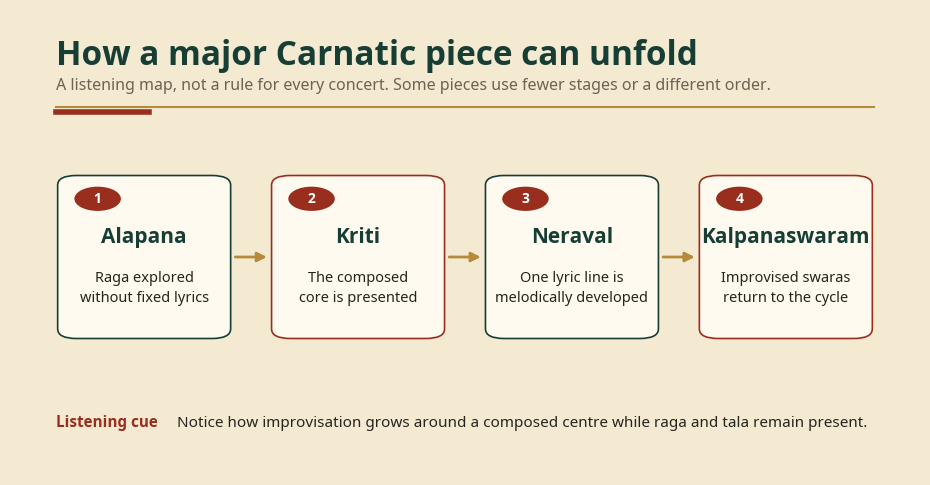
A typical major piece in a concert follows a specific sequence of composed and improvised elements [5]:
- Alapana: An improvised, rhythm free exploration of the raga. The artist introduces the raga and gradually unfolds its characteristics.
- Kriti: The main composed song. This is the core of the performance, featuring lyrics and a set rhythmic cycle.
- Neraval: Improvisation based on a specific line of lyrics from the kriti. The artist explores different melodic variations while maintaining the original rhythm and words.
- Kalpanaswaram: Rhythmic improvisation using the names of the notes (Sa, Ri, Ga, etc.). The artist creates complex rhythmic patterns that resolve precisely on a specific beat of the tala.
Understanding this structure helps you anticipate what is coming next and appreciate the different skills the artist is demonstrating. It changes the concert from a continuous stream of sound into a structured narrative with distinct chapters.
Learning by Listening: The concept of Kelvi Gnanam
In the Carnatic tradition, listening is not just a way to enjoy music; it is a primary method of learning. This concept is known as kelvi gnanam, which translates to knowledge gained through hearing 4.
Before the era of written notation and recorded audio, students learned entirely by listening to their teachers and other masters. They absorbed the nuances of ragas, the complexities of talas, and the stylistic elements of different compositions through repeated, focused listening.
Even today, kelvi gnanam is crucial. You cannot learn the subtle gamakas or the emotional depth of a raga from a book. You must hear them. As a beginner, you can cultivate your own kelvi gnanam by listening to official recordings and attending live concerts as often as possible. The more you listen, the more your brain will naturally begin to recognize patterns and structures.
Finding a Teacher: The Guru-Shishya tradition today
Indian classical music is traditionally passed down through the guru shishya parampara, a close, one on one relationship between teacher and student 2. The guru imparts not just musical knowledge, but also the values and aesthetics of the tradition.
If you decide to move from listening to learning, finding the right teacher is an important step. Look for someone whose teaching style matches your learning goals. Some teachers focus heavily on rigorous, step by step exercises, while others emphasize learning compositions and developing kelvi gnanam early on.
Remember that it is never too late to start. Many adults begin learning Carnatic music later in life and find it deeply rewarding. The key is patience, dedication, and a willingness to immerse yourself in the music. Finding a teacher who understands the specific challenges and strengths of adult learners can make a significant difference in your progress.
Glossary of Key Terms
- Alapana: An improvised, rhythm free melodic introduction to a raga.
- Arohana: The ascending scale of a raga.
- Avarohana: The descending scale of a raga.
- Gamaka: The characteristic oscillations and embellishments applied to notes.
- Guru shishya parampara: The traditional teacher student lineage.
- Kalpanaswaram: Rhythmic improvisation using the names of the notes.
- Kelvi gnanam: Knowledge and musical intuition gained through extensive listening.
- Kriti: A composed song, forming the core of a Carnatic performance.
- Laya: The steady rhythmic pulse or tempo.
- Manodharma: Spontaneous musical improvisation.
- Nadai: The subdivision of a main beat in a rhythmic cycle.
- Neraval: Melodic improvisation based on a specific line of lyrics.
- Raga: A melodic framework with specific rules and emotional identity.
- Shadjam (Sa): The fundamental base note of the scale.
- Shruti: The base pitch or drone.
- Swara: A musical note.
- Tala: The rhythmic cycle governing a composition.
Frequently Asked Questions (FAQ)
How can I start learning Carnatic music as a complete beginner? Start by actively listening to concerts and recordings. Focus on identifying the base pitch (shruti) and the steady pulse (laya). Once you are comfortable with active listening, look for a teacher who works well with adult beginners.
Is it too late to learn Carnatic music as an adult? No, it is never too late. Many adults successfully learn and appreciate Carnatic music. The key is consistent practice and focused listening.
What is the difference between listening for pleasure and listening to learn? Listening for pleasure is passive; you let the music wash over you. Listening to learn is active; you intentionally identify elements like the raga, tala, and the structure of the performance.
How do I identify the base pitch or shruti? Listen to the continuous drone instrument (like the tambura) in the background. Try to hum the lowest steady note you hear. That is the base pitch, or Shadjam (Sa).
What is the correct order of learning Carnatic vocal music? While teachers vary, most begin with basic exercises to establish pitch and rhythm, followed by simple songs, and eventually progress to complex compositions and improvisation.
First Visit: Confidence Before Analysis
For a first concert, it is enough to arrive settled, listen patiently, and let the sound world become familiar. A listener does not need to name each raga or count every tala to take part thoughtfully. Darbar’s etiquette guidance is useful here, but it should be treated as a guide to respectful attention rather than a fixed code for every venue: Indian music etiquette for listeners.
- Arrive a little before the main item so you can settle into the acoustic space.
- Listen first for the overall movement of the music, not for a test of recognition.
- Notice the venue. A formal sabha, a house concert, and a lecture demonstration can ask for different kinds of attention.
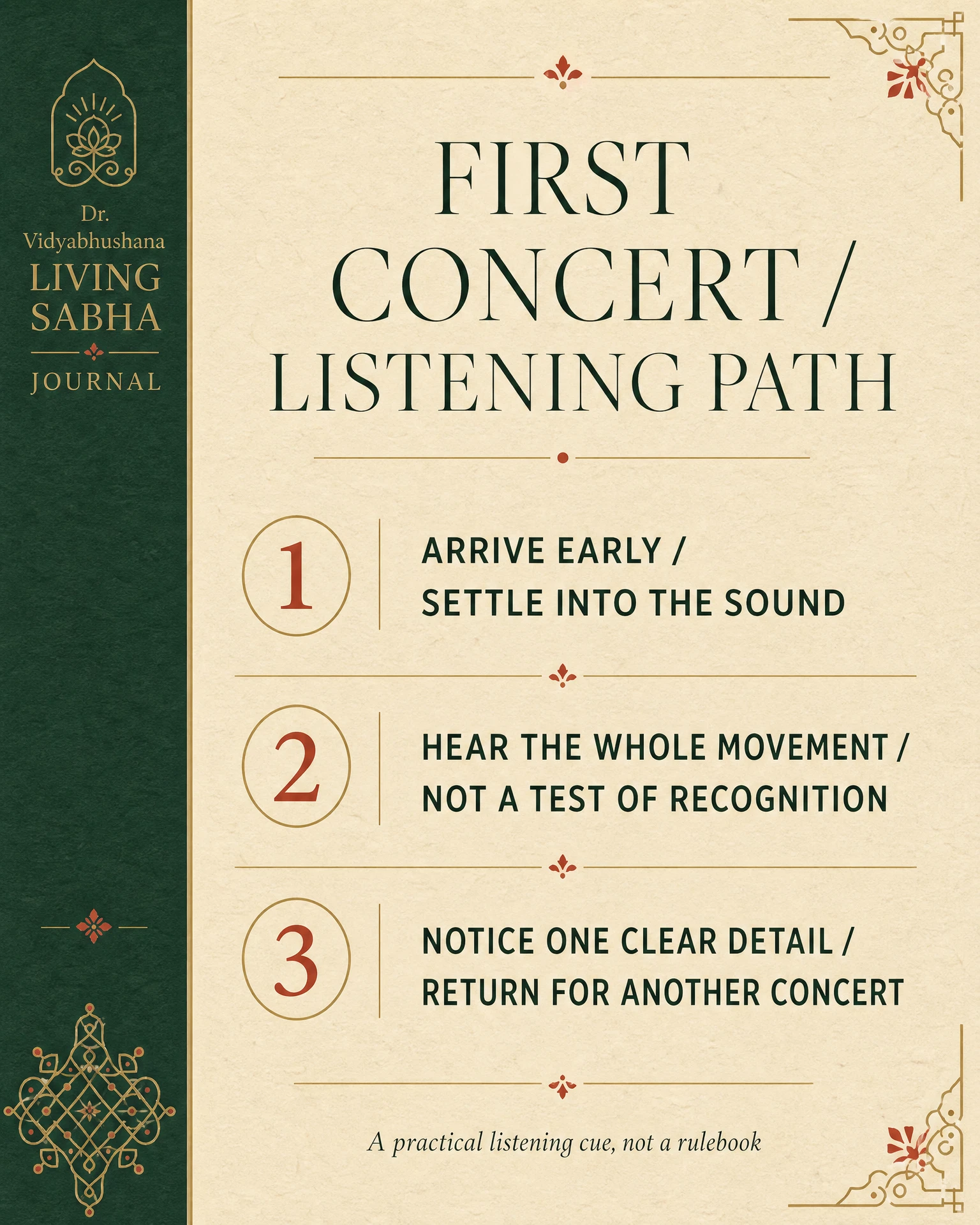
The most useful first-visit habit is simple: hear one thing clearly, then return for another concert. The guide on recognizing a raga can wait until the experience of listening itself feels less unfamiliar.
Conclusion: Your next steps in listening
Active listening transforms a Carnatic concert from a confusing wall of sound into a structured, engaging experience. By focusing on the shruti, identifying the Sa, and following the tala, you build a solid foundation. Understanding the role of ragas, gamakas, and manodharma allows you to appreciate the artist's skill and creativity.
Your next step is to put this into practice. Choose a recording, sit quietly, and apply these listening techniques. Over time, your kelvi gnanam will grow, and the intricate world of Carnatic music will become increasingly clear and rewarding. The journey of understanding this music is a lifelong pursuit, but every step brings a deeper level of enjoyment.
Related Listening and Articles
Use these links to move from this guide to the next practical listening question or to hear the ideas in an official recording.
- How to Recognize a Raga
- How to Follow Tala
- What Is a Suladi?
- Who Composed the Tunes of Haridasa Songs?
- Why Kannada Devotional Poetry Is Hard to Translate
- Guided listening examples
- Haridasa Sahitya overview
Hear the dialogue, not only the lead line
A concert does not present one melodic line in isolation. In the typical format described by Darbar, a vocalist or solo instrumentalist is commonly supported by a melodic accompanist, often a violinist, and by percussion. The varnam, kriti, alapana, niraval, kalpanaswaram and tani avartanam are useful landmarks for attention. They are not a compulsory sequence for every performance.
The violin can give a beginner a valuable second hearing of a phrase. HCL Concerts describes how Carnatic violin technique uses adapted posture and continuous bowing to render vocal-style gamaka. In practice, the accompanist may closely follow the lead line, answer it briefly, or offer an independent response. The aim is not to test whether both musicians make identical sounds. It is to notice how a phrase remains recognisable when another musician takes it up.
| Concert moment | A simple listening choice | What to leave for a later hearing |
|---|---|---|
| Varnam or early kriti | Notice one phrase that returns. | Naming the raga immediately. |
| Alapana | Hear the lead phrase, then the violin response. | Counting the tala, since the section may be unmetered. |
| Niraval | Follow how one text line is reshaped. | Translating every word while the music is moving. |
| Kalpanaswaram | Listen for a repeated landing point. | Calculating every internal subdivision. |
| Tani avartanam | Keep one steady pulse or wait for the melodic return. | Treating a lost count as a failure. |
This way of listening gives the ear a manageable job. A phrase heard twice is often easier to remember than a phrase heard once at full speed. If the varnam is the part of the programme that first catches your attention, continue with What Is a Varnam?. If rhythm becomes the main question, move to How to Follow Tala.
Source note: The concert landmarks here are presented as a typical format, not a fixed rule. The description of violin accompaniment is limited to the documented role of the instrument in following melodic phrases and vocal-style ornamentation.
Concert Structural Analysis: Landmarks of the Kutcheri
The modern Carnatic concert, or kutcheri, follows a structured progression that has evolved over several centuries to balance composed material with spontaneous improvisation. For a listener, understanding this architecture is the most effective way to transform a series of sounds into a navigable narrative. A typical performance, often lasting between two and three hours, is not a random collection of songs but a carefully curated sequence designed to build melodic and rhythmic intensity. According to the Darbar: Performance Format for Carnatic Concerts, the programme often opens with a varnam, which serves as a melodic warm up for the artist and a foundational statement of the raga for the audience. The varnam is a unique compositional form that emphasizes the core movements and characteristic phrases of a raga, providing a clear reference point before the more complex improvisations begin. If you are interested in the specific structure of these opening pieces, you can read more in our guide on what is a varnam. The varnam is particularly useful for the beginner because it presents the raga in a relatively straightforward manner, allowing the ear to adjust to the shruti and the basic intervals of the scale.
Following the varnam, the artist typically performs a series of kritis, which are the primary composed songs of the Carnatic tradition. These compositions form the backbone of the concert, providing the thematic and rhythmic framework for the performance. A major kriti in the middle of the programme often serves as the centerpiece, featuring extensive improvisational sections such as alapana, niraval, and kalpanaswaram. These sections allow the artist to explore the boundaries of the raga and the tala, demonstrating their technical mastery and creative depth. The alapana, an unmetered melodic exploration, is particularly important for the listener as it establishes the emotional landscape of the raga without the distraction of a rhythmic beat. This is followed by the kriti itself, and then by niraval, where the artist improvises on a specific line of the lyrics, and kalpanaswaram, where rhythmic patterns are created using the names of the notes. Each of these sections offers a different perspective on the music, from the pure melody of the alapana to the rhythmic complexity of the kalpanaswaram.
The climax of a major piece is often marked by the tani avartanam, a dedicated solo for the percussionists. This section allows the mridangam, and often other instruments like the ghatam or kanjira, to showcase their rhythmic complexity and mathematical precision. For the listener, the tani avartanam is a moment to focus entirely on the pulse and the intricate patterns of the tala. It is a unique feature of the Carnatic tradition, providing a dedicated space for the rhythmic artists to demonstrate their skill and creativity. The concert then typically moves into a series of shorter, lighter pieces known as tukadas, which may include devotional songs, tillanas, or ragamalikas. These pieces provide a melodic resolution to the performance, often returning to a more lyrical and accessible style. By recognizing these landmarks, a beginner can stay oriented throughout the performance, knowing when to focus on the melody, when to track the rhythm, and when to appreciate the interplay between the two. This understanding transforms the concert from a confusing wall of sound into a structured and engaging experience.
The evolution of the kutcheri format has been influenced by various factors, including the changing nature of the audience and the venues in which the music is performed. In the past, concerts were often much longer and were held in temples or royal courts. The modern two to three hour format is a relatively recent development, designed to fit into the schedule of a contemporary audience. Despite these changes, the core structural elements of the concert have remained remarkably consistent, providing a link to the rich history of the tradition. For the listener, this consistency is a great advantage, as it allows you to apply the same listening strategies to almost any Carnatic performance you attend. Whether you are in a formal sabha in Chennai or listening to a live stream at home, the landmarks of the kutcheri will provide a reliable guide to the music.
| Concert Landmark | Primary Musical Function | Listener Focus Strategy |
|---|---|---|
| Varnam | Melodic foundation and warm up | Identify the core raga phrases and the steady pulse. |
| Opening Kriti | Establishing the rhythmic cycle | Follow the tala gestures and the lyrical structure. |
| Alapana | Pure melodic exploration | Listen for the emotional mood and the lack of a beat. |
| Main Kriti | Thematic centerpiece | Observe the balance between composition and improvisation. |
| Niraval | Lyrical improvisation | Focus on how one line of text is melodically reshaped. |
| Kalpanaswaram | Rhythmic note patterns | Track the return to the landing point in the tala. |
| Tani Avartanam | Percussive solo | Observe the mathematical patterns and rhythmic resolution. |
| Tukada | Melodic resolution | Enjoy the lyrical variety and emotional shifts. |
Source note: The concert landmarks described here represent a typical format as documented by Darbar, though individual performances may vary in sequence and selection. The focus strategies are intended as practical aids for active listening rather than rigid rules for every listener. The description of the varnam and its role in the concert is limited to its function as a melodic and rhythmic opener.
The Role of Melodic Accompaniment in Active Listening
In a Carnatic vocal concert, the lead artist is almost always accompanied by a melodic instrument, most commonly the violin. This relationship is not one of a soloist and a background player, but rather a sophisticated dialogue that enhances the listening experience for both the performers and the audience. As noted by HCL Concerts: The Role of the Violin in Carnatic Music, the accompanist's primary role is to closely follow the lead performer, mirroring their vocal phrases, pitch, and gamakas. For a beginner, this provides a unique advantage: a second hearing of the music. When a vocalist executes a complex melodic phrase, the violinist immediately repeats or responds to it, giving the listener another opportunity to process the movement and the ornamentation. This "second statement" is a powerful tool for developing an ear for the subtle nuances of the music, allowing you to hear a phrase twice in quick succession.
The violin is particularly suited for this role because of its ability to produce a continuous sound, similar to the human voice. Unlike fretted instruments or those with a decaying sound, the violin can perfectly mimic the glides and oscillations that are central to the Carnatic tradition. Through adapted posture and continuous bowing techniques, Carnatic violinists can render the intricate gamakas that define a raga's identity. This allows them to follow the lead performer with remarkable precision, even during the most rapid and complex improvisations. A listener can learn a great deal by observing the interaction between the two. In sections like the alapana, the violinist may provide brief responses to the vocalist's phrases, creating a sense of call and response that builds the melodic narrative. In the composed sections, the violin often plays along with the lead line, providing a rich, layered texture that enhances the emotional impact of the song.
Understanding this dialogue helps the listener move beyond the lead line and appreciate the collaborative nature of the performance. It also provides a practical way to track the raga and the tala. If a particular phrase in the alapana seems difficult to grasp, the violinist's response may clarify the movement, providing a different perspective on the same melodic idea. The violin's constant presence also helps to reinforce the shruti, or base pitch, as the instrument is carefully tuned to match the lead performer. By paying attention to the accompaniment, a listener can develop a more holistic understanding of the music, hearing not just a single melody but a complex web of interaction and response. This active engagement with the dialogue of the concert is a key step in moving from a passive observer to an informed and appreciative listener.
The role of the violinist is also one of support and inspiration. A good accompanist does not just mirror the lead performer; they provide a melodic cushion that allows the soloist to explore the music with confidence. They may offer subtle suggestions or variations that inspire the lead artist to reach new heights of creativity. For the listener, this interaction is one of the most exciting aspects of a live concert. You can see the mutual respect and the shared joy of the musicians as they navigate the complexities of the raga and the tala together. By focusing on the relationship between the lead and the accompaniment, you can gain a deeper insight into the creative process and the collaborative spirit that lies at the heart of the Carnatic tradition.
Accompaniment Observation Protocol
- Identify the Lead and Response: Begin by distinguishing the lead melody from the violin's response. Notice how the violinist waits for a phrase to be completed before providing a second statement. This call and response is a key feature of the improvisational sections.
- Focus on the Shadowing: During the composed sections, listen to how the violin "shadows" the lead line. Observe the moments where the violin perfectly mirrors the vocal ornamentation and where it provides a subtle variation.
- Observe the Bowing: If you are at a live concert, watch the violinist's bow. Notice how continuous bowing is used to sustain the long, oscillating gamakas that define the raga's identity. The bow is the violinist's "breath."
- Listen for the Gaps: Pay attention to the brief moments when the lead performer pauses. Notice how the violinist fills these gaps with short, melodic flourishes that maintain the momentum of the performance and provide a transition to the next phrase.
- Track the Resolution: In the rhythmic sections, listen for the moments when the lead performer and the accompanist resolve their phrases together on the main beat of the tala. This synchronized resolution is a hallmark of a high quality performance.
Source note: The description of the violin's role is based on the practitioner accounts and technical descriptions provided by HCL Concerts. The observation protocol is a practical application of these principles for the purpose of active listening, focusing on the dialogue between the lead performer and the melodic accompanist.
The Percussive Narrative and Solkattu: Decoding the Tani Avartanam
The tani avartanam is the dedicated percussion solo that typically occurs after the main kriti of the concert. While it may initially seem like a break from the melody, it is actually a sophisticated rhythmic narrative that requires focused attention. According to the research of David Nelson in the Music Academy Journal 2011: Form and Process in the Tani Avartanam, the tani avartanam follows a specific structural progression that builds towards a rhythmic climax. It is not a random display of speed or technical prowess, but a calculated design that explores the possibilities of the tala cycle. For the listener, the key is to maintain a sense of the underlying pulse while observing the intricate patterns played by the mridangam and other percussion instruments. This process is made much more accessible through the use of solkattu, the traditional system of rhythmic syllables.
Solkattu is not just a way of vocalizing drum patterns; it is a comprehensive language that bridges the gap between the physical act of performance and the mental act of rhythmic analysis. By learning to recognize and internally vocalize these syllables, a listener can move from a passive awareness of the beat to an active understanding of rhythmic design. One of the most profound insights from Nelson's work is the distinction between "time-flow" and "calculated design." Time-flow refers to the underlying, steady pulse of the tala, the continuous movement of time that governs the performance. Calculated design, on the other hand, refers to the intentional construction of rhythmic patterns that play with and against this pulse. A skilled percussionist uses solkattu to create these designs, building layers of complexity that eventually resolve back into the steady time-flow of the tala.
A typical tani avartanam begins with the exploration of the tala's basic beats, gradually introducing more complex subdivisions and patterns. One of the most important structural elements is the kuraippu, a technique where the rhythmic patterns are systematically reduced in length. For example, a pattern that spans four cycles of the tala might be reduced to two cycles, then one, and finally to half a cycle. This creates a sense of increasing tension and momentum, as the resolution points become more frequent. The tani avartanam concludes with a periya mora and a final korvai. The periya mora is a large, concluding rhythmic statement that signals the end of the solo. The korvai is a specific rhythmic pattern that is repeated three times, designed to resolve precisely on the first beat of the tala cycle, the samam. For a listener, tracking these landmarks using solkattu is a rewarding challenge that transforms the percussion solo into a structured and engaging part of the concert narrative.
The use of solkattu as an analytic tool allows the listener to "speak" the music internally, even if they do not play a percussion instrument. By associating specific sounds with rhythmic groupings, the ear can process complex patterns much more efficiently than by simple counting. For example, a four beat grouping might be vocalized as "tha-ka-dhi-mi," while a three beat grouping might be "tha-ki-ta." This phonetic recognition provides a tangible way to follow the shifting subdivisions of the rhythm. As you become more familiar with these syllables, you will begin to notice how the percussionist uses them to build the narrative of the tani avartanam, moving from simple, grounding patterns to increasingly dense and intricate designs. This understanding deepens your appreciation for the mathematical beauty and the creative depth of the Carnatic rhythmic tradition.
| Rhythmic Element | Definition and Function | Listener Observation Tip |
|---|---|---|
| Tala Cycle | The underlying rhythmic framework | Keep a steady pulse with your hand or mind to stay oriented throughout the solo. |
| Kuraippu | The systematic reduction of rhythmic patterns | Listen for the patterns getting shorter and the tension building towards the climax. |
| Percussive Dialogue | The exchange between multiple drummers | Observe how the players respond to and challenge each other during the solo. |
| Periya Mora | A large, concluding rhythmic statement | Notice the shift in volume and intensity that signals the approach of the end. |
| Korvai | A pattern repeated three times for resolution | Listen for the final pattern that lands perfectly on the main beat of the tala. |
| Solkattu | The spoken rhythmic syllables | Try to internalize the "sounds" of the drums as a language for rhythmic analysis. |
Source note: The structural analysis of the tani avartanam and the discussion of solkattu are based on the scholarly work and practitioner accounts of David Nelson, as published in the Music Academy Journal. The terminology and descriptions reflect his framework for understanding percussive form and process in the Carnatic tradition, focusing on the distinction between time-flow and calculated design.
Technological Perspectives: The Limits of Automated Raga Recognition
In recent years, the intersection of traditional music and modern technology has led to significant research in the field of Music Information Retrieval (MIR). One of the most challenging problems in this area is automated raga recognition, the attempt to train computer algorithms to identify a raga from a recording. The UPF CompMusic: Indian Art Music Raga Recognition Dataset is a major contribution to this effort, providing a large collection of recordings with verified raga labels for both Carnatic and Hindustani traditions. For the listener, understanding the goals and the limitations of this research offers a unique perspective on the complexity of the raga system and the enduring importance of human intuition, or kelvi gnanam. It highlights the fact that a raga is much more than a simple collection of notes; it is a complex melodic entity that defies easy quantification.
Automated raga recognition involves training computer models to identify a raga based on its melodic features, such as the set of notes used and the frequency of their occurrence. However, this is a remarkably difficult task because a raga is defined by its gamakas, its characteristic phrases, and its emotional context. While a computer can easily identify the basic notes (swaras) of a recording, it struggles to capture the subtle oscillations, glides, and embellishments that give a raga its unique character. The UPF CompMusic research highlights that raga recognition is fundamentally a phrase based problem. A listener does not identify a raga by checking off individual notes in a scale; they recognize it by hearing familiar melodic movements and emotional gestures that are characteristic of that raga. These phrases are the building blocks of the raga's identity, and they are much more difficult for a computer to track than simple pitch values.
The limits of current technology reinforce the value of the traditional method of learning through listening. While a software tool might be able to provide a probable raga label for a recording based on statistical analysis, it cannot yet replicate the deep, intuitive understanding that a seasoned listener develops over years of focused exposure. This human expertise is what the tradition calls kelvi gnanam. It is a form of knowledge that is absorbed through the ears and stored in the musical memory, allowing the listener to recognize a raga even when it is presented in a highly improvised or unconventional way. The research dataset serves as a valuable tool for documentation and analysis, but it also serves as a reminder that the essence of the raga remains, for now, beyond the reach of complete automation. For the beginner, this technological perspective is encouraging, as it suggests that the "difficulty" you may experience in identifying ragas is a reflection of the inherent complexity of the system itself.
Furthermore, the research into automated raga recognition underscores the importance of context in the Carnatic tradition. A raga is not a static entity; it is unfolded and explored differently by different artists and in different performance contexts. The same raga may sound quite different depending on the tempo, the specific composition being performed, and the creative choices of the artist. Capturing this contextual nuance is a major challenge for MIR technology, which often relies on more rigid and universal models. As a listener, your ability to adapt to these variations and to recognize the underlying identity of the raga across different performances is evidence of the sophistication of human melodic perception. By continuing to build your own internal "dataset" through active listening, you are developing a skill that is far more flexible and nuanced than any current software.
Challenges in Automated Raga Identification
- Gamaka Complexity: The intricate oscillations and glides of Carnatic music are difficult to track with standard pitch detection algorithms, which are often designed for Western tempered scales.
- Intonation Variability: Different artists and different stylistic schools (banis) may treat the same swara with slightly different intonations, which can confuse a computer model but is easily understood by a human listener.
- Phrase Based Identity: Ragas are defined by specific melodic movements and recurring phrases, not just a set of notes. Capturing these long term dependencies is a major challenge for current MIR technology.
- Contextual Nuance: The emotional mood, the tempo, and the specific way a raga is unfolded in a performance are difficult to quantify and analyze using automated methods.
- Data Diversity: The vast number of ragas and the stylistic variations between different performers make it difficult to create a truly universal recognition model that works across all contexts.
Source note: The discussion of automated raga recognition and its limitations is based on the research context provided by the UPF CompMusic project. The comparison between technological methods and human kelvi gnanam is intended to highlight the unique nature of melodic perception in the Carnatic tradition and the phrase based identity of the raga system.
The Listener Focus Matrix: A Guide to Concert Engagement
One of the most common challenges for a beginner at a Carnatic concert is knowing where to direct their attention at any given moment. With multiple musicians on stage, complex melodic improvisations, and intricate rhythmic cycles occurring simultaneously, the "wall of sound" effect can quickly lead to mental fatigue and a loss of connection with the music. To address this, we have developed the Listener Focus Matrix, a strategic framework designed to help you manage your "attention budget" throughout a two or three hour performance. This matrix is based on the typical concert landmarks identified by Darbar and the percussive structures described by David Nelson. It recognizes that active listening is not about trying to hear everything at once, but about making intentional choices about what to prioritize in each phase of the concert.
The matrix operates on the principle that different sections of a concert demand different types of engagement. In the early stages, such as the varnam or the opening kriti, the focus should be on establishing a foundational awareness of the shruti and the tala. This is the time to settle into the acoustic space, tune your ear to the base pitch, and identify the steady pulse of the music. As the concert progresses into the more improvisational sections like the alapana, the focus shifts to pure melodic observation. Here, the listener is encouraged to let go of the rhythmic count and immerse themselves in the emotional contours and characteristic phrases of the raga. When the performance reaches the percussive solo of the tani avartanam, the focus shifts entirely to the mathematical beauty and the creative design of the rhythm, allowing the melodic mind to rest and reset.
By following this matrix, you can avoid the frustration of trying to track every detail and instead build a more sustainable and rewarding listening practice. It allows you to engage with the technical aspects of the music when they are most prominent and to surrender to the emotional experience when the improvisation takes center stage. This balanced approach is the key to developing a long term appreciation for the art form, as it prevents the exhaustion that comes from trying to "solve" the music as if it were a technical puzzle. The matrix is not a set of rigid rules, but a flexible guide that you can adapt to your own interests and level of experience. Whether you are more drawn to the melodic nuances or the rhythmic complexities, the matrix provides a way to stay connected to the performance from start to finish.
The concept of "attention budgeting" is particularly important in the context of a long Carnatic concert. Just as an artist must manage their energy over the course of a performance, a listener must manage their mental focus. By consciously choosing when to listen intensely and when to listen more expansively, you can maintain your engagement throughout the entire programme. The matrix helps you to identify the moments when a specific type of focus will yield the greatest reward. For example, focusing on the violinist's shadowing during a complex kriti can provide a valuable "second hearing" of the melody, while focusing on the rhythmic landing points during kalpanaswaram can help you stay connected to the tala. This strategic approach to listening transforms the concert into a series of manageable and rewarding tasks, rather than an overwhelming stream of information.
| Concert Phase | Primary Focus Area | Secondary Focus Area | What to De-prioritize |
|---|---|---|---|
| Opening (Varnam) | Identifying the base pitch (Sa) | Following the steady pulse | Naming the specific raga immediately |
| Early Kritis | Tracking the tala gestures | Observing the violin's shadowing | Analyzing every complex gamaka |
| Alapana | Emotional mood and phrases | The violinist's melodic responses | Counting beats (since none exist) |
| Main Kriti (Pallavi) | Thematic melody and lyrics | The interaction of swara and tala | Translating every word of the text |
| Niraval | Melodic reshaping of a line | The rhythmic resolution points | Tracking the entire song structure |
| Kalpanaswaram | Rhythmic patterns of notes | The dialogue with the violin | Identifying every individual swara |
| Tani Avartanam | Mathematical design and resolution | The dialogue between drummers | Searching for a melodic lead line |
| Closing (Tukada) | Lyrical beauty and variety | The overall emotional arc | Technical rhythmic analysis |
Source note: The Listener Focus Matrix is an original pedagogical framework developed for this guide, incorporating concert structure data from Darbar and rhythmic analysis principles from David Nelson. It is intended to bridge the gap between technical knowledge and the practical experience of attending a live performance, focusing on the strategic management of a listener's attention budget.
Tonic to Phrase Protocol: A Practical Listening Sequence
The transition from hearing a continuous stream of sound to recognizing distinct melodic patterns is the most significant milestone in a beginner's journey. This process, which we call the Tonic to Phrase Protocol, is a systematic way to build your melodic intuition, or kelvi gnanam. It is based on the fundamental principle that all Carnatic melody is relative to a fixed base pitch, the Shadjam or Sa. By anchoring your ear in this tonic, you can begin to perceive the intervals and phrases that define a raga. This protocol is designed to be practiced both at live concerts and while listening to recordings, providing a structured path from basic pitch awareness to advanced melodic recognition. It encourages a step by step approach that favors depth of understanding over the breadth of technical knowledge.
The first and most important step in the protocol is to establish a deep connection with the shruti. In every Carnatic performance, the drone instrument (tambura or shruti box) provides a continuous harmonic background. This drone typically sounds the base note (Sa), the fifth note (Pa), and the higher octave base note (higher Sa). Before you try to follow the lead melody, spend several minutes simply listening to the drone. Try to hum the Sa quietly to yourself. Feel the resonance of the note in your own voice. This creates a physical and mental anchor that will serve as your reference point for everything else that follows. When the vocalist or instrumentalist begins to play, notice how every note they produce relates back to this steady, unchanging drone. Some notes will sound consonant and restful, while others will create a sense of tension that seeks resolution back to the Sa. This awareness of the tonic is the foundation of all melodic understanding in the Carnatic tradition.
Once you are comfortable with the tonic, the next step is to observe the movement between notes. Instead of trying to identify individual swaras by name, focus on the "shape" of the melodic phrases. A phrase in Carnatic music is not just a sequence of notes; it is a specific movement, often embellished with gamakas, that carries a distinct emotional identity. For example, a raga might be characterized by a specific way of sliding from the second note (Ri) to the fourth note (Ma). By repeatedly hearing these characteristic movements, your brain will begin to recognize them as recurring patterns. This is the essence of raga recognition. It is not a mathematical calculation of scales, but a form of pattern recognition that is built through consistent, focused exposure. Over time, these phrases will become as familiar to you as the words of a language, allowing you to follow the artist's improvisational narrative with ease and to anticipate the melodic resolutions.
The final stage of the protocol involves connecting these melodic phrases to the overall structure of the performance. Notice how the artist uses these phrases to build the alapana, starting from the lower notes and gradually expanding into the higher octaves. Observe how the same phrases are used in the composed sections and the improvisations, providing a sense of unity to the entire piece. By tracking these phrases, you can begin to appreciate the artist's creative choices and the way they explore the boundaries of the raga. This level of active listening transforms the music from a passive experience into a dynamic and engaging dialogue. It allows you to participate in the creative process, as you begin to anticipate the melodic movements and appreciate the subtle variations that the artist introduces. This is the ultimate goal of the Tonic to Phrase Protocol: to develop a deep, intuitive connection with the music that transcends technical analysis.
Tonic to Phrase Listening Steps
- The Drone Immersion: Before the music begins, focus entirely on the drone instrument. Identify the three notes being played (Sa, Pa, higher Sa) and internalize the harmonic space they create. This immersion is the essential first step for every listening session.
- Finding the Anchor: As the lead performer begins, listen for the moments when they return to the base note (Sa). Notice the sense of rest and completion that this return provides. This anchor is your reference point for all other melodic movements.
- Observing the Intervals: Pick one note other than the Sa and try to hear its relationship to the tonic. Is it a high note that creates tension? A low note that feels grounded? Focus on the feeling of the interval rather than its technical name.
- Identifying Recurring Phrases: Listen for a short melodic idea that the artist repeats several times. This is often a "signature phrase" of the raga. Try to hum this phrase to yourself during the pauses in the performance to reinforce your memory.
- Tracking the Alapana: During the unmetered exploration of the raga, notice how the artist builds the melody from the lower notes to the higher ones, eventually returning to the base note. Observe the overall arc and the emotional development of the exploration.
- The Violin Mirror: Use the violinist's responses to verify what you have heard. If you identified a recurring phrase, listen to how the violinist renders the same phrase. This "second hearing" is a powerful way to reinforce your melodic memory and clarify the movement.
- Emotional Mapping: Notice the overall mood or "rasa" of the raga. Does it feel heroic, devotional, melancholic, or joyful? Associate the melodic phrases you have identified with this emotional quality to deepen your connection.
- The Daily Discipline: Practice these steps for 15 minutes every day using a single recording of a well known raga. Consistency is more important than the duration of the listening session for building long term kelvi gnanam.
Source note: The Tonic to Phrase Protocol is a practical ear training sequence developed for this guide, incorporating the fundamental principles of shruti and raga as documented in the Music Academy Journal and other practitioner resources. It is intended to provide a structured alternative to the often overwhelming task of learning hundreds of ragas by name, focusing instead on the development of intuitive melodic recognition.
The Cultural Context and Etiquette of Active Listening
The experience of listening to Carnatic music is deeply intertwined with the cultural and physical spaces in which it is performed. Traditionally, the primary venue for a concert is the sabha, a cultural organization or music society that hosts regular performances and festivals. The most famous of these is the annual "December Season" in Chennai, where hundreds of concerts are held over several weeks, attracting listeners from all over the world. For a beginner, understanding the atmosphere of a sabha concert is essential for feeling comfortable and engaged. The setting is often formal, with a dedicated audience that is highly knowledgeable and attentive. However, the rise of digital technology has created new spaces for listening, from house concerts and lecture demonstrations to YouTube and streaming platforms, each offering a different way to experience the music. Understanding these contexts is a vital part of active listening.
In a traditional sabha setting, the listener is part of a collective experience that is governed by specific norms of etiquette. You will see audience members keeping time with the tala using specific hand gestures, nodding in appreciation of a particularly fine melodic phrase, and offering vocal encouragement to the performers. This active participation is a key part of the Carnatic tradition, creating a dynamic and supportive relationship between the artist and the audience. For a beginner, this can be both inspiring and intimidating. It is important to remember that you are not expected to know every technical detail immediately. Simply being present and observant in this environment is a form of learning in itself. The collective energy of a live concert can often help you stay focused during long, complex improvisations that might feel difficult to follow at home, as the shared attention of the audience creates a powerful listening space.
The digital age has fundamentally changed how kelvi gnanam is developed, providing unprecedented access to a vast archive of recordings. While this accessibility is a great advantage, it also presents new challenges for the listener. The sheer volume of available music can lead to passive, distracted listening. To truly build your musical intuition in the digital space, you must apply the same principles of active listening and etiquette that you would use at a live concert. This means setting aside dedicated time, minimizing distractions, and following a structured listening protocol. Whether you are listening to a legendary recording from the 1960s or a live stream of a contemporary artist, the goal remains the same: to tune your ear to the structures and nuances of the music with the same respect and focus that you would bring to a formal sabha.
Following traditional etiquette, even in a digital or informal space, helps maintain the mental discipline required for deep engagement. The primary goal of concert etiquette is to provide respectful attention, allowing the sound world of the music to unfold without unnecessary distraction. This includes avoiding talking during the performance, minimizing movement, and respecting the policies of the venue regarding recording and photography. By understanding these cultural norms, you can ensure that your presence at a concert is supportive of the music and the community. The etiquette of active listening is not just about following rules; it is about creating a space in which the music can be truly heard and appreciated. It is a form of respect for the artists, the tradition, and your fellow listeners, ensuring that everyone can participate in the shared experience of the concert.
| Etiquette Category | Recommended Practice (Dos) | Discouraged Practice (Don'ts) |
|---|---|---|
| Arrival and Entry | Arrive early to settle into the space before the music begins. | Enter or leave the hall during a melodic or rhythmic improvisation. |
| Active Engagement | Use subtle gestures like nodding to show your appreciation. | Talk to your neighbors or use your mobile phone during the performance. |
| Tala Participation | Follow the tala gestures quietly if you are confident in the count. | Make loud or distracting hand claps that might disturb the rhythm. |
| Showing Appreciation | Save applause for the end of a major piece or the entire concert. | Applaud in the middle of a melodic phrase or a rhythmic solo. |
| Recording and Media | Respect the venue's policy on photography and recording. | Record the performance without permission or use a flash. |
| Post Concert Interaction | Offer a brief word of thanks to the artists if appropriate. | Engage in long, technical critiques immediately after the performance. |
Source note: The discussion of listening environments and the guidelines for concert etiquette are based on contemporary observations of the Carnatic music scene and the listener guidance provided by Darbar. They are intended to help beginners navigate the cultural context of a live performance with confidence and respect, emphasizing the importance of intentional engagement across all types of venues.
Building a Personal Listening Library: A Curated Path for Beginners
As you move from attending live concerts to developing a daily listening practice at home, the task of building a personal library of recordings can seem daunting. With thousands of hours of music available across various platforms, where should a beginner start? The key is not to collect as much music as possible, but to curate a selection of recordings that provide a clear and representative introduction to the tradition. A well chosen library should include a variety of ragas, talas, and compositional forms, as well as recordings from different "banis," or stylistic schools. By focusing on a small number of high quality recordings and listening to them repeatedly, you can build the kelvi gnanam necessary to navigate the wider world of Carnatic music. This curated approach allows for a deeper and more meaningful engagement with the music, as you become intimately familiar with the nuances of each performance.
For a beginner, it is often helpful to start with recordings that feature clear, well defined melodies and a steady rhythmic pulse. Look for artists who are known for their clarity of expression and their adherence to traditional structures. Many of the great masters of the 20th century have left behind a wealth of recordings that are considered essential listening for any student of the art form. Their performances provide a benchmark for melodic purity and rhythmic precision, offering a solid foundation for your own listening journey. As you become more comfortable, you can explore the work of contemporary artists who are bringing new perspectives and innovations to the tradition. The goal is to build a library that reflects both the history and the current state of the art form, providing a comprehensive overview of the Carnatic musical landscape.
When selecting recordings, try to include a balance of vocal and instrumental music. While vocal music is the heart of the Carnatic tradition, instrumental recordings, particularly on the violin, flute, or veena, can offer a different perspective on the raga and the tala. Without the presence of lyrics, the listener is encouraged to focus entirely on the melodic contours and the rhythmic patterns. This can be especially helpful for developing an ear for gamakas and other subtle ornamentations. Additionally, make sure to include recordings of different types of compositions, from the structured varnams and kritis to the more improvisational Ragam Tanam Pallavi. This variety will help you understand the full range of the Carnatic repertoire and the different skills that an artist must master, from the technical precision of the varnam to the creative freedom of the pallavi.
Finally, remember that your listening library is a living resource that will grow and change as your own understanding evolves. Don't be afraid to revisit recordings that you found difficult or confusing in the past. As your kelvi gnanam develops, you may find that a performance you once overlooked now reveals new layers of beauty and complexity. The goal is not to "finish" listening to a recording, but to develop a lifelong relationship with the music, finding new inspiration and insight with every hearing. By building a curated library and engaging with it through active listening, you are creating a personal sanctuary of sound that will support and enrich your musical journey for years to come. The road ahead is vast and filled with melodic and rhythmic wonders, and every recording you add to your collection is a new step on that rewarding path of discovery, providing a constant source of inspiration and joy.
A Curated Listening Path for Beginners
| Listening Stage | Recommended Focus | Suggested Ragas | Suggested Artists |
|---|---|---|---|
| Stage 1: Foundation | Clear melody and steady pulse | Shankarabharanam, Kalyani | M.S. Subbulakshmi, Lalgudi Jayaraman (Violin) |
| Stage 2: Rhythmic Awareness | Focus on tala and subdivisions | Todi, Bhairavi | Semmangudi Srinivasa Iyer, Palghat Mani Iyer (Mridangam) |
| Stage 3: Melodic Nuance | Exploring complex gamakas | Sahana, Anandabhairavi | G.N. Balasubramaniam, N. Ramani (Flute) |
| Stage 4: Improvisational Depth | Ragam Tanam Pallavi and Neraval | Kambhoji, Kharaharapriya | Madurai Mani Iyer, T.M. Krishna |
| Stage 5: Lyrical Variety | Tukadas and Devotional Songs | Ragamalika, Desh | M. Balamuralikrishna, Aruna Sairam |
Source note: The curated listening path and the recommendations for building a personal library are based on the common pedagogical practices of the Carnatic tradition and the consensus among educators and experienced listeners. They are intended as a starting point for beginners to explore the vast and diverse repertoire of the art form in a structured and manageable way, focusing on the development of a well rounded and informed listening perspective.
The process of building a personal library is also an exercise in developing your own musical taste. As you listen to different artists and ragas, you will naturally find yourself drawn to certain styles and emotional qualities. Some listeners prefer the intellectual rigor of a complex rhythmic performance, while others find their greatest resonance in the lyrical beauty of a devotional song. By exploring a wide range of recordings, you are not just learning about the tradition; you are discovering your own unique connection to the music. This personal journey is one of the most rewarding aspects of the Carnatic tradition, offering a lifetime of exploration and discovery. Every new recording is an opportunity to expand your horizons and to deepen your understanding of this rich and multifaceted art form. As you continue to curate your library and refine your listening skills, you will find that the music becomes a constant companion, providing a source of comfort, inspiration, and intellectual stimulation. The journey of active listening is a lifelong pursuit, and your personal library is the map that will guide you through the infinite wonders of the Carnatic musical world.
References
The sources below support the definitions, historical context, and listening guidance used in this article.
- Reddit, r/Carnatic: How can I start learning Carnatic music as a complete beginner (25F, working 9 - 5)?
- Sangeet Natak Akademi: Music
- University of Alabama at Birmingham: MU-Music Courses
- YouTube: Carnatic Music Masterclass ft. Sudha Ragunathan
- YouTube: How to Listen to Indian classical Music ? | Part 1 | Carnatic Music