
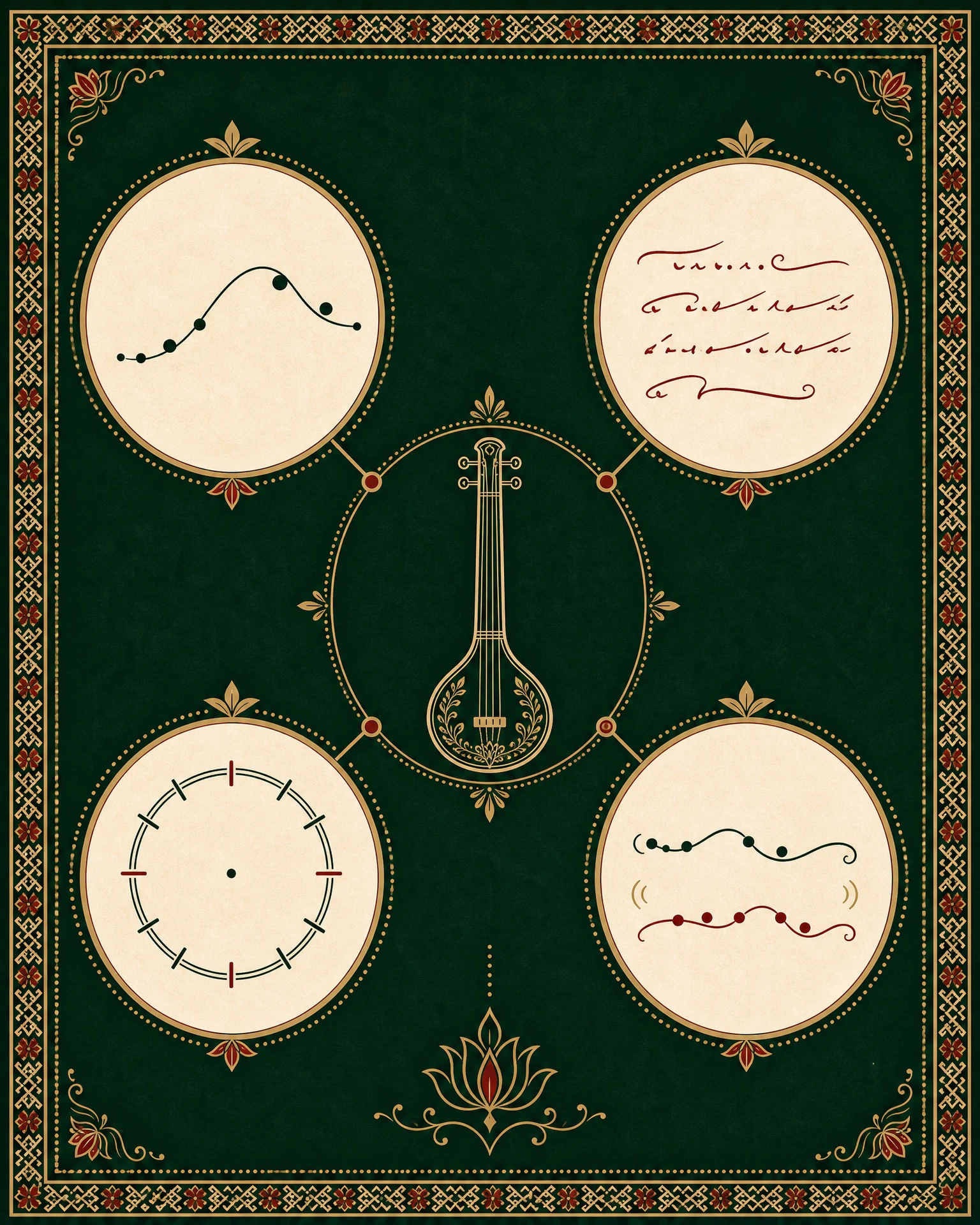
Introduction to Manodharma Sangeetha
Manodharma Sangeetha represents the creative zenith of the South Indian classical tradition. It is the art of spontaneous musical creation, where a performer generates new melodic and rhythmic patterns within the established framework of a Raga and Tala. The term itself is derived from the Sanskrit words "Manas," meaning mind, and "Dharma," meaning nature or duty. This etymology suggests music that originates from the creative impulses and the inherent nature of the artist's mind. Unlike pre-composed works, Manodharma is born in the moment of performance, making every concert a unique experience that cannot be replicated exactly. ref-1
In the context of a standard Carnatic performance, Manodharma is not a chaotic or random exercise. It is a highly disciplined form of expression governed by strict musicological rules known as Lakshana. A musician must possess a deep understanding of the Raga's characteristics, including its ascending and descending scales, its characteristic phrases, and the specific notes that carry emotional weight. This mastery allows the performer to explore the vast landscape of a Raga without deviating from its essential identity. For a listener, understanding Manodharma is key to appreciating how to listen to Carnatic music and recognizing the skill required to balance tradition with innovation. ref-2
The historical evolution of Manodharma as a formalized concept gained significant momentum in the early 20th century. While improvisational elements have always been part of Indian music, scholars like P. Sambamurthy helped categorize these practices into a unified musicological framework. Today, Manodharma is recognized as the element that breathes life into the classical repertoire, transforming a static composition into a dynamic dialogue between the artist, the tradition, and the audience. The transition from the temple and court environments to the modern concert stage has further emphasized the role of Manodharma as a primary measure of a musician's artistic caliber. ref-1
When a listener encounters Manodharma, they are witnessing the performer's ability to navigate the complex boundaries of a Raga in real time. This process is not just about technical skill but also about emotional depth. The musician seeks to evoke a specific Rasa, or aesthetic mood, through the spontaneous arrangement of notes and rhythms. This emotional connection is what makes a live performance so powerful, as the audience shares in the discovery of new musical ideas as they unfold. The spontaneity of Manodharma ensures that the music remains a living, breathing art form rather than a museum piece. ref-5
The significance of Manodharma extends beyond the performer to the entire ensemble. The accompanying violinist and percussionists must be equally adept at responding to the lead artist's creative choices. This interplay creates a collaborative environment where musical ideas are exchanged and expanded upon. For the audience, this dialogue is one of the most exciting aspects of a Carnatic concert. It requires the listener to be attentive and engaged, following the subtle shifts in melody and rhythm that characterize a masterly improvisation. ref-4
Furthermore, Manodharma serves as a bridge between the ancient traditions and the contemporary aesthetic. While the core principles remain rooted in centuries-old musicology, each generation of musicians brings their own unique perspective and creative innovations to the art. This continuous evolution ensures that Carnatic music remains relevant and vibrant in a changing world. By exploring the infinite possibilities within the framework of Raga and Tala, musicians continue to push the boundaries of what is possible in classical improvisation. ref-1
For the aspiring student, the introduction to Manodharma begins with a solid foundation in pre-composed music. Only after mastering the intricacies of the Kalpita repertoire can a musician hope to venture into the realm of spontaneous creation. This training process involves not just learning the notes but also internalizing the aesthetic values and the "grammar" of the tradition. The ability to improvise is seen as the ultimate test of a musician's maturity and their understanding of the art form's deepest principles. ref-3
Ultimately, Manodharma Sangeetha is a celebration of human creativity and the power of the musical imagination. It invites both the performer and the listener to explore the depths of the Raga, uncovering new layers of beauty and meaning with every performance. As we read more closely into the specific forms of Manodharma, such as Alapana, Tanam, and Niraval, we will see how each contributes to the rich and multifaceted experience of a Carnatic concert. ref-2
The Duality of Carnatic Music: Kalpita vs. Manodharma
To understand the role of improvisation, one must first recognize the fundamental duality of Carnatic music: the distinction between Kalpita Sangeetha and Manodharma Sangeetha. Kalpita Sangeetha refers to music that has been pre-composed, taught, and memorized. This includes foundational exercises, Varnams, and the vast repertoire of Kritis composed by great masters like the Trinity of Carnatic music. These compositions provide the structural foundation and the aesthetic vocabulary that a musician must master before attempting to improvise. ref-3
Manodharma Sangeetha, on the other hand, is the extemporaneous creation of music during a performance. It is often described as "unbound" music (Anibaddha Sangeetha) when it lacks a fixed meter, or as a creative elaboration of "bound" music (Nibaddha Sangeetha) when it is integrated with a composition. The relationship between these two forms is symbiotic. A well-composed Kriti serves as the anchor for improvisational exploration, while Manodharma provides the space for the artist to showcase their individual creativity and technical prowess. ref-4
The interaction between Kalpita and Manodharma is what gives a Carnatic concert its unique structure. A typical performance alternates between these two modes, creating a sense of balance and variety. The fixed lines of a composition provide a sense of familiarity and continuity, while the improvisational sections offer surprise and innovation. This duality allows the musician to demonstrate both their respect for tradition and their own creative voice. ref-5
In the learning process, Kalpita Sangeetha serves as the essential primer. A student spends years practicing Gitas, Jatiswarams, and Varnams to build a robust melodic and rhythmic vocabulary. These pre-composed pieces are like blueprints that teach the student the characteristic movements and ornaments of different Ragas. Without this foundation, any attempt at Manodharma would lack the necessary depth and musicological integrity. ref-3
| Feature | Kalpita Sangeetha | Manodharma Sangeetha |
|---|---|---|
| Origin | Pre-composed by a Vaggeyakara (composer) | Spontaneously created by the performer |
| Nature | Fixed and repeatable across different performances | Fluid and unique to each specific performance |
| Learning | Taught through oral tradition and notation | Developed through experience and Raga knowledge |
| Function | Preserves the tradition and specific compositions | Explores the creative potential of Ragas and Talas |
| Rhythmic State | Usually bound by a fixed Tala cycle | Can be unmetered (Alapana) or metered (Niraval) |
| Syllabic Content | Fixed lyrics (Sahitya) or solfa syllables | Spontaneous syllables or melodic variations of text |
| Examples | Gitas, Varnams, Kritis, Suladis | Alapana, Tanam, Niraval, Kalpanaswaram |
This table highlights the complementary roles of the two forms. While Kalpita Sangeetha ensures the preservation of the musical heritage, Manodharma Sangeetha allows for its continuous renewal and personal expression. The ability to transition seamlessly between these two states is a hallmark of a professional musician. It requires not only technical skill but also a deep aesthetic sensitivity to the mood and requirements of each section. ref-5
Historical records suggest that the balance between Kalpita and Manodharma has shifted over time. In earlier periods, the emphasis was often on the preservation of sacred compositions. However, as the concert format evolved in the 20th century, the role of improvisation expanded, allowing musicians more freedom to showcase their individual artistry. This shift has led to the development of highly sophisticated improvisational forms that are now the centerpiece of modern Carnatic performances. ref-1
The listener's role is also shaped by this duality. A seasoned rasika (connoisseur) appreciates the nuances of a well-rendered Kriti, but they also eagerly anticipate the performer's creative insights during the Alapana or Niraval. The tension and resolution between the fixed and the fluid elements are what make the music so engaging. By understanding this fundamental structure, a listener can better appreciate the layers of meaning and skill involved in a performance. ref-4
Moreover, the distinction between "bound" and "unbound" music is not always absolute. Even within a pre-composed Kriti, a musician may introduce subtle variations or ornaments that reflect their own creative style. Conversely, even the most spontaneous Alapana is guided by the rigid rules of the Raga. This overlap highlights the deep integration of tradition and innovation in Carnatic music. The duality is not a division but a dynamic relationship that fuels the art form's creative energy. ref-2
For the musician, the challenge lies in maintaining the integrity of the composition while exploring the possibilities of improvisation. A master performer knows how to use Manodharma to enhance the beauty of a Kriti without overshadowing its original intent. This sense of proportion and aesthetic judgment is a key part of the musician's training and experience. It ensures that the performance remains a cohesive and meaningful musical journey for the audience. ref-5
In conclusion, the duality of Kalpita and Manodharma is the engine that drives the Carnatic musical tradition. It provides a framework that allows for both the preservation of a rich heritage and the expression of individual creativity. As we move forward to explore the specific pillars of Manodharma, we will see how these two forms interact to create the complex and beautiful range of a Carnatic concert. ref-3
Raga Alapana: The Unmetered Melodic Canvas
Raga Alapana is perhaps the most recognizable form of Manodharma. It is a melodic improvisation that explores the nuances of a Raga without the constraints of a rhythmic cycle (Tala) or lyrical text. Because it is unmetered, it falls under the category of Anibaddha Sangeetha, or "unbound" music. The primary goal of an Alapana is to establish the Raga Swarupa, which is the unique melodic identity and emotional essence of the Raga, through a systematic and creative exposition. This form allows the musician the greatest freedom to explore the melodic possibilities of a Raga, unencumbered by the demands of rhythm or language. ref-6
The structure of an Alapana typically follows a logical and time-honored progression through the three octaves, known as Sthayis. It begins with a brief introduction called Akshiptika, which serves to set the mood and introduce the Raga's basic scale and characteristic phrases. The musician then moves into the Ragavardhani, the main body of the elaboration. This section is often divided into several stages, where the performer explores the Raga in the lower (Mandra), middle (Madhya), and higher (Tara) registers. Each stage focuses on specific Jiva Swaras, the life-giving notes, and Nyasa Swaras, the resting notes, that define the Raga's character. ref-3
During the Ragavardhani, the musician uses a variety of melodic movements to bring out the Raga's personality. This includes the use of Gamakas, or ornaments, which are essential for creating the distinctive sound of each Raga. The performer might linger on a particular note, exploring its different shades and textures, or execute rapid, cascading phrases that showcase the Raga's range. The transition between the different registers is handled with care, ensuring a smooth and aesthetically pleasing progression that builds a musical narrative. ref-5
Vocalists perform Alapana using specific non-lexical syllables such as "aa" (Akara), "ee" (Ikara), and "uu" (Ukara), as well as phrases like "tana," "na," and "ri." These syllables are chosen for their phonetic properties, allowing the singer to articulate complex melodic ornaments without the distraction of linguistic meaning. The use of these syllables is a formalized practice that helps the singer maintain the focus on the melody. In instrumental music, the performer uses the specific techniques of their instrument to achieve a similar effect, focusing on the Raga's melodic contours and ornaments. ref-1
The role of the accompanying violinist is crucial during the Alapana. In a standard concert format, the lead artist and the violinist engage in a call and response dialogue. After the lead artist completes a section of the Alapana, the violinist responds with their own interpretation of the same phrases. This interaction not only provides a melodic contrast but also allows the lead artist a moment to rest and plan their next movement. The violinist's response is not a mere imitation but a creative expansion that adds to the overall depth of the exposition. ref-4
As the Alapana reaches its climax, the performer enters the Makarini section. Here, the musician synthesizes the Raga's essence through rapid, multi-octave phrases known as Sancharis. These phrases are designed to showcase the performer's technical virtuosity and their comprehensive understanding of the Raga's possibilities. The Makarini section builds a sense of excitement and fulfillment, leading the audience toward the resolution of the improvisation. The Alapana finally concludes by returning to the tonic note, the Shadja, leaving the listener with a complete and satisfying picture of the Raga. ref-1
For the listener, following an Alapana requires a different kind of attention than listening to a pre-composed song. One must be sensitive to the subtle shifts in melody and the emotional atmosphere that the musician is creating. Understanding the Raga's basic structure can help, but the true appreciation comes from experiencing the spontaneous flow of ideas. A successful Alapana is one that not only demonstrates technical mastery but also touches the heart of the listener, evoking the specific Rasa that the Raga is intended to convey. ref-2
/manus-storage/journal-manodharma-pillar-map_94f1c0c0.png
| Alapana Stage | Purpose | Key Features |
|---|---|---|
| Akshiptika | Introduction | Sets the mood, introduces the Raga's basic scale and phrases. |
| Ragavardhani | Main Elaboration | Systematic exploration of the Raga across the Mandra, Madhya, and Tara Sthayis. |
| Vidari | Phrasing and Pauses | The use of resting notes (Nyasa Swaras) to create melodic structure. |
| Sancharis | Melodic Movements | Complex and rapid phrases that showcase the Raga's dynamic range. |
| Makarini | Synthesis | The final, high-speed synthesis of the Raga's essence before resolution. |
This systematic approach ensures that the Alapana is not just a collection of random notes but a well-structured musical journey. Each stage builds upon the previous one, creating a comprehensive and aesthetically satisfying portrait of the Raga. For those interested in how to recognize a raga, the Alapana is the best place to start, as it provides a clear and detailed exposition of the Raga's unique characteristics. ref-3
Listening Prompt: When listening to an Alapana, try to identify the moment the musician moves from the middle register to the higher register. Notice how the energy of the performance shifts and how the violinist responds to these higher-pitched phrases. This transition is often a key emotional turning point in the exposition. ref-5
The historical development of Alapana can be traced back to the ancient Prabandha forms of Indian music. Over centuries, it has evolved from a relatively simple introduction into the highly sophisticated and expansive form we hear today. Scholars like P. Sambamurthy have noted that the Alapana is the ultimate test of a musician's creative imagination, as it requires the ability to generate endless variations within the strict confines of the Raga's grammar. This balance between freedom and discipline is what makes Alapana a unique and enduring feature of the Carnatic tradition. ref-1
In contemporary performances, the length and complexity of an Alapana can vary significantly depending on the Raga and the context of the concert. A major Raga like Shankarabharanam or Kalyani might be given an Alapana lasting twenty minutes or more, while a minor Raga might be explored in a few minutes. Regardless of its length, the goal remains the same: to reveal the Raga's beauty and emotional depth to the audience. This commitment to the Raga's essence is what distinguishes a truly great Alapana from a merely technical one. ref-2
The aesthetic principles of Alapana also emphasize the importance of proportion and balance. A musician must know when to linger on a note and when to move forward, when to use complex ornaments and when to favor simple, clear phrases. This sense of "Auchitya," or appropriateness, is developed through years of listening and practice. It ensures that the Alapana remains a meaningful and focused exploration of the Raga rather than a self-indulgent display of technique. ref-5
Ultimately, Raga Alapana is a profound meditation on the nature of melody. It invites both the performer and the listener to step outside the constraints of time and language and immerse themselves in the pure sound of the Raga. In the hands of a master, an Alapana can be a transformative experience, uncovering new dimensions of beauty and emotion in even the most familiar Ragas. It remains the foundation upon which all other forms of Manodharma are built. ref-6
Tanam: Rhythmic Pulsation without Tala
Tanam is a unique improvisational form that serves as a bridge between the free-flowing Alapana and the metered sections of a performance. While it does not follow a formal Tala cycle, it possesses a distinct rhythmic pulse or "ghana," meaning density. The term Tanam is said to be derived from the word "Anantam," meaning infinite, and the syllables used in Tanam, such as "ta," "nam," "tam," and "a-nam-tam," are traditionally associated with this concept. This syllabic structure is not merely phonetic; it is believed to represent the eternal nature of the divine, grounding the rhythmic exploration in a spiritual and philosophical context. ref-5
In a Tanam, the musician creates rhythmic patterns by varying the speed and accentuation of melodic phrases. This creates a sense of momentum and energy that distinguishes it from the meditative and expansive quality of an Alapana. Tanam is most commonly heard as the second movement in a Ragam-Tanam-Pallavi (RTP) presentation, where it builds the necessary rhythmic tension before the introduction of the Pallavi line and the formal Tala. The transition from the unmetered Alapana to the pulsating Tanam is one of the most sophisticated and aesthetically pleasing sequences in a Carnatic concert. ref-2
The rhythmic sense in Tanam is internal rather than external. There is no percussion accompaniment, such as the Mridangam or Ghatam, during this section. This absence of an external beat allows the lead performer to dictate the pace and flow, shifting between different speeds (Kalas) and rhythmic groupings without being bound by a fixed cycle. The performer might explore a "Jod" style, where the rhythm is more pronounced, or a "Khali" style, where the melody is more fluid. This internal rhythm requires a high degree of concentration and a keen sense of timing from the musician. ref-3
Instrumentalists, particularly Veena players, have a long and rich tradition of Tanam performance. The Veena's ability to sustain notes through rapid plucking and its specific rhythmic capabilities make it an ideal instrument for this form. In the Vainika tradition, Tanam is often categorized into different "ghana" styles, such as the "Manava" (human), "Ashva" (horse), and "Gaja" (elephant) styles, each reflecting a different rhythmic quality and pace. These categories help the musician structure their improvisation and provide a framework for rhythmic innovation. ref-2
The syllables used in Tanam are not just meaningless sounds; they are carefully chosen to facilitate the rhythmic flow. The repetition of "ta," "nam," and "tam" creates a percussive effect that mimics the sound of a drum, even in the absence of one. This allows the singer to build complex rhythmic structures that would be difficult to achieve with the "aa" and "ee" syllables used in Alapana. The use of these syllables is a specialized skill that requires training in both melody and rhythm. ref-1
| Tanam Syllable | Symbolic Association | Rhythmic Function |
|---|---|---|
| Ta | Stability | Acts as a rhythmic anchor or start of a phrase. |
| Nam | Continuity | Provides a smooth transition between melodic ideas. |
| Tam | Resolution | Used to mark the end of a rhythmic grouping. |
| A-nam-tam | Infinity | Represents the expansive and eternal nature of the music. |
This table illustrates how the syllables contribute to the rhythmic architecture of the Tanam. By strategically using these sounds, the musician can create a sense of pulse and drive that prepares the audience for the metered sections of the performance. The internal logic of these syllables is a key part of the "grammar" of Tanam. ref-5
Listeners can identify Tanam by its characteristic "thrumming" sound and the repetitive use of the specific syllables mentioned earlier. It often evokes a sense of grandeur and majesty, particularly when performed in Ragas like Todi, Shankarabharanam, or Kalyani. The mastery of Tanam requires not only melodic precision but also a keen sense of internal rhythm and the ability to maintain a steady pulse while executing complex melodic variations. It is evidence of the performer's ability to create structure out of fluidity, preparing the audience for the mathematical and rhythmic challenges of the metered sections that follow. ref-4
The interaction between the lead performer and the violinist during Tanam is also unique. Unlike the long solo responses in Alapana, the violinist typically follows the lead artist more closely, often responding to shorter phrases in a rapid exchange. This creates a sense of building excitement and energy as the two musicians weave their rhythmic patterns together. The violinist must be highly responsive to the lead artist's shifts in tempo and rhythmic groupings, making this a challenging and rewarding part of the concert for both performers. ref-3
Listening Prompt: During a Tanam, listen for the way the musician shifts between different speeds. You might hear a section that feels slow and deliberate, followed by a sudden burst of rapid, rhythmic phrases. Notice how the musician maintains the pulse throughout these changes, even without a drummer to keep time. This mastery of internal rhythm is the core of a great Tanam. ref-5
The historical roots of Tanam are closely tied to the development of the Veena and the Vainika tradition in South India. It was originally a form of instrumental improvisation that was later adapted for vocal music. The influence of the Veena can still be heard in the way vocalists approach Tanam, with its emphasis on rhythmic plucking and percussive syllables. This cross-pollination between instrumental and vocal styles has enriched the Carnatic tradition, leading to the development of the highly sophisticated Tanam we hear today. ref-1
In the context of a Ragam-Tanam-Pallavi, the Tanam serves as a vital emotional and structural link. It moves the performance from the meditative, unmetered space of the Alapana into the dynamic, rhythmic world of the Pallavi. By building rhythmic tension and energy, the Tanam ensures that the introduction of the Tala and the percussion instruments feels like a natural and exciting progression. It is a masterful example of how Carnatic music uses different forms of Manodharma to build a complex and satisfying musical narrative. ref-4
The aesthetic of Tanam also emphasizes the concept of "Laya," or rhythmic flow. A good Tanam should feel effortless and natural, with the rhythm emerging organically from the melody. The musician must avoid making the rhythm feel mechanical or forced, instead focusing on the "ghana" or density of the phrases. This balance between melodic beauty and rhythmic drive is what makes Tanam a unique and compelling form of improvisation. ref-2
In conclusion, Tanam is evidence of the sophistication of the Carnatic rhythmic system. It demonstrates that rhythm can exist and thrive even without a formal meter or percussion accompaniment. By exploring the infinite possibilities of internal pulse and syllabic patterns, musicians continue to showcase the creative potential of this unique form. As a bridge between the unmetered and the metered, Tanam remains an essential and exciting part of the Manodharma repertoire. ref-5
Niraval: Melodic Expansion of the Sahitya
Niraval, also known as Sahitya Vinyasa, is a sophisticated form of improvisation that focuses on a specific line of lyrics, or Sahitya, from a composition. Unlike the unmetered Alapana or the pulsating Tanam, Niraval is strictly bound by the rhythmic cycle, or Tala. The performer's primary challenge is to create new melodic variations of the chosen line while ensuring that the lyrics remain phonetically intact and that the rhythmic starting point, known as the Eduppu, is strictly maintained. This form represents a unique intersection of musical creativity and linguistic artistry, requiring the musician to be as sensitive to the meaning and sound of the words as they are to the melody and rhythm. ref-2
The term Niraval comes from the Tamil word "nirappu," which means "to fill." In this context, the musician is "filling" the rhythmic cycle with melodic and rhythmic creativity. A successful Niraval requires a delicate balance between innovation and precision. The performer must ensure that the emotional essence, or Bhava, of the lyrics is enhanced and not obscured by the improvisation. This requires a deep understanding of the language in which the composition is written, as well as the aesthetic requirements of the Raga and Tala. ref-5
The process of selecting a line for Niraval is an art in itself. Musicians typically choose a line that has significant emotional or spiritual weight and offers enough melodic and rhythmic space for exploration. The chosen line must also have a clear Eduppu, which is the specific point within the Tala cycle where the lyrics begin. Maintaining this Eduppu throughout the improvisation is a fundamental rule of Niraval, as it ensures that the variations remain anchored to the original structure of the composition. ref-3
Niraval typically progresses through different speeds, or Kalas, to build musical tension and excitement. It often begins in the Vilamba Kala, the slow tempo, where the focus is on exploring the melodic nuances and the emotional weight of each word. In this phase, the musician uses expansive and meditative phrases to reveal the deeper layers of the Raga and the Sahitya. As the improvisation progresses, the musician moves into the Madhyama Kala, the medium tempo, and sometimes the Durita Kala, the fast tempo. In these faster sections, the rhythmic complexity increases, and the performer executes more rapid and intricate variations. ref-2
The interaction between the lead performer and the violinist is particularly dynamic during Niraval. They engage in a call and response dialogue, where the lead artist presents a variation and the violinist immediately responds with their own interpretation. This exchange builds a sense of collaboration and shared creative exploration. The violinist must not only follow the melody but also be perfectly in sync with the rhythmic cycle and the Eduppu of the lyrics. This collaborative effort is a key part of the carnatic accompaniment guide and is essential for a successful Niraval presentation. ref-4
One of the most challenging aspects of Niraval is the requirement to keep the lyrics phonetically intact. The musician must avoid breaking words in a way that changes their meaning or makes them unrecognizable. This "musicolinguistic" artistry requires the performer to be mindful of the syllables and their placement within the melodic phrases. The goal is to make the variations feel like a natural extension of the original line, as if the lyrics themselves are evolving through the music. ref-2
| Niraval Element | Role in Performance | Aesthetic Goal |
|---|---|---|
| Sahitya (Lyrics) | The Foundation | Preserves the meaning and emotional essence of the line. |
| Eduppu (Starting Point) | The Rhythmic Anchor | Ensures the variations remain within the Tala framework. |
| Arudhi (Punctuation) | The Structural Marker | Provides a point of resolution within the rhythmic cycle. |
| Kala (Tempo) | The Dynamic Driver | Builds tension and excitement through speed variations. |
| Bhava (Emotion) | The Soul | Connects the musical variations to the lyrical sentiment. |
This table outlines the key elements that a musician must balance during a Niraval. Each element plays a vital role in ensuring that the improvisation is both technically sound and aesthetically meaningful. The mastery of these elements is what distinguishes a professional Niraval from a basic one. ref-5
For the listener, following a Niraval is a rewarding way to engage with the intersection of text and melody. One should try to identify the specific line being elaborated and notice how the musician returns to the Eduppu at the end of each variation. This sense of return provides a feeling of stability and resolution amidst the creative exploration. As the tempo increases, the listener can appreciate the performer's ability to maintain rhythmic precision while executing complex melodic patterns. ref-4
Listening Prompt: When a musician starts a Niraval, pay close attention to the first beat of the Tala cycle. Notice where the lyrics begin in relation to that beat. As the variations become more complex and faster, try to see if you can still hear that same starting point. This "internal clock" is what keeps the musician and the accompanists together. ref-5
The historical significance of Niraval is rooted in the Haridasa tradition of Karnataka, where short compositions like Ugabhogas and Suladis were used for spiritual and ethical instruction. These forms emphasized the importance of the Sahitya and provided a foundation for the melodic and rhythmic elaboration of sacred texts. Over time, these practices were integrated into the broader Carnatic tradition, leading to the development of Niraval as a formalized improvisational form. The influence of these early traditions can still be seen in the spiritual and emotional focus of modern Niraval performances. ref-6
In a contemporary concert, Niraval is often performed during the main composition of the evening. It serves as a bridge between the fixed lines of the Kriti and the purely syllabic improvisation of the Kalpanaswaram. By focusing on the lyrics, Niraval ensures that the emotional message of the composition remains central to the performance, even as the musician explores new creative territory. This commitment to the Sahitya is what gives Niraval its unique character and aesthetic appeal. ref-2
The technical challenges of Niraval are also significant. The musician must be able to think several cycles ahead, planning their variations to ensure they resolve perfectly on the Eduppu. This requires not only melodic imagination but also a high degree of mathematical and rhythmic control. The ability to execute complex variations while keeping the lyrics clear and the rhythm steady is evidence of the performer's skill and experience. ref-3
Ultimately, Niraval is a celebration of the power of language and music combined. It demonstrates how a single line of text can be transformed into a vast and beautiful musical landscape through the power of Manodharma. By honoring the lyrics while exploring the possibilities of the Raga and Tala, musicians continue to showcase the rich and multifaceted nature of the Carnatic tradition. It remains one of the most intellectually and emotionally satisfying forms of improvisation in the repertoire. ref-5
Kalpanaswaram: Mathematical and Melodic Swara Play
Kalpanaswaram is the improvisational form where the performer uses the solfa syllables, or Swaras (Sa, Ri, Ga, Ma, Pa, Dha, Ni), to create spontaneous melodic and rhythmic patterns. Like Niraval, Kalpanaswaram is metered and anchored to a specific point in a composition, usually the Pallavi, Anupallavi, or Charanam of a Kriti. After each sequence of swaras, the musician must return seamlessly to the chosen line of the song, resolving the improvisation at the Eduppu. This form allows the musician to showcase their technical virtuosity, their understanding of Raga grammar, and their command over complex rhythmic calculations. ref-1
The performance of Kalpanaswaram typically involves a structured transition from Sarvalaghu to Kanakku. Sarvalaghu refers to natural, flowing melodic phrases that adhere to the Raga's grammar without overly complex rhythmic calculations. In this phase, the focus is on melodic beauty and the effortless flow of the Raga. The musician creates phrases that feel like a natural extension of the composition, emphasizing the Raga's characteristic movements and ornaments. This stage is often meditative and expansive, allowing the listener to soak in the Raga's atmosphere. ref-2
As the improvisation progresses and the tempo increases, the musician introduces Kanakku, which involves mathematically calculated patterns. These patterns might include variations in the number of notes per beat, the use of specific rhythmic shapes known as Yatis, or the construction of complex sequences that challenge the listener's rhythmic perception. The Kanakku phase is a display of intellectual and technical prowess, where the musician weaves intricate mathematical puzzles into the melodic range of the Raga. ref-5
A sequence of Kalpanaswarams usually culminates in a Korvai, which is a structured rhythmic pattern repeated three times. The Korvai is a climax of both melody and math, designed to resolve precisely on the Eduppu or the Samam, the first beat of the Tala cycle. The successful execution of a Korvai requires the lead performer and the accompanists to be in perfect sync, as any error in calculation can lead to a rhythmic misalignment. The Korvai is one of the most exciting moments in a Carnatic concert, as the audience anticipates the final resolution of the complex patterns. ref-3
The interaction between the main performer and the violinist is particularly dynamic during Kalpanaswaram. They often engage in a call and response format, where the singer presents a phrase and the violinist immediately repeats or expands upon it. As the swara sequences become shorter and faster, this dialogue becomes more intense, building musical tension and excitement. The violinist must be highly responsive to the lead artist's creative cues, matching their melodic and rhythmic complexity in real time. ref-4
The percussionists, particularly the Mridangam player, also play a vital role during Kalpanaswaram. They provide the rhythmic foundation and often engage in their own improvisational dialogue with the lead artist. During the Kanakku phase, the percussionists must be able to anticipate and support the complex rhythmic patterns that the musician is creating. The final Korvai is a collaborative effort, with the entire ensemble working together to achieve a precise and powerful resolution. ref-3
| Kalpanaswaram Phase | Primary Focus | Rhythmic Character |
|---|---|---|
| Sarvalaghu | Melodic Beauty | Natural, flowing, and intuitive pulse. |
| Kanakku | Mathematical Logic | Calculated, intricate, and challenging patterns. |
| Korvai | Climax and Resolution | Structured, repetitive, and precise finale. |
| Ragamalika Swaras | Melodic Variety | Transitioning through multiple Ragas during the play. |
This table illustrates the progression of a Kalpanaswaram presentation. By moving from the intuitive flow of Sarvalaghu to the calculated complexity of Kanakku and finally to the structured resolution of the Korvai, the musician creates a compelling and dynamic musical narrative. This structure is a key part of the how a carnatic kutcheri works and is a highlight of many performances. ref-5
For the listener, following Kalpanaswaram is a great way to engage with the rhythmic architecture of the music. One can try to identify the different rhythmic shapes and patterns that the musician is creating and anticipate the final resolution of the Korvai. The sense of excitement and satisfaction that comes from a perfectly executed Korvai is one of the unique pleasures of listening to Carnatic music. It showcases the performer's ability to think several cycles ahead, weaving complex mathematical puzzles into a beautiful melodic range. ref-4
Listening Prompt: As the Kalpanaswaram section progresses, listen for the moments when the phrases become shorter and the exchange between the singer and the violinist becomes faster. This is a sign that the performance is building toward a Korvai. Try to count the three repetitions of the final pattern to see if you can land on the first beat of the next cycle along with the musicians. ref-5
The historical development of Kalpanaswaram is closely linked to the evolution of the Kriti and the concert format. While solfa syllables have always been part of Indian music, their use in spontaneous improvisation became more formalized in the 19th and 20th centuries. Musicians like the Trinity of Carnatic music paved the way by including pre-composed swara sections, known as Chittai Swaras, in their Kritis. These pre-composed sections provided a model for the spontaneous Kalpanaswarams that modern musicians perform today. ref-1
In a contemporary RTP, Kalpanaswaram is often the final and most elaborate form of improvisation. It allows the musician to pull together all the melodic and rhythmic ideas they have explored throughout the performance into a grand finale. The use of Ragamalika, where the performer transitions through multiple Ragas during the swara play, adds another layer of complexity and beauty to the presentation. This synthesis of melody, rhythm, and mathematics is what makes Kalpanaswaram a pinnacle of the Manodharma tradition. ref-4
The aesthetic of Kalpanaswaram also emphasizes the concept of "Sowkhyam," or musical well-being. Even in the most complex Kanakku sections, the musician must maintain a sense of ease and melodic beauty. The math should never overshadow the melody, and the performance should always feel like a cohesive musical statement. This balance is achieved through years of practice and a deep understanding of the Raga's emotional essence. ref-2
In conclusion, Kalpanaswaram is a brilliant display of the intellectual and creative depth of Carnatic music. It demonstrates how simple solfa syllables can be used to create a vast and intricate world of melody and rhythm. By exploring the infinite possibilities of swara patterns and mathematical structures, musicians continue to push the boundaries of what is possible in classical improvisation. As a climax to the Manodharma repertoire, Kalpanaswaram remains an essential and thrilling part of the Carnatic experience. ref-5
Ragam-Tanam-Pallavi (RTP): The Pinnacle of Creative Expression
Ragam-Tanam-Pallavi, commonly referred to as RTP, is the most elaborate and sophisticated form of Manodharma in a Carnatic concert. It is often considered the centerpiece of a performance, where the musician showcases their complete mastery over melody, rhythm, and spontaneous creation. The RTP is a multi-movement presentation that synthesizes all the pillars of improvisation into a single, cohesive masterpiece. It allows the performer to explore a single Raga in extraordinary depth, moving from the unmetered Alapana to the pulsating Tanam and finally to the metered Pallavi. ref-4
The Pallavi is the heart of the RTP. It is a single line of lyrics, often composed by the performer themselves, which serves as the foundation for extensive improvisation. A Pallavi is characterized by three essential elements: Pada (words), Laya (rhythm), and Vinyasam (variations). The line is typically divided into two halves by a rhythmic punctuation point called the Arudhi. The performer explores the Pallavi through various techniques, including Niraval and Kalpanaswaram, stretching the single line into a vast musical landscape. ref-6
The composition of a Pallavi requires a deep understanding of both music and literature. The lyrics are usually short and focused, often in Sanskrit, Telugu, Tamil, or Kannada, and are designed to fit perfectly within a specific Tala cycle. The musician must ensure that the Eduppu, the starting point, and the Arudhi are clearly defined and provide enough space for creative elaboration. A well-composed Pallavi is like a seed that contains the potential for an entire musical universe. ref-5
One of the most challenging and exciting aspects of an RTP is Trikalam. In this section, the performer executes the Pallavi at different speeds while the Tala tempo remains constant. This typically involves doubling (Anuloma) and quadrupling (Pratiloma) the speed of the lyrics, and sometimes even halving it. Trikalam requires extraordinary rhythmic control, mental focus, and a deep internal sense of the Tala. It is a display of the musician's ability to navigate complex rhythmic transformations without losing the pulse or the integrity of the lyrics. ref-4
Following the Trikalam, the musician often embarks on a Ragamalika section. Here, the performer transitions through multiple Ragas during the improvisation, creating a "garland of Ragas." This adds a new dimension of melodic variety and beauty to the RTP. The musician might perform Niraval or Kalpanaswaram in each of the chosen Ragas, eventually returning to the main Raga of the RTP for the final resolution. This transition requires a high degree of melodic sensitivity and the ability to shift between different Raga grammars seamlessly. ref-1
| RTP Movement | Musical Nature | Rhythmic Framework |
|---|---|---|
| Ragam (Alapana) | Melodic Exploration | Unmetered (Anibaddha) |
| Tanam | Rhythmic Pulsation | Internal Pulse (Ghana) |
| Pallavi (Line) | Lyrical Foundation | Metered (Nibaddha) |
| Niraval | Melodic Variations | Metered, focused on lyrics. |
| Trikalam | Speed Variations | Metered, complex rhythmic play. |
| Kalpanaswaram | Syllabic Play | Metered, mathematical climax. |
| Ragamalika | Melodic Variety | Metered, multiple Ragas. |
This table provides a roadmap of a typical RTP presentation. By moving through these different movements, the musician builds a complex and satisfying musical narrative that showcases the full range of their creative abilities. The RTP is the ultimate test of a musician's artistry and their commitment to the Carnatic tradition. ref-5
For the listener, an RTP is a journey of discovery. One should try to follow the progression from the free-flowing Alapana to the structured Pallavi and appreciate the performer's skill in navigating the various rhythmic and melodic challenges. The Trikalam and Ragamalika sections are often the highlights of the performance, offering moments of technical brilliance and melodic surprise. A successful RTP leaves the audience with a profound sense of the Raga's beauty and the musician's creative vision. ref-4
Listening Prompt: When the musician begins the Pallavi, try to identify the Arudhi, the rhythmic pause in the middle of the line. Notice how the musician returns to this point after each variation. During the Trikalam, pay attention to how the speed of the words changes while the underlying beat of the Tala remains the same. This contrast is the key to appreciating the rhythmic complexity of the RTP. ref-5
The historical evolution of RTP is closely tied to the development of the concert format in the 19th and 20th centuries. It emerged as a way for musicians to demonstrate their scholarship and their ability to handle the most complex aspects of the tradition. In the past, RTPs were often marathon performances lasting several hours, with musicians competing to showcase their technical and creative prowess. While modern RTPs are typically shorter, they remain the most prestigious and challenging part of the Carnatic repertoire. ref-1
The collaborative nature of RTP is also worth noting. The accompanying violinist and percussionists must be highly skilled and responsive to the lead artist's creative choices throughout the entire presentation. The dialogue between the lead artist and the violinist during the Alapana and Tanam, and the interaction with the percussionists during the Pallavi and Kalpanaswaram, are essential for a successful RTP. This collective exploration of the musical landscape is what makes a live RTP performance so powerful and engaging. ref-4
Ultimately, Ragam-Tanam-Pallavi is a celebration of the infinite possibilities of the Raga and Tala. It demonstrates how a single musical idea can be expanded and transformed into a complex and beautiful masterpiece through the power of Manodharma. By synthesizing all the elements of the tradition into a single presentation, musicians continue to push the boundaries of what is possible in classical improvisation. It remains the pinnacle of the Carnatic musical experience. ref-5
The Grammar of Spontaneity: Rules and Training
While Manodharma is spontaneous, it is never arbitrary. It is governed by a set of rules and principles, known as Lakshana, that ensure the music remains within the classical aesthetic and musicological boundaries. This "grammar of spontaneity" is not something that can be learned overnight; it is the result of years of rigorous training, disciplined practice, and immersive listening. A student does not begin their musical journey with Manodharma; instead, they first spend years mastering the Kalpita repertoire, building a robust vocabulary of Raga phrases and rhythmic structures. ref-2
The training process for Manodharma is multifaceted and involves several critical stages of development. First is the acquisition of Raga Gnanam, or the deep, intuitive understanding of a Raga's personality. This is achieved through the repetitive practice of Varnams, which are like blueprints of a Raga, containing all its essential movements, ornaments, and characteristic phrases. By mastering a large number of Varnams in different Ragas, the student internalizes the Raga's grammar and begins to develop their own melodic imagination. ref-3
Second is Laya Gnanam, the mastery of rhythmic cycles and the ability to maintain a steady pulse even while executing complex improvisations. A musician must be able to "feel" the Tala internally, without needing to constantly look at their hands or a metronome. This is developed through the practice of rhythmic exercises and the study of complex compositions that challenge the student's sense of timing. The ability to maintain the Eduppu and navigate the rhythmic boundaries of the Tala is essential for any form of metered improvisation. ref-5
Observation and listening are equally important parts of the training process. Students are encouraged to closely listen to recordings and live performances of great masters to understand how they structure their improvisations, how they build musical narratives, and how they navigate the transitions between different forms of Manodharma. This immersion helps the student internalize the aesthetic standards of the tradition and learn the subtle nuances that cannot be taught through notation alone. ref-4
| Stage of Training | Primary Activity | Learning Outcome |
|---|---|---|
| Foundational | Practice of Gitas and Swarajatis. | Basic understanding of Swaras and simple Talas. |
| Intermediate | Mastery of Varnams and Kritis. | Acquisition of Raga Gnanam and melodic vocabulary. |
| Advanced | Study of RTP and complex Talas. | Development of Laya Gnanam and rhythmic control. |
| Improvisational | Guided Alapana and Niraval practice. | Development of spontaneous creative imagination. |
| Professional | Performance and immersive listening. | Refinement of aesthetic judgment and personal style. |
This table outlines the long and disciplined journey that a musician must undertake to master the art of Manodharma. Each stage builds upon the previous one, ensuring that the musician has the necessary technical and aesthetic foundation for spontaneous creation. The transition from a student to a performer is a gradual process of internalizing the rules and then learning how to transcend them through creativity. ref-5
The professional performer must also be aware of the aesthetic boundaries and the sense of proportion required in a concert setting. This concept of "Auchitya," or appropriateness, is an essential part of a musician's Manodharma. It involves knowing how to balance innovation with tradition, and complexity with clarity. For example, an Alapana should not be so long that it overshadows the main composition, and the rhythmic complexity of Kalpanaswaram should never come at the expense of melodic beauty. This sense of balance is what distinguishes a master performer. ref-2
Furthermore, the training in Manodharma involves a deep ethical and spiritual commitment. The musician is not just creating music for entertainment but is also engaging in a form of worship and self-expression. The goal is to evoke a specific Rasa in the listener and to connect with the divine through the power of sound. This spiritual dimension is what gives Carnatic music its depth and meaning and is a central part of the musician's journey. ref-1
In the modern era, the training process has also adapted to new technologies and learning environments. While the traditional Guru-Shishya Parampara remains the ideal, many students now supplement their training with online courses, recordings, and digital tools. These resources provide new ways to access the tradition and to study the work of great masters. However, the core principles of disciplined practice and immersive listening remain as important as ever. ref-5
Ultimately, the grammar of spontaneity is what allows Manodharma to thrive as a living art form. By providing a clear framework of rules and principles, the tradition ensures that the music remains grounded in its classical roots while allowing for infinite creative exploration. The journey of a musician is a continuous process of learning and discovery, as they seek to master the art of spontaneous creation and to share the beauty of the Raga with the world. ref-2
Boundary and Scope: What Manodharma is Not
To maintain the integrity of the Carnatic tradition, it is important to define the boundaries of Manodharma and clarify what it is not. While it is a form of improvisation, it is not "free jazz" or entirely unstructured creation. Every note, ornament, and rhythmic pulse must strictly adhere to the Lakshana of the chosen Raga and Tala. A performer cannot simply introduce notes that are foreign to the Raga's scale, known as Anya Swaras, unless those notes are specifically recognized as part of the Raga's traditional usage. The creative freedom in Manodharma exists within a well-defined framework. ref-6
Furthermore, Manodharma is not merely a display of speed or mathematical gimmicks. While technical virtuosity and the ability to execute rapid-fire swara patterns are admired, they must always serve the aesthetic and emotional purpose of the music. Improvisation that loses touch with the Raga's Bhava or the lyrics' meaning is considered aesthetically inferior. The goal is to evoke a specific Rasa in the listener, not just to impress them with technical feats. A musician who prioritizes math over melody is often said to be lacking in "Sowkhyam," or the sense of musical well-being. ref-1
Manodharma is also distinct from the Sangatis, or melodic variations, that are built into a Kriti. While Sangatis are often creative and beautiful, they are typically pre-composed parts of the song that have been passed down through the teacher-student lineage. In contrast, Manodharma is generated spontaneously in the moment of performance. While a musician may have practiced certain phrases or patterns, the way they are combined and presented is unique to that specific performance. This distinction is crucial for understanding the structure of a Carnatic concert. ref-2
Finally, Manodharma is a collaborative and conversational effort in a concert setting. It is not a solo act but a dialogue between the lead performer, the violinist, and the percussionists. They must work in harmony, responding to each other's creative cues and supporting the overall musical narrative. This interaction is not a competition but a collective exploration of the musical landscape. A successful performance is one where the accompanists enhance the lead artist's vision while contributing their own creative insights, all within the shared boundaries of the tradition. ref-4
| Feature | Manodharma Sangeetha | Pre-composed Variations (Sangatis) |
|---|---|---|
| Creation | Spontaneous in the moment. | Pre-planned by the composer or Guru. |
| Repeatability | Unique to each performance. | Fixed and repeatable. |
| Function | Explores new creative territory. | Enhances the beauty of the composition. |
| Ownership | The performer's creative voice. | The composer's original vision. |
This table clarifies the distinction between spontaneous improvisation and pre-composed variations. By understanding these boundaries, the listener can better appreciate the different layers of creativity involved in a Carnatic performance. The interplay between the fixed and the fluid is what gives the music its unique character and depth. ref-3
The boundaries of Manodharma also extend to the emotional and aesthetic realm. A musician must be careful not to over-elaborate a Raga to the point where it loses its essential character. This requires a deep sensitivity to the Raga's personality and a commitment to maintaining its integrity. The goal is to reveal the Raga's beauty, not to distort it through excessive innovation. This sense of responsibility to the tradition is a key part of the musician's artistic identity. ref-5
In conclusion, the boundaries and scope of Manodharma are what ensure the continuity and vitality of the Carnatic tradition. By providing a clear framework for creative exploration, the tradition allows musicians to express their individual artistry while remaining grounded in the classical roots. The balance between freedom and discipline, and between innovation and tradition, is the heart of the Manodharma experience. As we have seen through the various forms of Alapana, Tanam, Niraval, and Kalpanaswaram, the art of spontaneous creation remains a vibrant and essential part of South Indian classical music. ref-1
The Listener's Perspective: Recognizing Creative Choices
For many attendees, a significant challenge is distinguishing between practiced material and spontaneous invention. While technical labels like Alapana or Niraval are helpful, they are not strictly necessary for an initial appreciation of the art form. Instead, a listener can focus on specific auditory cues that signal a shift into spontaneous expression. By paying attention to the way a musician interacts with their accompanists and the melodic boundaries of the Raga, one can begin to appreciate the logic behind these creative choices. ref-5
Identifying the Shift from Memory to Creation
One immediate sign that a musician has moved from a pre-composed song into Manodharma is a change in their physical and vocal posture. In the metered sections of a performance, the focus is often on the precise delivery of the lyrics and the established melodic variations known as Sangatis. However, when the performer begins an Alapana or a sequence of Kalpanaswarams, the energy often shifts toward an exploratory and inward looking state. The musician may close their eyes or use hand gestures to trace the melodic contours of the Raga as they search for new phrases. ref-2
This transition is also marked by a change in the phonetic texture of the music. In a composition, the listener hears the specific words of the Sahitya, which carry linguistic meaning. When the performer shifts to an Alapana, these words are replaced by open vowel sounds like "aa" or "ee" and traditional syllables like "tana." This removal of linguistic constraints allows the performer to focus entirely on the melodic nuances and emotional weight of the Raga. For the listener, this is an invitation to stop looking for literal meaning and instead immerse themselves in the pure sound and movement of the notes. ref-1
Observing the Dialogue within the Ensemble
The collaborative nature of a Carnatic performance provides clear evidence of spontaneous creation. Because the accompanists do not know exactly what the lead artist will do next, they must listen with extreme focus and respond in real time. This creates a musical dialogue that is visible and audible to the audience. In a Raga Alapana, the violinist often repeats the phrases of the lead singer, but they may also offer their own creative interpretation or extension of those ideas. This call and response format is a hallmark of the tradition and serves as an indicator of the improvisational process. ref-4
In metered sections like Niraval or Kalpanaswaram, the interaction becomes even more complex. The percussionists must maintain the rhythmic cycle while simultaneously responding to the lead artist's mathematical and melodic choices. When a singer executes a complex rhythmic pattern, the Mridangam player often reinforces that pattern with their own strokes, creating a unified rhythmic statement. This shared sense of timing and creative alignment is what allows the ensemble to navigate the boundaries of the Tala without losing the pulse. The listener can notice these moments of synchronization as points of high musical tension and resolution. ref-3
Sensing the Emotional Landscape of the Raga
Beyond the technical and collaborative aspects, Manodharma is a tool for emotional exploration. The goal of a performer is to evoke a specific Rasa, or aesthetic mood, that is inherent to the Raga. This is achieved through the spontaneous use of Gamakas, which are the subtle ornaments and oscillations that give each note its character. A listener does not need to know the name of the Raga to feel the shift in mood when a musician lingers on an expressive note or executes a rapid, cascading phrase. These choices are not random but are guided by the musician's deep understanding of the Raga's emotional grammar. ref-2
The concept of "Auchitya," or appropriateness, plays a crucial role in these choices. A master performer knows how to balance technical virtuosity with emotional depth. They may choose to simplify their phrases in a slow, meditative Raga to emphasize its peaceful nature, or they may use complex mathematical patterns in a more dynamic Raga to create a sense of excitement. This sense of proportion ensures that the improvisation enhances the overall musical experience rather than becoming a distraction. By noticing these shifts in intensity and mood, a listener can gain a deeper understanding of the performer's artistic vision and their respect for the tradition. ref-5
The Intellectual Reward of Structural Awareness
While the emotional impact of the music is immediate, there is also a significant intellectual reward in recognizing the structural boundaries of Manodharma. In the metered sections, the performer is constantly working toward a specific point of resolution known as the Eduppu. This is the starting point of the lyrical line within the Tala cycle. Every variation in Niraval or sequence of Kalpanaswarams must eventually return to this point. The sense of stability and satisfaction that comes from hearing the musician land perfectly on the Eduppu after a long and complex improvisation is a unique pleasure of Carnatic music. ref-3
The climax of a swara sequence often involves a Korvai, which is a structured rhythmic pattern repeated three times. This is a moment of both melodic and mathematical synthesis. The listener can try to identify the start of the Korvai and count the three repetitions to see if they can anticipate the final resolution. This active engagement with the music's structure helps to bridge the gap between the performer and the audience. It transforms the listener from a passive observer into an active participant in the discovery of the musical landscape. Through this process, technical labels become secondary to the direct experience of creative logic. ref-4
Frequently Asked Questions
Can Manodharma be taught or is it purely intuitive? While the creative impulse is intuitive, the skills required for Manodharma are systematically taught. Students learn the "grammar" of Ragas and Talas through pre-composed works, which provides the foundation for spontaneous creation. Mastery comes through years of practice, listening, and experience. The ability to improvise is seen as a combination of rigorous training and individual creative spark. ref-2
What is the difference between Niraval and Kalpanaswaram? Niraval focuses on the melodic and rhythmic elaboration of a lyrical line, maintaining the text's integrity and phonetic clarity. Kalpanaswaram uses solfa syllables (swaras) to create patterns, often incorporating complex mathematical structures. Both are metered and return to a fixed point in the composition, but they use different building blocks, lyrics versus syllables. ref-5
Do all Carnatic compositions require Manodharma improvisation? No. While many Kritis are preceded or followed by improvisation, some compositions are performed as standalone pieces. The inclusion of Manodharma depends on the concert's structure, the performer's choice, the time available, and the specific requirements of the Raga and composition. Some lighter pieces toward the end of a concert may have minimal or no improvisation. ref-3
How does a performer ensure they stay within the Raga's grammar while improvising? This is achieved through rigorous training and a deep internal mapping of the Raga's rules. Experienced musicians have an intuitive sense of the "permitted" and "prohibited" phrases within a Raga, allowing them to create freely without violating its essential character. This "Raga Gnanam" is developed through years of practicing Varnams and listening to master performers. ref-1
What is the role of the violinist during improvisation? The violinist acts as a melodic accompanist and a creative partner. During Alapana, they engage in a call and response dialogue with the lead artist. In metered sections like Niraval and Kalpanaswaram, they follow the lead artist's variations and provide their own responses, building musical tension and excitement. The violinist must be highly responsive and knowledgeable about the Raga and Tala. ref-4
What is a Korvai and why is it important? A Korvai is a structured rhythmic pattern, usually repeated three times, that serves as a climax and resolution for a sequence of Kalpanaswarams. It is important because it demonstrates the musician's mathematical precision and their ability to resolve complex patterns perfectly on the rhythmic starting point (Eduppu) or the first beat of the Tala (Samam). It is often one of the most exciting moments for the audience. ref-3
How does Manodharma differ from improvisation in Jazz? While both involve spontaneous creation, Manodharma is strictly bound by the rules of Raga (melody) and Tala (rhythm) within the Indian classical tradition. Every note and rhythmic pulse must adhere to the Raga's grammar and the Tala's cycle. Jazz improvisation often allows for more harmonic freedom and different rhythmic structures. Both require high skill but operate within different aesthetic and musicological frameworks. ref-5
What is the significance of the syllables used in Tanam? The syllables like "ta," "nam," and "tam" are used to create a rhythmic pulse (Ghana) in the absence of a formal Tala or percussion accompaniment. They are traditionally associated with the word "Anantam" (infinite) and help the musician build momentum and energy. These syllables allow for a percussive melodic exploration that serves as a bridge between unmetered and metered sections. ref-2
Related Reading
- How to Listen to Carnatic Music
- How to Recognize a Raga
- How a Carnatic Kutcheri Works
- What is a Kriti in Carnatic Music?
- What is Gamaka in Carnatic Music?
- The Role of the Violin in Carnatic Music