
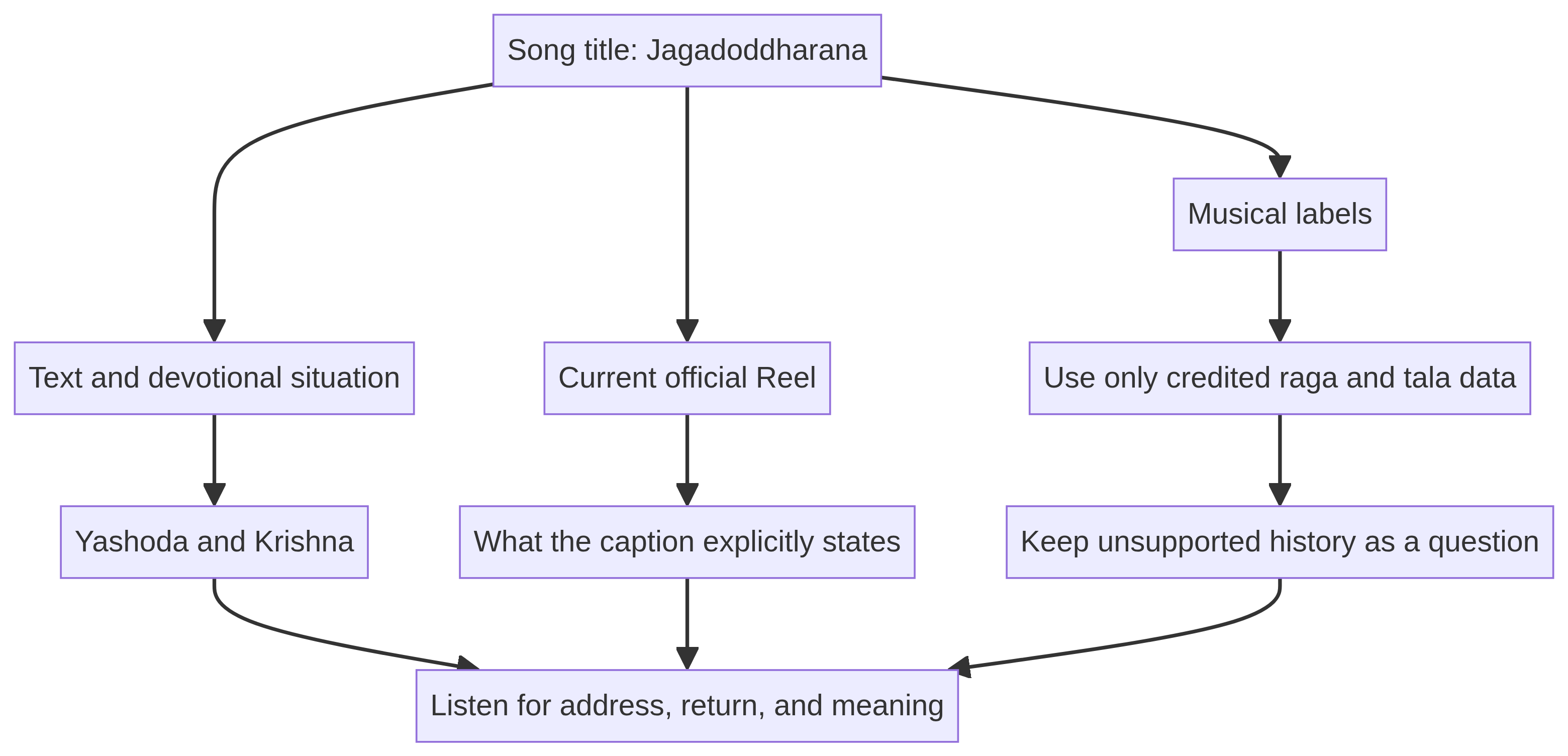
A short answer
Jagadoddharana can be heard first as a song of deliberate contrast. A public lyric page prints a refrain in which Yashoda is said to move or rock the one called the redeemer of the world. Its following lines expand that contrast: the child is also described with words of immeasurable greatness, and the final printed stanza names Purandara Vittala. The basic listening task is therefore not to force the song into only one scale. Hear the domestic act and the vast devotional names at the same time. ref-2
A careful answer needs a second distinction. The official Dr. Vidyabhushana Instagram account posted a Reel on 4 September 2026 with the caption “Jagadoddharana Aadisidalu Yashoda” and Krishna-related devotional tags. That record shows that the account publicly presented the title in a present devotional-performance context on that date. It does not itself identify an author, prove the age of a melody, supply a full translation, or establish a raga and tala. ref-1
For words, attribution, language, and the musical labels visible on one public lyric page, the Karnatik entry is a useful witness. It prints the text in Roman transliteration, calls the language Kannada, names Purandara Daasar, lists Adi tala, and displays both Dhanakaapi and Kaapi. It also calls its English meaning “partial.” Those features make the page useful precisely when its limits remain visible. It is not presented as a critical edition or as a complete performance history. ref-2
This guide therefore offers a modest listening route. Begin with the title. Locate Yashoda's action. Notice the growth from a child image to cosmic descriptions. Keep the source's two raga labels in view instead of choosing one without further evidence. Treat a particular recording as a particular rendition. Record what it names, what you hear, and what remains unknown. That discipline lets devotion, language, and present performance coexist without pretending that one web page settles every question.
How to use this guide
The title can appear in several spellings when it travels between Kannada, Roman transliteration, and English discussion. This guide uses Jagadoddharana as a readable short form because that is the title form commonly visible in the public material reviewed for this page. The lyric source prints jagadOddhaaraNaa and begins its refrain jagadOddhAraNa ADisidaLe yashOde. These spelling choices are not rival texts in this guide. They are signals that transliteration makes editorial choices about long vowels, retroflex sounds, and capitalization. ref-2
A listener does not need to settle every transliteration question before listening. One useful practice is to keep three fields open: title as supplied by the source, Roman form used for personal notes, and Kannada script where a reliable edition is available. The first field preserves a source record. The second lets the listener search or remember the item. The third belongs to textual study and should not be improvised from sound alone. This guide quotes only the short Roman text visible on the cited page. It does not reconstruct a Kannada-script edition.
The guide also uses several evidence lanes. A textual observation comes from wording printed on the cited lyric page. A present-performance observation comes from the 4 September Reel and concerns only that account's caption, date, tags, and public presentation. A contextual observation comes from the Music Academy page that points readers to a 1947 journal article by K. Vasudevachar on Tyagaraja and Purandaradasa. A listening observation is a prompt for your own hearing, not a statement about what every singer must do. ref-1 ref-4
This separation matters because the same sentence can otherwise do too much work. “The Reel names the song” is a narrow and checkable statement. “The Reel proves the song's original musical setting” is not. “The lyric page attributes the song to Purandara Daasar” accurately reports a page. “The page establishes a critical authorial text” would claim more than the page can bear. The goal is not to make listening cold or suspicious. It is to make each kind of attention more precise.
A source-aware guide can still be intimate. It can ask what happens when a figure called Yashoda holds the child whom the text also calls immeasurable. It can invite a listener to notice a returning refrain. It can help an English reader distinguish a literal gloss from a broader devotional reading. It simply marks those acts as reading and listening rather than as newly discovered history.
The wider Living Sabha Journal offers several paths that complement this one. The Kannada devotional repertoire guide considers how text, setting, and modern labels should be held apart across a larger repertoire. The guide to translating Kannada devotional poetry discusses why an English rendering cannot carry every linguistic and devotional association. The guide to Haridasa song tunes is the appropriate place for a wider question about words, oral transmission, and later tune histories. This page stays with one song and one transparent source ledger.
The Reel as a dated present-performance record
The official account's Reel supplies an important but narrow starting point. Its visible caption reads “Jagadoddharana Aadisidalu Yashoda.” The public page displays the date September 4 and tags that include devotional, Krishna, and Krishna songs. At the time of the discovery review, the page also displayed engagement figures, but those figures are dynamic and are not repeated here. They would describe a platform state at one inspection, not a stable measure of a song's history or importance. ref-1
The caption has value because it identifies the account's chosen title for a specific current post. The tags frame the post as devotional and Krishna-related. That is enough to explain why a listener may encounter the song through a short video and then want a careful guide. It is not enough to infer venue, accompanists, recording date, complete lyrics, authorial manuscript, raga, tala, or the intended meaning of every phrase. The caption does not supply those details.
This is a useful distinction for any Reel-led article. A short video can be a public record of an account's presentation. It can preserve an item title, a date, a caption, selected tags, and the fact that an account chose to share a performance. It is not automatically an archive, a score, or a scholarly edition. Its speed and reach do not convert it into proof of a historical or theoretical claim.
For this guide, the Reel is not treated as an oracle. It is treated as a doorway. It directs attention toward a named Kannada devotional song. The lyric page then supplies a separate textual witness. The Music Academy page supplies a separate institutional route to a historical journal article. Each source has a different job. When those jobs are kept separate, the reader can learn from all three without imagining that they say the same thing. ref-1 ref-3
The practical outcome is simple. If you share the Reel, call it a 4 September 2026 post by the official account whose caption names the song. If you discuss a particular audible rendition, describe it as that rendition unless its credits offer more. If you cite a raga label, name the page that provides it and preserve its ambiguity. If you want to discuss a word, return to the line where it appears. This is careful language, not unnecessary hesitation.
The Reel also should not be used to manufacture a social result. Visible likes and comments do not establish broad public demand, general agreement, audience understanding, or an aesthetic verdict. Comments are responses by particular accounts. They are not musicological evidence. The video may be meaningful to a listener. Meaning can be personal and real without becoming a claim about the past.
A compact evidence ledger
The table below gives each source only the role it can support in this guide. A ledger is a listening tool as much as an editorial tool. It helps the reader know when a phrase is a source report, a cautious interpretation, or an open question.
| Evidence item | What it directly supports here | What it does not settle |
|---|---|---|
| Official Dr. Vidyabhushana Reel, 4 September 2026 | The account caption names “Jagadoddharana Aadisidalu Yashoda”; the visible tags frame the post as devotional and Krishna-related. ref-1 | Authorship, text history, raga, tala, original tune, full translation, or performer intention. |
| Karnatik lyric entry | The page prints Roman-transliterated lyrics, identifies Kannada, attributes the item to Purandara Daasar, lists Adi tala, and displays Dhanakaapi and Kaapi. ref-2 | A critical text, a complete translation, or a conclusive history of every melody heard now. |
| Music Academy post | The institution presents a 1947 journal article by K. Vasudevachar as a comparative study focused mainly on Tyagaraja and Purandaradasa. ref-3 | A song-specific reading of Jagadoddharana. |
| 1947 journal article | A historical writer's devotional and comparative framing of Purandaradasa and Tyagaraja, read as the argument of that article. ref-4 | A final consensus on every historical assertion in the article. |
| Karnatik composer page | A later web overview's description of Purandara Daasar and its stated biographical traditions. ref-5 | Independent proof for its narrative details or an edition of this song. |
The ledger explains a central feature of the guide. It will quote or paraphrase the lyric page when discussing the text. It will report the Reel when discussing the Reel. It will not treat the two as interchangeable. That is especially important in music with many routes of transmission. A title in a caption can bring a listener to a song. It does not tell the listener how far a source can carry them.
The table also guards against false precision. A raga field looks exact, but the cited page places two names in that field. A tala field looks concise, but it does not describe tempo, arrangement, phrase treatment, repetitions, accompaniment, or the performance situation of an individual recording. An author field is meaningful, but a public web attribution has a different scholarly status from a critical source apparatus. A good guide lets the fields remain useful without making them larger than they are.
For a first listening, this ledger may seem formal. Try using it as a sequence rather than as paperwork. First, hear the Reel as a present post. Second, read the refrain from the lyric page. Third, return to the sound and identify a recurrence or pause. Fourth, write one question that the sources do not answer. The unanswered question is not an error. It is the edge of responsible attention.
The title, refrain, and a public text witness
The public lyric entry is headed “Song: jagadOddhaaraNaa.” Under its pallavi heading, it prints jagadOddhAraNa ADisidaLe yashOde, followed by the abbreviated return cue “(jagadO).” In ordinary English discussion, the title is often heard as invoking the one who redeems or uplifts the world. The page itself does not supply a full word-by-word translation of the refrain, so this guide uses that English description only as a cautious title gloss, not as an official translation printed by the source. ref-2
The source's visible grammar gives the listener a clear dramatic relationship even before any large doctrinal reading. Yashoda is named in the refrain. The phrase ADisidaLe is associated in the title context with an act of moving, rocking, or making the child play. The next printed line begins jagadOddhAraNa maganendu tiLiyuta, placing the world-redeemer description alongside the idea of a son. A listener does not need to decide every grammatical nuance to notice the juxtaposition. It is there in the repeated naming.
The refrain is valuable because it can organize hearing. When it returns, listen for the name Yashoda. Listen for the title's broad claim. Then notice that the song does not present those as separate characters or separate scenes. The intimacy and the scale belong to the same subject in the public text. This is the source-led core of the guide.
A transliteration is still not the sound of Kannada itself. It cannot fully show vowel length, pronunciation, poetic pace, or local recitation practice. It can help a non-Kannada reader track recurrence, but it should not license careless pronunciation. If you are learning the words, compare a reliable Kannada text or learn from a qualified teacher. If you are listening only, it is enough to recognize that the Roman letters are an access aid rather than the poem's complete life.
The lyric page calls its English meaning “partial,” and the visible note glosses only phrases from the second charanam. That admission is helpful. It reminds a reader that an online lyric page may preserve a title, a text sequence, and selected explanation without providing a finished translation. Do not fill the space with an invented polished rendering. Keep the source's partiality visible. ref-2
/manus-storage/jagadoddharana-listening-map_47e0c1e2.png
Who is speaking, and what does the poem stage?
A song can have an addressee, a narrator, and named figures without announcing a single modern speaker label. The public text of Jagadoddharana names Yashoda in the refrain and then develops descriptions of the child. Rather than declare a fixed dramatic narrator, this guide takes the safer route: it says the poem stages Yashoda's act and names the child through devotional descriptions. That language stays close to what the lines make visible. ref-2
This distinction matters for listeners who want to ask, “Who is speaking?” Sometimes a lyric lets us identify a first-person voice. Sometimes it uses direct address. Sometimes it presents an image that a singer, group, or listener inhabits differently in performance. Here, the visible text does not require us to turn a third-person devotional scene into a biographical report about a historical author or a declaration about a modern performer. The scene is enough.
The scene has a strong physical center. A person called Yashoda is linked with a child's motion or play. The child is then called ranganA in the anupallavi line on the cited page. Later phrases enlarge the child's description beyond ordinary measurement. As an act of reading, one can say that the text holds domestic care and devotional exaltation together. One should not say that a Reel proves a particular performer had a particular private intention while presenting the scene.
For an English-speaking listener, “Yashoda and Krishna” can become a quick shorthand. The caption's Krishna tags and the devotional vocabulary on the lyric page make that shorthand understandable. Yet it is better to preserve the sequence of evidence. The Reel itself uses Krishna-related tags. The lyric page's final charanam includes purandara viThalana, while its text calls the child through several devotional descriptions. This guide reads those published words, not an imagined lost scene behind them. ref-1
The word “stage” is useful because it does not force a division between poetry and devotion. It says that the lyric places figures and descriptions before a listener. A listener may respond through affection, faith, linguistic curiosity, or musical concentration. Those responses do not all need to be the same. A guide can offer the scene without telling every reader what spiritual conclusion to draw.
A helpful question for one hearing is: What changes when I hear the word Yashoda not as an abstract reference but as the name that organizes the refrain? You may notice that the song's large claims become more startling because a familiar caregiving action contains them. That is an interpretation prompted by the printed juxtaposition. It remains an interpretation, not a claim that the source gives a formal doctrine of motherhood.
Yashoda's action: holding, moving, and naming
The refrain's action deserves patient attention. The cited lyric page prints Yashoda with the verb form ADisidaLe. In the common listening context of a child-focused devotional song, English readers may hear the phrase through rocking, playing with, or moving a child. The exact shade can depend on grammatical reading, performance context, and translation choice. This guide therefore does not reduce it to a single compulsory English verb. It keeps “moves or rocks” as a practical listening gloss. ref-2
Why stay with one action word? Because it gives the song a body. The listener is not first asked to picture a distant cosmic ruler. The refrain puts an intimate human action beside a huge title. That contrast can be heard on the scale of breath and repetition. The broad phrase arrives. Yashoda's name follows. Then the line can return. The song asks the ear to hold these terms together.
The anupallavi on the cited page adds maganendu tiLiyuta, which can be approached cautiously as “knowing him as a son” or “regarding him as a son.” It is best used here as a reading cue, not as an occasion for an unsupported theological essay. The text makes the family relation part of the scene. The guide's job is to notice that relation and to leave deeper doctrinal claims to sources that explicitly support them. ref-2
This close focus also corrects a familiar listening habit. When devotional vocabulary feels grand, listeners can rush past ordinary verbs. But an ordinary verb may be the hinge of the whole scene. Ask yourself: does the rendition give the action a sense of lift, swing, tenderness, or pause? That question concerns your hearing of a particular version. It does not require a claim that every rendition has the same phrasing or effect.
Naming has an action of its own. “Yashoda” is not merely a character card added to the title. In the refrain, the name gives the listener a location from which the large title can be heard. The anupallavi's son-language gives that location another layer. You can write a short note such as, “The refrain joins the world-redeemer phrase to Yashoda's care.” Such a note records a text-based perception without pretending to translate every word.
For listeners who do not know Kannada, the safest first practice is repetition. Follow the return of the word Yashoda. Locate the return of the title. Let the printed line supply a visual anchor while the recording supplies duration, voice, and timing. Do not claim a word has only one meaning because an English gloss feels tidy. A short gloss should open a door, not close a poem.
The translation guide provides a broader discussion of why a devotional Kannada line can carry sonic, cultural, and conceptual dimensions that do not transfer neatly into English. The present guide uses that caution at a small scale. It offers enough language for a listener to follow the scene, while refusing to present its own prose as the song's final English form.
Krishna at two scales
The lyric source creates a repeated contrast between smallness and vastness. In its first charanam, it prints nigamakE silukada agaNita mahimana magugaLa mANikyana. Its visible partial meaning does not explain this whole line, so a cautious reader should not announce a definitive translation. At the level of observable wording, the line uses language of countless or immeasurable greatness near an image associated with children and a jewel. The contrast is enough to guide attention. ref-2
The second charanam is the one for which the source supplies a partial English note. It glosses aNOraNIyana as “smaller than the atom,” mahatO mahImana as the greatest or bigger than the biggest, and connects apramEyana with the immeasurable. Here a listener can make a more direct observation, because the source has given an English foothold. The child figure is named through extreme smallness and extreme greatness. ref-2
This is not a cue to treat the page's gloss as a complete translation of the song. It is a cue to respect its stated limit. A phrase-by-phrase gloss can be illuminating while still leaving syntax, literary force, and devotional associations unaddressed. The useful listener question is not “Have I solved the poem?” It is “What contrast has become audible to me?”
One answer may be: the text refuses to leave the child at one scale. Yashoda's relation is intimate. The descriptions are expansive. The listener can hear the friction between those two frames every time the refrain returns. That is a literary observation based on the cited text. It does not require a claim about the date, historical origin, or original musical setting of the composition.
The fourth visible line of the second charanam includes apramEyana. The Karnatik note uses “immeasurable.” Rather than extend this into an exhaustive doctrinal definition, let the word function as a reminder of scale. In a short devotional lyric, one designation can widen the listener's sense of what a scene is carrying. The widening does not erase the physical image. It gives the image a second horizon.
The public Reel's Krishna tags fit this textual field only at a general level. They show that the account grouped the post with Krishna devotional material. They do not tell us which charanam was sung in the clip, how long a particular phrase lasted, or how the performer interpreted a word. The distinction may feel small, but it protects both text and performance from being flattened into a hashtag. ref-1
A listener can use a two-scale exercise. On the left side of a page, write “near”: Yashoda, child, motion, son. On the right, write “beyond measure”: world-redeemer, smallness beyond ordinary scale, greatness beyond ordinary scale. In the middle, write the refrain title. The exercise is not an authoritative analysis. It is a way to make the song's visible contrast available to the ear.
The Purandara Dasa and pedagogy guide addresses a different subject, namely claims around pedagogy and tradition. It should not be used as proof for a line-by-line reading here. Still, it can give a reader a separate route into the broader name attached to the song. Keeping the pages separate is part of good internal navigation.
A stanza-by-stanza listening map
A stanza map is not a substitute for a translation or a notation. It is a way to follow the public text without claiming more than it gives. The Karnatik page divides the lyric into pallavi, anupallavi, and three charanams. That visible architecture gives a listener a path: first find the refrain, then notice how each successive section adds names or descriptions. ref-2
| Textual location on the cited page | What the page visibly gives | A cautious listening prompt | Boundary to keep |
|---|---|---|---|
| Pallavi | jagadOddhAraNa ADisidaLe yashOde and a return cue | Notice the recurrence of the title phrase and Yashoda's name. | Do not infer a full translation from the title alone. |
| Anupallavi | Son-language, Yashoda, and ranganA | Listen for whether a rendition makes the line feel like an expansion of the refrain. | Do not call a phrase treatment traditional without a source for that claim. |
| Charanam 1 | Language of greatness and a child-jewel image | Hear the pressure between grandeur and childhood imagery. | The page does not provide a full English rendering of this line. |
| Charanam 2 | Smallness, greatness, and immeasurability, with a partial gloss | Notice a sequence of scale-related descriptions. | The partial gloss is not a complete commentary. |
| Charanam 3 | parama puruSana, paravAsudEvana, and purandara viThalana | Listen for the final identifying names and any return to the refrain. | Do not turn the printed final line into a complete authorial biography. |
The pallavi is your return point. The printed parenthetical “(jagadO)” is a page-level cue indicating a return to the beginning phrase. In a recording, the exact number and placement of returns belong to that rendition. The listener can use the page as a map without assuming that every artist, teaching setting, or group-singing context uses identical repetitions. ref-2
The anupallavi enlarges the relation shown in the refrain. The source connects the world-redeemer phrase to one known as a son and names Yashoda again. You may find that the anupallavi changes the emotional weight of the first line because it spells out a family relation. That response is available even to a listener who does not attempt an exhaustive translation. It is a text-guided hearing.
Charanam 1 should be approached with restraint. A reader may recognize terms that invite large devotional descriptions, but the cited page does not give a line-by-line English explanation here. Rather than produce a confident paraphrase, write down the words as printed and notice their placement after the Yashoda refrain. The sequence itself tells us that the song does not leave the child image alone. It places it beside language of extraordinary stature.
Charanam 2 offers the clearest supplied gloss. The source's wording moves between “smaller than the atom,” “bigger than the biggest,” and “immeasurable.” The words need not be forced into a scientific analogy. In this song, they are devotional descriptors as supplied by the page's partial translation. A listener can hear them as a widening of the scene, not as a technical definition of cosmic size. ref-2
Charanam 3 contains the final terms parama puruSana, paravAsudEvana, and purandara viThalana as printed by the page. The final phrase makes the Purandara Vittala attribution field visible within the lyric. For listening, it is enough to note the appearance of the name and to let it lead to a separate question about attribution. It does not let us skip from a signature-like name to a total history of composition, manuscript transmission, or melody.
Try the map in four minutes. Read only the pallavi before pressing play. On the first hearing, mark the return of Yashoda. On the second, read the anupallavi along with the source. On the third, look at the three charanam headings and write only one word beside each: “child,” “scale,” “name,” for example. Then stop. A compact first map is better than a long note built on words you cannot yet verify.
This method differs from a raga-identification exercise. The guide to recognizing a raga can help a listener ask broader questions about melodic identity. Here, the first task is textual orientation. A song title, a returning name, and a visible stanza structure can give meaningful entry before a listener tries to name what is being heard musically.
Purandara Vittala and the attribution field
The final charanam printed on the Karnatik page ends with purandara viThalana, and the page's metadata names Purandara Daasar as composer. These are two related but distinct items of evidence. One is a name within the text as printed. The other is the site's metadata attribution. Together they explain why the song is commonly introduced to listeners under Purandara Daasar's name. ref-2
It is still useful to name the source level. The public lyric page is a web resource. It does not display a critical apparatus, manuscript comparison, editorial history, or an argument about variant readings. This guide may accurately report its attribution. It should not pretend that reporting an attribution has transformed the page into a critical edition.
The Music Academy's 2025 post offers a different kind of context. It announces and links to a 1947 Journal of the Music Academy article by K. Vasudevachar, titled “A Comparative Study of Sri Tyagaraja and Other Vaggeyakaras,” and says that it focuses mainly on Tyagaraja and Purandaradasa. That institutional page is useful for locating a historical article in a public journal route. It does not make the post itself a song-specific source for Jagadoddharana. ref-3
In the linked article, Vasudevachar presents a strongly devotional comparison of Purandaradasa and Tyagaraja. The article groups their compositions into types and discusses devotional music as a vehicle for their message. Those are positions and classifications within a 1947 author's argument. They can offer historical reading context when labeled as such. They should not be recast as a complete modern consensus or as evidence that every present performance preserves a single old form. ref-4
The Karnatik composer page is also best read as a later web overview. It describes Purandara Daasar as a pre-Trinity Carnatic composer associated with Kannada songs and early musical lessons, while also retelling biographical material through stated traditions and beliefs. The page itself says that knowledge of the life stems mainly from compositions of Vijaya Dasa, written after Purandaradasa's passing. That self-description is a reason for editorial caution, not a reason to discard the page entirely. It tells a reader that biography and tradition require source-aware handling. ref-5
For this guide, the attribution field has one practical purpose: identify the author name as the lyric source presents it. A listener can write, “Karnatik credits Purandara Daasar.” That is clean and true to the source. If the listener wants to research the field further, they can distinguish at least four questions: What does this lyric page attribute? What name appears in the printed final line? What does an institutional or historical essay argue? What textual or archival evidence would be needed for a critical edition?
The Purandara Dasa and pedagogy guide offers an existing Journal route for the pedagogical association. It should be read as a separate article with its own sources and claims. It does not remove the need to check what a particular Jagadoddharana source actually identifies.
This practice prevents a common collapse. “Attributed to Purandara Daasar” is not the same as “every feature of the rendition is original to Purandara Daasar.” Text, present melody, raga label, tala label, edition, tempo, and performance context are different fields. The moment we keep those fields apart, an attribution becomes more useful, not less. It tells us precisely what is being attributed.
What the public lyric page lists musically
The Karnatik entry labels the song “raagam: dhanakaapi” and then also displays “kaapi.” Under these labels, it prints ascent and descent patterns. It separately labels the tala as “aadi.” This guide reports those labels exactly as a present public page displays them. It does not silently select one raga name or claim that the printed patterns settle the identity of every rendition. ref-2
A reader may be tempted to treat the first label as the final answer and the second as an error. That would go beyond the available evidence. The page visibly preserves both. At minimum, the dual display tells us that the article must not present a single unqualified raga claim while using that page as its source. It is more accurate to say that the cited entry lists Dhanakaapi and Kaapi.
The printed scales are also page-specific information. A notation-like representation can be useful for readers who already know how to read the symbols. Yet it does not reveal how any particular singer shapes a phrase, uses ornament, moves between notes, treats text syllables, or places repetitions. It cannot tell us whether the Reel uses the full text, which labels the performer would use, or which version a teacher prefers. A line of symbols has a different job from a sound recording.
The Adi tala label is similarly helpful but bounded. It identifies a named tala field on this source. It does not tell a new listener exactly where to clap in an unfamiliar rendition, how fast the cycle proceeds, how a singer handles pickup syllables, whether a group repeats a line, or what accompanists do. If you are learning tala, consult the how to follow tala guide for a broader listening orientation rather than treating this one field as a complete lesson.
A good listening note can retain the page's exact uncertainty. For example: “Source consulted: Karnatik. It lists Dhanakaapi and Kaapi, and Adi tala. Recording label: [write only what the recording gives].” This note is stronger than a forced conclusion because another reader can see where each statement came from.
The broader concern is not merely editorial. Musical labels often travel with texts through teaching, concerts, online lyric pages, and memory. A field may be shared confidently without showing the evidence behind it. When a public source itself displays more than one possibility, the listener has a rare opportunity to see uncertainty rather than hide it. Preserve that opportunity.
This guide does not ask a beginner to hear a raga from an English paragraph. It asks the beginner to hear one rendition, record supplied labels, and avoid turning those labels into a historical timeline. The named raga remains a useful present clue. It is not a guarantee that all performances, books, or lineages use the same label.
Why the Dhanakaapi and Kaapi labels should remain separate
The public lyric page's double display is the most important musical evidence boundary in this guide. The page gives Dhanakaapi a heading, then places Kaapi below it, with a separate notation line for each. We do not need to resolve the relationship between the two labels in order to use the page responsibly. We need only refrain from erasing one of them. ref-2
That restraint is especially useful online, where a question such as “What raga is Jagadoddharana?” invites a one-word answer. A single answer may be practical in a particular teacher's lesson, a particular concert programme, or a particular edition. But the cited lyric page in front of us does not offer just one word. An article grounded in that page should say so.
There are several responsible sentences a listener can use:
- “The Karnatik lyric entry displays Dhanakaapi and Kaapi.”
- “The source provides two raga labels, so this guide does not choose one as universally final.”
- “For this recording, I will note the label supplied by its uploader, if any.”
- “A raga question needs a source tied to the exact rendition or edition being discussed.”
None of these sentences denies musical knowledge. They identify which knowledge is available on which evidence. This is preferable to importing an uncredited assertion from search results, memory, or a comment thread.
The distinction also makes listening more honest. A listener can hear a recording and say, “I notice a phrase returning here,” without claiming that the phrase proves a particular raga identity. A listener can read the source's scale lines and say, “The page displays these patterns,” without pretending to have verified their use in the Reel. A listener can seek a teacher's explanation while retaining a note of which version is being explained.
The same care applies to broad words like “traditional.” A version may be traditional in a specific community, teaching lineage, or documented publication sense. But the cited Reel caption does not use that word, and the public lyric page alone does not provide a full provenance chart. The safest language is local: “the cited page labels,” “this recording credits,” “this teacher's version,” “this edition prints.”
A source-conscious approach can feel less dramatic than a confident label. It gives the listener better questions, however. Which source names this raga? Is the label attached to the text, the recording, the performer, or a later editor? Are two labels appearing on one page? Can I hear a particular version more than once before making a note? These questions deepen attention without inventing a verdict.
The Kannada devotional repertoire guide takes up this broader habit of separating text, present label, setting, and open question. Jagadoddharana is a compact case study in the same method. The two visible raga labels are not an inconvenience to be corrected. They are a reason to listen with documented humility.
The Adi tala label: useful, but not a complete performance description
The Karnatik page lists “taaLam: aadi.” That is a clear and useful data point. The correct first sentence is therefore simple: the cited lyric page labels Jagadoddharana as Adi tala. ref-2
The second sentence needs equal clarity: that label does not describe the whole rhythmic life of a rendition. It does not supply a tempo, a starting point for every line, a clapping demonstration, a notation of syllable placement, a list of repeats, or the particular shape of an accompaniment. It cannot, by itself, tell a listener what happens in the Reel, because the Reel's caption provides no tala information. ref-1
For a new listener, this boundary is liberating. You do not have to identify every beat on the first hearing to use the tala field responsibly. Start with a smaller task. Notice whether the refrain seems to return with a dependable pulse. Notice whether a line begins before or after a beat you can feel. Notice whether the singer lingers on a word. Write “pulse felt, cycle not counted” if that is the honest note.
A second pass can be more specific. If you already know a basic Adi tala demonstration from a teacher or a reliable learning source, you may try to locate the recurrent cycle. Do not turn that private attempt into a declaration that you have fixed the composition's universal eduppu or version. Record the version, source, and point in the audio. “At 00:32 in this upload, I tried counting with the refrain” is useful. “Jagadoddharana always begins here” is larger than the evidence.
The how to follow tala guide is designed for the broader task of learning what repeated rhythmic cycles can feel like in Carnatic listening. It can support a beginner's general practice. This song guide adds only what its own source warrants: a page-level Adi tala label and an invitation to hear one performance carefully.
The word tala should not become a shortcut for mechanical counting. In a song led by a text, rhythm also carries recurrence, syllables, breath, and pauses. A listener can recognize that the beat cycle and the poem's phrasing work together without pretending to know every technical detail. A careful ear says, “I heard a return,” before it says, “I can explain the architecture.”
If two recordings feel different, the first response should be descriptive. One may sound more spacious. Another may seem more brisk. One may repeat a line more often. Those descriptions do not require the claim that one has changed the tala or that one is historically older. Ask for credits, a programme note, teaching context, or an edition. Let evidence determine whether a stronger claim is possible.
The Adi tala label remains worth recording because it connects a particular public page to a recognizable rhythmic field. But it should stay in its lane: a supplied label attached to that page. It is not a video transcript, a universal performance protocol, or proof that the same feature appears in every version.
A four-pass way to listen to one rendition
A careful guide should make listening possible without requiring a laboratory, a score, or a verdict. The following four-pass practice works with the 4 September Reel, another public recording, or a classroom version. The key condition is to identify the exact item you are hearing. Write down the account or publisher, title as displayed, date where available, and the date you accessed it. Those details keep a present rendition from becoming an imagined timeless object.
Pass one: encounter. Listen once without trying to label raga, tala, author, or every word. Notice the return of the title phrase. If you recognize Yashoda, mark that moment. Write two neutral observations: “the refrain returned,” “the pace changed,” “a phrase was sustained,” or “I could not follow the words.” Avoid evaluative language. The task is to preserve your first hearing, not to grade it.
Pass two: text. Keep the Karnatik page open and follow only the visible headings: pallavi, anupallavi, charanam 1, charanam 2, charanam 3. Do not assume that the audio includes all of them. Put a question mark beside any section you cannot place. The source page's return cue can help you identify the refrain, but the exact audio form remains a question for the rendition. ref-2
Pass three: source fields. Make five labeled lines: title; text source; author attribution; raga label; tala label. Fill them only with information supplied by a source. For the public lyric page, write “Purandara Daasar,” “Dhanakaapi and Kaapi,” and “Adi.” For the Reel, write the caption title and date but leave musical fields blank. This is not an incomplete notebook. It is an accurate one. ref-1
Pass four: reflection. Return to the title's contrast. Where do you feel Yashoda's presence in the sound? Where do the words of immense scale appear, if you can identify them? What can you not tell from the audio? A good final note may be, “I heard the refrain as an intimate return, but I have not verified the full text of this version.” That conclusion is more valuable than a generic claim of understanding.
| Pass | Primary task | A useful note | A claim to avoid |
|---|---|---|---|
| One | Hear the rendition as sound | “The title phrase returned several times.” | “This is the song's fixed structure.” |
| Two | Follow the visible text map | “I could place the pallavi but not the second charanam.” | “The recording definitely omits a stanza.” |
| Three | Separate source fields | “The lyric page displays Dhanakaapi and Kaapi.” | “The singer therefore used one of them.” |
| Four | Reflect on text and sound | “The contrast of child and world-redeemer stood out to me.” | “The performer intended this exact interpretation.” |
This sequence supports repeat listening because it rewards uncertainty. On a second day, you may recognize a word you missed. On a third, you may discover that an upload offers credits elsewhere. Update the note with a date. Do not overwrite your earlier uncertainty as though it was a mistake. It was a truthful record of what you knew then.
The practice also helps protect against audio compression and short-form context. A Reel can cut a song into a small window. A post may omit credits. A clip might be edited, excerpted, or visually framed in a way that pulls attention from the words. None of that makes it worthless. It simply means its best use is as a dated present-performance object, not as the whole evidence base for a composition.
If you share your notes, keep quotation and observation apart. Quote the Reel caption exactly. Quote a lyric line only from the page you used. Label your own sentence as “my listening note.” Do not assign emotion or intention to another listener. These simple practices make private listening communicable without making it falsely authoritative.
Translation as a listening aid, not a replacement
An English guide can make a Kannada song more approachable, but it cannot make English the final court of meaning. The Karnatik entry itself states that its meaning is partial. That small statement gives the right starting ethic: a translation can support attention while remaining incomplete. ref-2
The clearest English clues available on the cited page concern the second charanam. The page glosses aNOraNIyana with “smaller than the atom,” mahatO mahImana with “the greatest or the bigger than the biggest,” and describes apramEyana as immeasurable. A listener may use those clues to hear a pattern of extreme scale. It would be wrong to present them as a full translation of every line or as the only possible English phrasing.
Literal gloss, readable paraphrase, and devotional interpretation are different tools. A literal gloss tries to keep close to individual words. A readable paraphrase seeks a sentence that works in English. A devotional interpretation explains how a listener understands an image in a broader framework. Each can be useful. Confusion begins when a paraphrase is printed as if it were a dictionary, or an interpretation is presented as if the source explicitly stated it.
For Jagadoddharana, the short working gloss “Yashoda moves or rocks the redeemer of the world” can orient a new listener. It cannot exhaust the line. The title's first term, the action term, and the name Yashoda carry associations that are not captured merely by a smooth English sentence. Let the gloss remain a handrail, not a replacement for the steps.
The guide to translating Kannada devotional poetry is the appropriate place to explore wider questions of syntax, sound, devotional context, and translation ethics. Its relevance here is methodological. A listener should not mistake ease of reading for completeness of understanding. The more familiar an English paraphrase becomes, the more important it is to remember what it leaves behind.
A small translation worksheet can help:
| Layer | What to write | Example for this guide |
|---|---|---|
| Source text | The exact Roman phrase from the cited page | jagadOddhAraNa ADisidaLe yashOde |
| Minimal gloss | A deliberately limited English aid | “Yashoda moves or rocks the world-redeemer.” |
| Source support | Where the wording or gloss comes from | Karnatik text; its partial meaning note where relevant. ref-2 |
| Open question | What the gloss cannot settle | Full syntax, poetic force, and performance-specific emphasis. |
A worksheet like this is not an attempt to make every listener a translator. It stops the common slide from “I have a rough sense of this line” to “I know exactly what this poem says.” That distinction is a form of respect for language.
It is also worth avoiding a false choice between literal and devotional hearing. A careful listener can value the poem's devotional power while acknowledging that they do not know every word. One can hear Yashoda's care and the text's immense descriptions. One can notice the final Purandara Vittala phrase as printed. One can also leave unfamiliar terms unglossed rather than inventing certainty.
When you need more, seek a source that names its translator, edition, and method. A page that provides a full Kannada text and a credited translation can be evaluated differently from a lyric page that calls its meaning partial. In every case, record what the source supplies. Translation has provenance too.
A source-aware notebook for this song
A notebook is a modest technology for making careful listening repeatable. It does not turn a listener into a historian or performer. It gives every claim a place to stand. For Jagadoddharana, make one page for the song and divide it into four areas: present performance, public text, supplied labels, and open questions.
In the present-performance area, record the official Reel as follows: account name, URL, caption, displayed date, and tags. Your entry might say, “Official Dr. Vidyabhushana account; caption: ‘Jagadoddharana Aadisidalu Yashoda’; displayed 4 September 2026; devotional and Krishna-related tags.” Do not add raga, tala, or authorship because the caption does not give them. ref-1
In the public text area, record the page title, the title spelling it uses, the refrain, section headings, and the page's statement that the English meaning is partial. You can add the exact source URL and an access date. If you use a different text later, make a separate entry. Do not silently merge them into a hybrid lyric. ref-2
In the supplied labels area, write the source and the field together: “Karnatik: language Kannada; composer Purandara Daasar; raga display Dhanakaapi and Kaapi; tala Adi.” The words “raga display” are useful. They remind future you that this is a report of a page, not a conclusion extracted from the sound. ref-2
In the open questions area, write what you would need to know before making a larger statement. Examples include: Which text edition is being used in this performance? Which raga label does the performer or programme use? Does a reliable credited translation explain the full first charanam? What source traces this present musical setting? An unanswered question is active research planning, not empty space.
| Notebook field | Entry for the cited materials | Why it matters |
|---|---|---|
| Present post | Official Reel caption and 4 September 2026 date | Separates a current performance record from text history. ref-1 |
| Text witness | Karnatik's title, refrain, stanza layout, and partial meaning note | Lets the listener follow an identified public page. ref-2 |
| Attribution | “Composer: Purandara Daasar” on that page | Records the source's field without overstating its scholarly status. ref-2 |
| Music labels | Dhanakaapi and Kaapi; Adi tala | Preserves the page's dual raga display and tala label. ref-2 |
| Context | Music Academy link to a 1947 comparative article | Provides a separate institutional route, not song-specific proof. ref-3 |
| Question | “What does this exact rendition credit?” | Keeps claims proportional to evidence. |
A notebook makes comparison possible later. Suppose you hear another Jagadoddharana recording. Do not begin by deciding whether it is “the same.” Start a fresh entry: source, date, title spelling, text segments audible, labels given, and your observations. Only after two entries are visible should you ask whether a comparison is fair. This avoids treating a memory of one rendering as the song's permanent shape.
This method is also kind to future correction. Online pages change. Captions can be edited. URLs can disappear. A note that says what you saw, where you saw it, and when you accessed it is easier to revise than a note that claims a permanent fact without a source. If a better edition appears, add it. Do not conceal that your earlier entry was limited.
Add a small claim check before sharing a note. Read each sentence aloud and ask which field supports it. “The Reel caption names the song” belongs in the present-post field. “Karnatik lists Dhanakaapi and Kaapi” belongs in the supplied-labels field. “I heard a long return after the refrain” belongs in the listening-observation field. “This is the original tune” has no place unless a source tied to that precise claim has been identified. The check does not require scholarly jargon. It simply makes the difference between report, observation, interpretation, and unanswered question visible.
The protocol can also protect a listener from accidental quotation errors. Copy a lyric line only from the page in front of you, then mark the page and access date. If you spell a title differently to make it easier to find, retain the source spelling beside it. If a performance appears to omit a stanza, write “not heard in this clip” rather than “not part of the song.” A short upload can be excerpted. A classroom rendition can be selective. A memory can be incomplete. Each cautious phrase keeps an ordinary note from becoming a false catalogue entry.
When comparing two items, place their evidence in parallel rather than combining it. Put each URL, title spelling, supplied raga or tala label, text scope, and date on its own row. Then add a final row named “not comparable yet.” That row is useful when one source gives only a caption and another gives a full lyric, or when one recording has no credits. It prevents a listener from using the richer source to fill blanks in the poorer one. A comparison becomes more informative when its missing fields remain visible.
Finally, distinguish revising a note from correcting a tradition. If a reliable credited edition changes your understanding of a line, revise your personal entry and record why. Do not announce that all other listeners were wrong. A source-aware notebook is a record of your encounter and its evidence, not a court issuing universal verdicts. This modest practice lets knowledge grow while keeping the song, the source, and the listener in their proper relation.
For learners, the notebook can remain nontechnical. It can include a sketch of the refrain's return, a single word you want to look up, or a time stamp. For researchers, it can include stable URLs, screenshots where permitted, edition details, and variant fields. The shared principle is the same: do not make the record say more than it contains.
What this guide does not claim
This guide does not claim to provide a critical edition of Jagadoddharana. The text discussed here is the text printed on a public lyric page. That page is a useful witness, but it does not display manuscript evidence, an editorial apparatus, or a comparison of variants. A reader seeking a critical text needs a source built for that task. ref-2
This guide does not claim that the 4 September 2026 Reel proves historical facts about the composition. The Reel is cited for a caption, public date, account context, and devotional Krishna-related tags. It does not provide a raga, tala, author, manuscript, tune history, full lyric, translation, or a statement of performer intention. ref-1
This guide does not choose between Dhanakaapi and Kaapi as a universal raga answer. The cited lyric page displays both labels. The responsible result is to preserve the pair, identify the source, and seek a rendition-specific credit when a more precise answer is needed. ref-2
This guide does not claim that the Adi tala label gives a complete rhythmic analysis. The label is recorded because the lyric page supplies it. It does not specify every speed, entry point, textual placement, repeat, or accompaniment choice in a performance. ref-2
This guide does not provide a full English translation. The only English meaning supplied by the lyric page is explicitly partial. The short English glosses here are teaching aids that remain visibly limited. They should not be copied as final translations or used to flatten Kannada diction into one English equivalent. ref-2
This guide does not claim first-hand experience, quote an artist beyond the visible caption, or report hidden production details. It makes no claim about what a performer felt, intended, or meant to communicate. It also does not reproduce Reel audio, images, or stills. Reuse of a Reel needs platform-, creator-, and site-level rights clearance.
This guide does not make metrics claims. A current social post can signal that an account shared a named item. It cannot, by itself, establish search demand, broad audience agreement, historical popularity, quality, or cultural consensus. Visible engagement can change and is not treated here as enduring evidence.
This guide does not guarantee that a page will be indexed, ranked, or cited by any search system or artificial-intelligence system. Its purpose is more modest: to help a listener read available evidence carefully, hear a song with clearer questions, and preserve the difference between what is documented and what remains open.
Finally, this guide does not ask devotion to prove itself in editorial language. A listener may find the Yashoda-Krishna scene moving. Another may approach it as literature, language, or music. Both responses can begin with the same evidence discipline: name the source, identify the line, describe the particular rendition, and leave unverified claims unverified.
Related Living Sabha paths
Jagadoddharana is one entry point into a much larger listening practice. The following internal paths are useful when the question expands beyond this one song.
- Read Kannada Devotional Vocal Repertoire for a broader framework that separates text, present settings, labels, and open questions across Kannada devotional listening.
- Read Why Kannada Devotional Poetry Is Hard to Translate before treating a short English gloss as a complete literary or devotional translation.
- Read Who Composed the Tunes of Haridasa Songs? for the larger distinction between a text, oral transmission, and later musical settings.
- Read Purandara Dasa's Contribution to Carnatic Music for a separate, source-led page on pedagogy and the wider name associated with this attribution field.
- Read How to Recognize a Raga if you want to learn why a raga question must be tied to a particular source or rendition.
- Read How to Follow Tala for a general listening approach to rhythmic cycles before attempting to count a version of this song.
- Visit Listen to navigate Living Sabha listening material without assuming that a single guide is a complete repertoire archive.
These links are deliberately complementary. None should be used as an automatic substitute for a source tied to the exact Jagadoddharana text or rendition in front of you. A broader guide can improve your questions. It cannot fill a missing credit, prove an original tune, or make a partial translation complete.
A final source check before sharing a note
Before sharing a note about Jagadoddharana, pause and identify the object you are describing. It may be the public lyric page, the 4 September 2026 Reel, another recording, or your own listening response. Give the object a name, retain its direct link, and make the claim fit that record. If the lyric page supplies a title, a credit field, two raga labels, and an Adi tala label, write those as labels displayed by that page. If the Reel supplies a caption and date, write those as caption and date. Do not merge the separate records into a single statement that seems more settled than either source allows.
This small check is especially useful when a short post needs to be concise. A careful note can say, “The cited lyric page displays Dhanakaapi and Kaapi, while the official Reel names the song in a 4 September 2026 caption.” It does not need to add an original-tune story, a technical diagnosis, or a claim about what every performer does. Leaving those fields open is not a failure of listening. It is the condition that lets a future edition, programme note, or credited recording add information without forcing a correction to an overconfident earlier statement.
Frequently Asked Questions
Is Jagadoddharana a song about Yashoda and Krishna?
The official Reel caption names “Jagadoddharana Aadisidalu Yashoda” and uses Krishna-related devotional tags. Separately, the cited lyric page names Yashoda in the refrain and prints devotional descriptions of the child, including a final Purandara Vittala phrase. Those records support describing the guide as focused on Yashoda, Krishna-related devotional imagery, and a Kannada text. They do not by themselves settle every theological or narrative interpretation. ref-1
What does Jagadoddharana mean in this guide?
This guide uses a cautious title-level gloss: “the redeemer” or “uplifter of the world.” It is an orientation aid for the word as it appears beside Yashoda in the public refrain. It is not offered as a complete translation of the song. The cited page does not provide a full English meaning for the refrain and labels its own English meaning partial. ref-2
Who is Jagadoddharana attributed to?
The Karnatik lyric page names “Purandara Daasar” in its composer field, and its final printed charanam includes purandara viThalana. This guide reports those facts as attributes of the cited page. It does not claim that the page is a critical edition or that the attribution alone establishes the history of every textual or musical feature of a present rendition. ref-2
Which raga is Jagadoddharana in?
The cited Karnatik entry displays Dhanakaapi and Kaapi rather than a single unqualified label. For that reason, this guide preserves both labels and does not choose one as a universal answer. If you are asking about a particular recording, look for credits or a programme note connected to that exact rendition. ref-2
Is Jagadoddharana in Adi tala?
The cited lyric page lists Adi tala. That is a useful source-level label. It is not a complete rhythmic analysis of every performance, and the Reel caption itself does not provide a tala label. A listener can record Adi tala as the page's information while keeping rendition-specific timing and phrasing as separate questions. ref-1
Does the Reel prove the song's history or original tune?
No. The Reel is evidence that the official account posted a caption naming the song on 4 September 2026 and framed it with devotional and Krishna-related tags. It does not establish authorship, original tune, raga, tala, manuscript history, or a full translation. Those subjects require separate sources suited to each claim. ref-1
Can I use this guide as a word-for-word translation?
No. The guide offers a few deliberately limited glosses and identifies the page's partial meaning note. It does not substitute for a credited full translation, a Kannada edition, or instruction from a qualified teacher. Use it to follow the song's visible contrast between Yashoda's care and expansive devotional descriptions, then seek fuller linguistic support where needed. ref-2
Why does this guide keep saying “the cited page” or “this rendition”?
Because text, author attribution, raga label, tala label, translation, and performance are not the same kind of evidence. Naming the source prevents a useful clue from becoming an unsupported universal claim. It also makes future correction possible when a more specific edition, credit, or recording becomes available.
References
- Dr. Vidyabhushana official Instagram Reel, 'Jagadoddharana Aadisidalu Yashoda,' displayed 4 September 2026
- Karnatik, 'jagadOddhaaraNaa' lyric entry
- The Music Academy, Madras, 'Tyagaraja and Purandaradasa'
- K. Vasudevachar, 'A Comparative Study of Sri Tyagaraja and Other Vaggeyakaras,' Journal of the Music Academy, 1947
- Karnatik, 'Famous Carnatic Composers - PD'