
A short answer
Tappu Nodade Bandeya is presented in a public Reel posted on 10 September 2026 by the account shown as Medha Vidyabhushana. The caption names the song, prints the line “ತಪ್ಪು ನೋಡದೆ ಬಂದೆಯಾ ಎನ್ನಯ ತಂದೆ?”, gives the English sentence “Father, did You come without looking at my faults?”, states that Sri Prasanna Venkatadasaru wrote it, and says that Pt. Bhimsen Joshi tuned it. Those are important and useful statements. They are also statements made in one dated social-media caption. The most careful first conclusion is therefore about the caption itself: this is what that account publicly presented to listeners on that date. ref-1
That conclusion is neither timid nor dismissive. A Reel can be a valuable present-day record. It can document what a performer or uploader chose to call a song, what words were displayed, which translation was offered, and which credits were supplied for a particular audience-facing performance. It can also lead a listener to a poem that deserves closer attention. It does not, by itself, establish every fact that a compact caption may place beside the song. A caption is not automatically a critical edition, a manuscript catalogue, a verified biography, or an early notation source.
This guide uses that distinction as its method. It does not ask a listener to distrust the post. It asks the listener to preserve the form of each claim. “The caption says” is a precise and respectful phrase. “An edition identifies” is a different phrase. “A notation source documents” is different again. When the available record does not support a fuller conclusion, “unresolved” is an honest result rather than a gap to fill with confident language.
The line in the Reel can be heard as a direct address. In a compact English gloss, it asks whether a father came without looking at the speaker's faults. The Kannada wording, its relationship to any larger text, the identity of the addressed “father,” and the story attached to the poem each need their own evidence. A careful listener may be moved by the line before all those questions are settled. Feeling the force of an address is not the same task as claiming a complete historical explanation for it.
The tune credit requires the same care. The caption says “Tuned by the best Pt. Bhimsen Joshi Sir.” That is a clear present credit in the post. It is reasonable to report it as a stated modern tune attribution. It does not tell us, by itself, the raga, tala, date of setting, transmission route, source edition, or relationship between this version and every other setting of the text. The right response is not to invent those fields. It is to label the credit accurately and leave the other fields open.
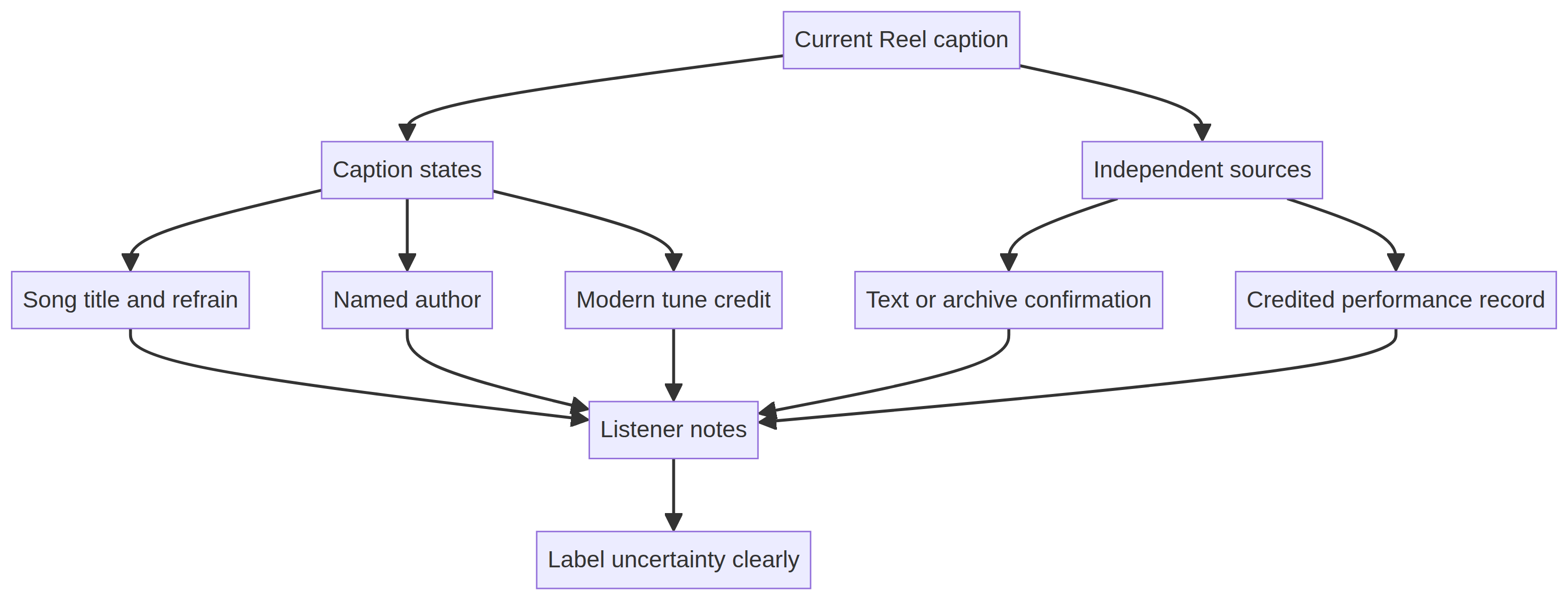
A useful way to listen, then, is to hold four cards in mind: captioned text, stated poet credit, stated modern tune credit, and claims still needing independent support. This guide gives each card a place. It also shows why a listener can enjoy a present performance while resisting the temptation to turn a brief post into a total history of a song.
What the dated Reel establishes
The direct public record is the Reel URL assigned to this guide. At inspection, the page identified the post as Tappu Nodade Bandeya and displayed a September 10 date. Its caption included the Kannada refrain, an English rendering, the name Prasanna Venkatadasaru, and the wording “Tuned by the best Pt. Bhimsen Joshi Sir.” The same caption also offered a short story about a person described as having come to Tirupati in distress and remaining at the Tirumala temple. ref-1
These details should not be flattened into one undifferentiated fact. The page supplies several kinds of information. The title is a title field in ordinary reading. The Kannada line is a text witness within a caption. The English sentence is a translation chosen by the account. The author and tune statements are attribution statements. The narrative is a biographical or devotional account as told by the caption. The image, audio, performance, comments, and caption form a contemporary social record. They are not all the same type of evidence.
A dated Reel is especially useful when the question is present-tense. What did this account call the song? Which words did it place before its audience? What attribution did it print? Did it frame the song as devotional? The answer may be direct. The post gives a listener a stable point from which to begin, even though platform displays can change and engagement counts are dynamic. This guide does not freeze likes, comments, or shares as measures of importance. They are not needed to understand the caption's claims.
The post also makes a more modest kind of listening possible. It presents a performance context in which a singer has chosen this song and this wording. A listener may say, “I heard Tappu Nodade Bandeya in Medha Vidyabhushana's Reel posted on 10 September 2026.” That sentence identifies a specific encounter. It does not claim that this Reel is the first performance, the only authoritative version, a standard notation, or evidence of an original melody.
The associated official Dr. Vidyabhushana account describes itself as an official account for Dr. Vidyabhushan and lists Indian classical music and Dasa Sahithya in its profile. It visibly includes Medha material in the public stream at inspection. That helps explain the surrounding public context. It does not transform a profile display into proof of authorship, textual history, or a particular musical lineage for this song. ref-4
The difference matters because an account context can be genuine and still be limited. A performer may accurately name a song for a broad audience without supplying an apparatus of editions and archival references. A short caption has a different job from a scholarly catalogue. It can open a doorway. It cannot be required to do every task that a critical source would do. The listener's responsibility is to notice the difference rather than treating the brevity of the form as either proof of everything or proof of nothing.
This is also why the Reel should not be used as evidence for labels it does not show. The inspected caption does not state a raga. It does not state a tala. It does not reproduce a full lyric. It does not name a book, manuscript, or notation edition. It does not identify a recording date for the tune credit. It does not document an oral lineage. A guide that adds any of those details without a separate source would no longer be describing the Reel. It would be adding claims that need their own verification.
Read the caption as a record, not a complete history
A careful reading begins by preserving the caption's wording before interpreting it. The title “Tappu Nodade Bandeya” tells us how the account labels the item. The printed line tells us the exact portion of Kannada text made visible. The English sentence tells us how the account introduced that portion to an English-reading audience. “Written by Sri Prasanna Venkatadaasaru” tells us the account's stated text attribution. “Tuned by the best Pt. Bhimsen Joshi Sir” tells us the account's stated tune attribution. ref-1
The word stated is not a hedge that drains these details of value. It identifies their source. If a visitor copies the statement into a programme note, the visitor should preserve the source relationship: “The Reel caption credits...” If a later edition corroborates the same attribution, the description can become more specific: “The caption credits X, and Y independently identifies...” The language becomes stronger because the evidence becomes stronger. It should not become stronger before that work is done.
The caption also contains a narrative. It says that Prasanna Venkata Dasaru was abandoned by family, came to Tirupati in pain, thought of going to Srinivasa, remained at the temple after its doors closed, was found the next morning, experienced grace, and composed the song. This guide records that sequence only as the caption's account. ref-1 It does not repeat the sequence as settled biography. It does not supply dates, places beyond those named in the caption, motivations, witnesses, or a causal history that the caption cannot document on its own.
This distinction protects the song as well as the reader. A devotional story may have ritual, oral, literary, or community importance. Its importance does not increase when editors present it with a kind of certainty the visible source does not carry. A responsible guide can say that the story is part of the post's framing. It can invite a reader to seek a publication or institutional source that treats the composer and the episode directly. Until that source is in view, the story remains an attributed account from the caption.
The same method prevents a common listening error. A listener often hears a moving present performance and assumes that every surrounding label belongs to the same historical layer. In fact, a song can bring together a poetic text, a remembered attribution, a modern tune, a particular performer, a caption translation, and a present visual format. These layers may be connected, but they should not be collapsed. The Reel helps us identify a particular present arrangement of them. It does not automatically date every layer to the same period.
A caption-first method is practical. Copy the words exactly, including spelling variations. Note the account handle and the post date as displayed. Save the direct URL. Separate quotation from paraphrase. If you translate a displayed Kannada line, label the result as your gloss or as the caption's translation. Do not quietly replace the caption's wording with a more polished sentence and then present it as a quotation. Small acts of transcription are part of accurate listening.
There is another benefit. A source-bound method leaves room for correction. A reader may later locate a text edition, an authorised publication, or a notation book. The ledger can then be updated without revising the past into a false certainty. The original entry remains clear: on 10 September 2026, the Reel said this. The later entry remains clear: another source says that. A journal guide becomes easier to maintain when it shows its evidence trail rather than hiding it.
The refrain: text, Roman script, gloss, and reading
The Reel prints the line “ತಪ್ಪು ನೋಡದೆ ಬಂದೆಯಾ ಎನ್ನಯ ತಂದೆ?” and immediately offers the English sentence “Father, did You come without looking at my faults?” ref-1 The most useful first step is to keep those two forms together. The Kannada line is the visible source text. The English sentence is the caption's reader-facing translation. Neither needs to be forced into a claim that it represents a full, definitive edition of the song.
A plain Roman-script reading can be written as tappu nōḍade bandeyā ennaya tande? Romanisation is a convenience for readers who do not read Kannada script. It is not a replacement for the Kannada line. Different systems may mark long vowels and retroflex consonants differently. This guide uses Roman script only to help a listener return to the source text. It does not treat one spelling convention as proof of a critical textual reading.
A deliberately close gloss might read: fault, without seeing, did you come, my father? English requires a different order to become a natural sentence. The caption gives one smooth English result: “Father, did You come without looking at my faults?” ref-1 That sentence is useful because it carries the direct question and the intimate address. It should also remain visibly a translation, not a claim that every Kannada word has only one English equivalent in every context.
The table below keeps four listening layers apart. It is not a philological edition. It is a transparency tool for a person meeting the line through the Reel.
| Layer | Wording or task | What it can responsibly do | What it does not settle |
|---|---|---|---|
| Captioned Kannada | ತಪ್ಪು ನೋಡದೆ ಬಂದೆಯಾ ಎನ್ನಯ ತಂದೆ? | Preserves the line displayed in the post. | The full lyric, an authorised edition, or textual variants. |
| Roman-script aid | tappu nōḍade bandeyā ennaya tande? | Lets a non-Kannada reader follow the visible line. | A single mandatory system of pronunciation or spelling. |
| Close gloss | “Without seeing fault, did you come, my father?” | Shows the compact question structure. | A complete literary interpretation. |
| Caption translation | “Father, did You come without looking at my faults?” | Records the account's reader-facing English wording. | A final translation for every context. |
A reader may be tempted to choose between literal and poetic translation, as if one must defeat the other. That is not necessary. A literal gloss helps the reader see the shape of a question. A reading translation helps the reader understand how the question may land in English. The two can sit beside each other when their roles are named. Living Sabha's translation guide notes that Kannada devotional poetry can resist a simple word-for-word transfer because language, word order, and cultural context carry more than a dictionary equivalent. ref-3
That general caution is especially helpful here. The word tande can be rendered “father,” but the addressee is not fixed by that English noun alone. The Reel's translation capitalises “You,” which signals its devotional framing, but a caption format cannot settle every theological, poetic, or dramatic question raised by a larger lyric. The reader should avoid adding a precise identity merely because the English word “Father” feels familiar. A wider text source could clarify the speaker and addressee. This Reel excerpt does not do that work by itself.
The word tappu is translated in the caption as “faults.” A gloss such as “mistake,” “wrong,” or “fault” may be possible in different English contexts, but choosing among them without a full text and edition would be an editorial choice. The caption's “faults” is the best wording to report when describing the Reel. If a guide later uses another rendering, it should say that it is a reading translation rather than silently treating it as the post's wording.
Notice what the line allows before larger claims arrive. It contains a question. It contains a second-person address. It frames the arrival as gracious precisely because fault is not being inspected. A listener can pause on that tension between fault and welcome. That is a response to the displayed language, not a claim about the whole song's doctrine, biography, or original performance practice. The restraint makes the response more faithful to what is actually present.
Text attribution and the biographical story are different claims
The caption credits the writing to Sri Prasanna Venkatadaasaru. That is a textual attribution in the post and should be reported in that form. ref-1 The caption also tells a biographical-devotional episode about a person it calls Prasanna Venkata Dasaru. These two items may appear side by side, but they answer different questions. One says who the post names as writer. The other tells why, according to the caption, the poem was composed.
It is tempting to make the narrative prove the attribution or make the attribution prove every narrative detail. Neither move follows automatically. An author credit can be correct while a short retelling simplifies a longer tradition. A moving story can circulate with a song while needing a separate source before it is used as biographical fact. A source-bound guide should therefore have two separate ledger rows. This is not pedantry. It stops the authority of one claim from being borrowed by another claim.
A useful editorial sentence is: “The Reel caption attributes the text to Sri Prasanna Venkatadaasaru and frames the song with a Tirupati story.” That sentence records the post accurately. A stronger statement would need a source designed to support it. For example, a published text collection might identify the poet. A biography might document an episode. A manuscript catalogue might record a text witness. A temple publication might explain a devotional tradition. Each source would have to be read for its own scope.
The Tirumala Tirupati Devasthanams Dasa Sahitya Project publicly describes its work as popularising Karnataka Haridasa literature. It lists publications, commentaries, hymns with musical notation, glossaries, rare works, recordings, programmes, and scholarly seminar papers. These are examples of the kinds of resource categories that can help a reader look beyond a social caption. The page does not, in the portion used here, identify this specific song or verify the Reel's narrative. ref-5
That limitation is important. Institutional standing does not turn every broad project page into a source for every song. The value of the TTD page in this guide is modest. It shows that a listener can seek publications, commentaries, notation, and rare works through an institutional preservation project. It does not license this article to announce a confirmed edition of Tappu Nodade Bandeya. A good research path begins with the right type of source, then checks whether that source actually names the text in question.
A listener can make a simple two-column note. In the first column, write “Caption attribution: Sri Prasanna Venkatadaasaru.” In the second, write “Independent textual witness: not identified in this guide.” The second entry does not erase the first. It tells a future reader what remains to be checked. If a reliable edition is found, record its title, editor, publication details, page, spelling, and any signature or variant it supplies. Do not replace the caption row. Add an evidence row.
The biographical story should receive the same treatment. A listener can write “Caption narrative: the post says...” and then summarise it without embellishment. Under a separate heading, write “Independent biographical source: not identified in this guide.” This makes it possible to appreciate the story as part of the performance frame while declining to present it as verified chronology. It also prevents accidental repetition of a narrative that may have multiple versions.
This method matters beyond this song. Devotional music often travels through compact introductions, concert announcements, oral teaching, recordings, and posts. Each form can be meaningful. Each form also has different strengths. An oral introduction can guide attention. A published edition can stabilise a textual reading. A recording can document a performance. A short social post can preserve a present attribution. The listener gains precision by asking not merely “Is this true?” but “What kind of source is making this claim, and what exactly can it show?”
What a modern tune credit can mean
The Reel's tune credit is clear in one limited sense. The caption says “Tuned by the best Pt. Bhimsen Joshi Sir.” ref-1 In this article, that wording is reported as a stated modern tune credit. It identifies what the caption asks the audience to associate with the song's tune. It does not need to be weakened into a vague impression. It also should not be inflated into claims that the post does not document.
A tune credit can refer to several related but distinct actions. It may identify the person whom a performer credits with setting the text to a melody. It may identify a setting that became familiar through recordings or concerts. It may identify a version that a community transmits by listening. It may identify an arrangement attached to a particular presentation. These possibilities are not interchangeable. Without notation, dates, a stated raga and tala, a documented source chain, or corroborating publications, the article should not choose among them.
The phrase modern tune is useful because it points to a musical layer that can be credited in present practice without claiming an original historical melody. “Modern” here does not judge the setting as lesser or more important. It describes the kind of claim: a named person is credited with a tune in a contemporary source. The listener can honour the credit precisely by keeping it tied to the source that makes it.
The caption itself does not name a raga or tala. It does not state the structure of the tune, an opening phrase, a notation, a recording date, or a chain of teachers. It does not say whether the credit refers to the first setting of the text, a well-known arrangement, or the precise version heard in the Reel. This article will not add those labels by inference from sound. Listening may reveal contour, pacing, emphasis, and the relationship between words and melody. It cannot certify an undocumented label simply because a listener recognises a familiar pattern.
The distinction between a tune and a performance also helps. A tune may be a stable object for some listeners, but a Reel is still a particular performance event. The voice, tempo, text emphasis, accompaniment if any, recording conditions, edit, and visual framing belong to this presentation. A listener may describe the post as a performance of a song with a stated tune credit. That does not prove that the Reel reproduces a notated version exactly or that every future performance will sound the same.
One reason to retain this distinction is fairness to credited artists. A vague statement such as “this is an old tune” can erase the named modern credit. An overconfident statement such as “this is the original tune” can claim more than the evidence bears. Saying “The 10 September 2026 caption credits Pt. Bhimsen Joshi with the tune” preserves the credit and the date. It also tells the reader where to look if the attribution is later corroborated, clarified, or qualified.
The credit need not be treated as a contest between text and music. A song can have a literary attribution and a separate musical-setting attribution. The two describe different creative and transmission layers. Confusion arises when a listener expects one name to answer every question. A poet credit does not necessarily establish a present melody. A tune credit does not necessarily establish a text's authorship. A performer's name does not necessarily establish either. The ledger works because it gives each role its own field.
Why the existing tune guide helps, and where it stops
Living Sabha's guide, Who Composed the Tunes of Haridasa Songs?, offers a general framework for separating a text source, historical notation, a modern setting, and a recorded rendering. It advises readers to describe a present concert setting as a current artistic choice unless earlier musical evidence can be shown. ref-2 That framework is useful for Tappu Nodade Bandeya because the Reel presents a named tune credit but does not present the documentary material needed to make a broader historical claim.
The framework is not a substitute for song-specific proof. The existing guide discusses tune questions at the level of Haridasa song transmission and explains an evidence ladder. It does not itself provide a critical edition, notation, or historical account for this particular title. Its value here is methodological. It teaches the reader to distinguish textual foundation, historical notation, modern melodic setting, and recorded performance. That distinction lets a listener describe the Reel without assigning it evidence it does not contain.
For this guide, the four terms can be used carefully. The visible Kannada refrain is a captioned text excerpt. The named Prasanna Venkatadaasaru credit is a captioned textual attribution. The Bhimsen Joshi statement is a captioned modern tune attribution. The Instagram item is a recorded present performance record. Historical notation is not identified here. This is not a verdict that no earlier source exists. It is a transparent account of what this guide has and has not verified.
The same general guide notes that public discussion can reveal questions and recurring terms without becoming historical proof. ref-2 This is a useful warning for social media as well. Comments, shares, and familiar phrases can show that listeners are engaging with a performance. They do not settle a poet's biography, an original melody, or a lineage. A listener can use public conversation to find leads, but should not cite applause as evidence for a history claim.
The existing guide also identifies institutional publications and editors as potential resources for modern settings and notation. Its point is not that every notation restores a lost past. Its point is that a documented modern setting should be credited as such. ref-2 That language is especially apt when a public caption already names a musician for the tune. A well-labelled modern credit gives the setting a history of its own. It should not be hidden behind an unexamined word such as “traditional.”
For a reader learning to hear versions, related Journal pages can help without duplicating this guide. How to Read Carnatic Music Notation explains why a score is a cue for listening and learning, not a complete script for performance. What Is Gamaka in Carnatic Music? gives a separate introduction to ornamented melodic movement. Neither page authorises an unsupported raga or tala claim for this Reel. They provide vocabulary for future listening once a relevant source names those features.
The phrase “modern setting” also deserves patience. It need not mean a fixed date, a single version, or a claim about artistic intention. The T. K. Govinda Rao site, for example, states that he tuned numerous Dasapadas and lists notation-and-meaning publications. It illustrates that named musical-setting and editorial work can be documented as work in its own right. It says nothing about this specific caption or this specific Bhimsen Joshi credit. ref-6 The lesson is limited but useful: a modern setting is a meaningful field that benefits from a named source.
A listener may therefore use the existing Haridasa tune guide as a lens, not as a shortcut. Start with the Reel. Keep the stated tune credit. Ask whether a named edition, notation, recording note, or expert publication supports more. If no such source is in hand, stop at the caption-level claim. That is not an incomplete listening experience. It is a disciplined one.
A first listening pass without borrowed labels
A first listening pass can be rich without guessing a raga, tala, lineage, or original tune. Begin by listening for the return of the visible line. Does the performance make the question feel like an appeal, a pause, a release, or a repeated address? Describe what you hear in ordinary language. A listener can say, “The phrase seems to settle after the question,” only if that is their own careful description of the recording. The listener should not convert that observation into an undocumented technical label.
Next, listen for the placement of the words. The caption makes the refrain available to the reader. When the line is heard, note whether the performance seems to linger on tappu, move quickly through a connective word, or give space to tande. These are listening notes, not prescriptions about how the song must be sung. Another performance may distribute the text differently. The notebook should record the particular Reel, not announce a universal compositional rule.
Third, listen to the relation between the English framing and the Kannada line. The caption gives the English question before or beside the Kannada text. Does hearing “Father” guide your attention toward intimacy? Does “faults” make the welcome in the question more striking? This is a valid reader response. It should be distinguished from a claim that the song has only one emotional meaning. A short excerpt can prompt a response without exhausting a poem.
Fourth, listen for the boundary between text and performance. The printed Kannada line remains available on screen as a textual object. The sung or played version is time-based. Repetition, stretch, emphasis, breath, accompaniment, and the platform edit may shape how the words reach the listener. It is useful to write both facts down: “The caption prints this line” and “this Reel presents it in this performance.” Conflating the two can make a temporary performance choice look like a permanent textual feature.
Fifth, make a note of what you do not hear securely. If you cannot identify a word, do not supply it from memory. If you are not certain whether a phrase repeats, write a question mark. If the audio compression makes a detail hard to hear, state that limitation. A good listening notebook has room for uncertainty. It does not reward a listener for turning partial hearing into an authoritative transcription.
A simple three-pass model can keep the listening focused. In the first pass, attend to the question in the refrain. In the second, read the caption and notice the distinct claims it makes. In the third, compare your listening note to the ledger. The sequence matters. It lets the performance have immediate force, then lets the source record guide context, then lets evidence boundaries correct overreach.
| Listening pass | Focus | A safe note | A claim to avoid without a source |
|---|---|---|---|
| First | The refrain as heard | “The displayed question returns as a focal point in this Reel.” | “This is the song's original refrain structure.” |
| Second | Caption language | “The post translates the line using ‘Father’ and ‘faults.’” | “This is the definitive translation.” |
| Third | Credits | “The caption credits Prasanna Venkatadaasaru and Pt. Bhimsen Joshi.” | “The original poem and melody are fully documented here.” |
| Fourth | Technical labels | “No raga or tala is stated in the caption inspected.” | “The audio proves a particular raga or tala.” |
This kind of attention connects with How to Listen to Carnatic Music, which encourages active listening, and with Kannada Devotional Vocal Repertoire, which places Kannada devotional songs in a wider listening context. Those pages can widen a listener's vocabulary. They do not add documentary fields to this post. The specific Reel remains the source for its date, caption, and visible credits.
A first listening pass should end with a modest sentence. For example: “I encountered a Kannada devotional question in a 10 September 2026 Reel, and the caption identifies a poet and a tune credit.” That sentence is already substantial. It links sound, words, and source. It also leaves space for future research instead of mistaking attention for certainty.
Build a song evidence ledger
An evidence ledger is a small table that keeps a claim attached to the source that supports it. It is not a ranking of what matters emotionally. It is a way to stop one source from doing another source's job. For Tappu Nodade Bandeya, the ledger begins with the date and caption because those are the items directly available in the assigned record.
/manus-storage/tappu-nodade-evidence-ledger_2db1fe75.png
| Claim or question | What the Reel caption supplies | What is independently supported in this guide | Editorial status |
|---|---|---|---|
| What is the post called? | “Tappu Nodade Bandeya.” ref-1 | The direct Reel is the source for this title. | Caption record. |
| When was this public post displayed? | September 10 on the Reel page. ref-1 | The date is used only for this post record. | Dated caption record. |
| Which Kannada line is visible? | ತಪ್ಪು ನೋಡದೆ ಬಂದೆಯಾ ಎನ್ನಯ ತಂದೆ? ref-1 | The post visibly prints that line. | Captioned text excerpt. |
| What English meaning does the post offer? | “Father, did You come without looking at my faults?” ref-1 | The wording is the caption's translation. | Caption translation. |
| Who does the post name as writer? | Sri Prasanna Venkatadaasaru. ref-1 | No separate text edition is identified here. | Stated attribution, awaiting corroboration. |
| Who does the post credit for the tune? | Pt. Bhimsen Joshi. ref-1 | No notation or tune history for this title is identified here. | Stated modern tune credit, awaiting corroboration. |
| What biographical story does the post tell? | A Tirupati and temple-grace narrative. ref-1 | No independent biographical source is identified here. | Caption narrative, not treated as settled biography. |
| What raga and tala are used? | The inspected caption does not state them. | None. | Unresolved in this guide. |
| Is the tune original to the poet? | The caption does not say. | None. | Unresolved in this guide. |
The ledger is intentionally plain. It does not turn “unresolved” into a failure. It tells the listener what to look for next. A full text edition might strengthen the author field. A reliable notation publication might identify a present setting. A dated recording note might clarify how a particular version was transmitted. A historical source might supply a more limited claim about an earlier tune. Until one of those sources is found, the blank field remains useful information.
This table also prevents a false choice between belief and scepticism. The caption can be treated respectfully as a primary witness to its own wording. The same caption can be treated cautiously for claims beyond its format. Both actions are forms of reading well. A listener does not insult an artist by saying that a short caption does not stand in for an archive. The listener honours the post by quoting it accurately and refusing to make it say more than it says.
The ledger can be copied into a personal notebook. Add a column called source checked and another called quote or page location. If you later find a book or institutional page, write its exact page number rather than just a broad title. If a source is a recording, identify the performer, platform, date, and timestamp. If a source is an oral explanation, identify it as oral and do not silently convert it into a published reference. Such details make a later correction possible.
Use a separate field for spelling. The Reel uses “Prasanna Venkatadaasaru” in the author credit while the narrative spells “Prasanna Venkata Dasaru.” ref-1 A ledger should preserve both visible forms instead of silently declaring one to be the canonical form. They may reflect transliteration choices, spacing choices, or a simple caption variation. This guide does not infer a conclusion. It records the variation and leaves standardisation to a source that explicitly establishes it.
The ledger also makes citations easier to use ethically. A direct quote should point to the direct source. A general method should point to a guide that states that method. An institution should be cited only for the project functions it describes. A copyright page should be cited only for its guidance area. Citation is not decoration. It is a map that shows a reader which claim can be checked where.
How to compare sources without forcing agreement
When a second source appears, begin by comparing fields rather than declaring winners. Does it print the same first line? Does it spell the attributed poet's name the same way? Does it give a full text or only an excerpt? Does it name a tune setter? Does it give a raga and tala? Does it state the date and nature of its evidence? These are practical questions. They allow a reader to see agreement and difference without pretending that all discrepancies are errors.
A source can agree with the Reel at one level and differ at another. A lyric collection might confirm an opening line but use another spelling. A programme note might repeat a tune credit without explaining its source. A recording description might name a raga but refer to a different arrangement. Each item can be entered in the ledger with a source label. The goal is not to manufacture a single smooth account. The goal is to disclose which account belongs to which witness.
Start with the narrowest statement that the sources share. If the Reel and a text edition print the same line, say that both sources print the line. If both name the same poet, say that the attribution is corroborated by those named sources. Do not jump from agreement on a line to agreement on a complete biography or original tune. Evidence should travel only as far as the source actually carries it.
If sources differ, state the difference in a stable form. “The Reel caption gives this spelling; source B gives that spelling.” “The Reel names a tune credit; source B does not.” “Source C labels a setting, but this guide has not established that it is the version in the Reel.” This language can feel less dramatic than declaring a source right or wrong. It is more useful to a future reader because it preserves the research question.
The page Translating Kannada Devotional Poetry is helpful here because it warns that a neat English sentence can conceal choices of word order, cultural context, and interpretation. ref-3 Compare translations with the same care as music labels. If a second translation uses “mistake” rather than “fault,” ask whether it is a literal gloss, a reading translation, or a rendering of a wider verse. Do not treat different English words as proof that one translator misunderstood the Kannada without examining the textual context.
A similar discipline applies to notation. The notation guide explains that written notation can serve as a cue for listening and learning rather than a complete record of performance. That point does not reduce the value of notation. It tells the reader to identify the edition and its conventions. How to Read Carnatic Music Notation is therefore a next step if a score for this song is located. A score would still need to be connected to the Reel's setting before it is used to label the Reel.
The most important comparison rule is to keep “not found” different from “does not exist.” This guide has not identified an independent edition, biography, or notation for the specific claims in the caption. That does not prove there is no such source. It defines the present scope of this article. Future evidence may strengthen, complicate, or correct the ledger. A transparent guide can welcome that development because it has not buried its limits.
Sharing, quoting, and reusing the Reel responsibly
The direct Reel is a useful link for readers who want to see the caption in its original platform context. Linking to a public page is different from copying its video, audio, screenshots, or visual design into another publication. This guide uses a typographic evidence ledger rather than a Reel still or an audio extract. The choice keeps the article focused on source relationships and avoids suggesting that a public post automatically grants reuse permission.
Instagram's copyright help centre says that its materials explain copyright and avoiding infringement, and it notes that copyright law can vary by country. It directs users to legal resources and says Instagram cannot provide legal advice. ref-7 That page is not a specific clearance for this Reel. It is a reason to treat reuse as a separate question. A site editor who wants to include a still, an audio excerpt, or a transcription beyond a short quotation should obtain appropriate permission and review the relevant rights context.
The same caution applies to a detailed transcription. The displayed line in the caption can be quoted with a direct citation when the quotation is necessary to discuss the caption. A full lyric copied from another unverified page should not be silently added to make the guide look complete. Full-text reproduction raises both accuracy and rights questions. The better approach is to quote only the visible line necessary for analysis, link to the direct post, and seek an authorised edition for any larger text work.
Credit language should be exact. “Captioned as written by” is different from “written by,” when the article has not located an independent text source. “Captioned as tuned by” is different from “composed by,” when the article is discussing a present tune credit. These phrases protect readers from accidentally copying an unverified claim into a new setting. They also preserve the artist's actual wording rather than replacing it with a more sweeping label.
A listener sharing the Reel can attach a short note: “The 10 September 2026 caption identifies the song as Tappu Nodade Bandeya, credits Sri Prasanna Venkatadaasaru for the text, and credits Pt. Bhimsen Joshi for the tune.” The note should link directly to the post. If it includes the English refrain, it should identify it as the caption's translation. If it repeats the Tirupati story, it should say that the story is the caption's framing, not a verified biography.
Avoid turning platform engagement into an evidence claim. Likes, comments, and reposts can change. They can show activity, but they do not establish the song's historical significance, a theory of its transmission, or a public consensus about its labels. This article does not use engagement numbers because the caption itself provides the evidence needed for the limited claims at issue. A listener can value the response around a post without confusing it with source criticism.
Finally, do not use responsible attribution as a promise of discoverability. A careful page, correct link, and clear citation can make a claim easier for a human reader to inspect. They do not guarantee search indexing, ranking, recommendation, or citation by any system. The aim of source-bound writing is clarity and repairability, not a guarantee of visibility.
A repeatable listening notebook
The method in this guide can be reused for any short performance clip. Begin with a record card. Write the platform, account, direct URL, displayed date, title, and whether you are viewing a caption, a video, a programme note, or an edition. This card tells future-you what you actually encountered. It prevents a later memory from turning a Reel into a book or a book into a performance.
Then make a claim card. Split every statement into one sentence. “The caption names the song.” “The caption prints this line.” “The caption gives this English translation.” “The caption attributes the text.” “The caption credits a tune.” “The caption tells this story.” A short form is often crowded because it compresses many claims into a few lines. Splitting them apart is the first act of careful listening.
Next make a source card. For each claim, write what type of source would be needed to strengthen it. A full lyric needs an edition or authorised text witness. A literary attribution needs a reliable textual source. A biographical story needs a source that treats the person and event. A tune claim benefits from notation, recording documentation, a musician's credited publication, or another appropriate source. A raga or tala label needs a source that actually names it for the relevant version. This card turns “I do not know” into a research plan.
After that, make a listening card. Write only what you can hear or see in the specific item. Avoid technical labels unless they are supplied by a source. You may note recurrence, pace, pause, text emphasis, visual cuts, or the effect of the line. State that these are observations of this version. Do not infer that the song has always been performed this way or that the performer intended a particular historical interpretation.
A final language card helps with translation. Preserve the original script where possible. Add a Roman-script aid only as an aid. Keep a close gloss beside a readable translation. Mark whether the English sentence comes from the caption, a published translator, or your own editorial rendering. When terms have several possible English equivalents, say so rather than hiding the choice. This practice gives readers room to return to Kannada instead of treating English as the sole original.
The notebook can end with three status labels: supported by this source, needs independent source, and not stated. Tappu Nodade Bandeya is a useful model because it has meaningful entries in all three columns. The Reel supports its own title, date, visible text excerpt, translation, and credits as caption statements. The author and tune claims need corroboration before this guide expands them. Raga, tala, original tune, full text, and verified biography are not stated in the inspected caption.
This method is compatible with many ways of listening. A devoted listener can be attentive to the question of grace in the refrain. A student can practise observing text placement. A researcher can build a bibliography. A presenter can write an accurate programme note. None of these roles requires an invented certainty. The more clearly the evidence is labelled, the more easily different readers can use the guide for their own next step.
Research paths that fit the question
The next source should be chosen for the next question. This is a simple rule, but it saves a great deal of confusion. If the question is about the complete Kannada text, look for an identified text edition, an authorised publication, or a library catalogue entry that actually prints the song. If the question is about the poet credit, look for an edition that identifies the composer and shows its editorial basis. If the question is about the Tirupati narrative, look for a biographical or institutional source whose subject is the person and episode. If the question is about the tune, look for a notation book, a documented recording note, a publication by or about the credited musician, or another source that says what kind of setting is being attributed.
This rule stops a researcher from treating a nearby source as a substitute for a direct one. The TTD Dasa Sahitya Project, for example, says that its publications include literature with exhaustive commentaries, hymns with musical notations, a glossary, rare works, recordings, and scholarly seminar papers. ref-5 Those categories may point an interested reader toward useful research material. Yet the overview page is not, by itself, an edition of Tappu Nodade Bandeya. A reader should search the relevant catalogue or publication and then check the actual item. A broad project page can establish that an institution makes certain kinds of material available. It cannot establish the contents of a title it does not name.
The same discipline applies to a musician's official site. The T. K. Govinda Rao site says that he tuned numerous Dasapadas and describes published music books with meanings and notation. ref-6 That makes the site a helpful example of how tune-setting and editorial work can have traceable forms. It does not confirm the specific tune credit in the Reel. The careful conclusion is limited to the named site: a modern setting can be documented through attribution and notation. It should never become an unsupported bridge to another artist, another title, or another song.
For the present song, a productive research path could begin with an exact-title search in Kannada script and Roman spellings. Record each spelling rather than choosing one too early. Search for ತಪ್ಪು ನೋಡದೆ ಬಂದೆಯಾ, Tappu Nodade Bandeya, and variants that preserve the same visible words. Then inspect whether a result is a lyric repost, a commercial music listing, a scanned book, an institutional catalogue, a performance upload, or an edition. The format changes what the result can show. A repost may preserve a line but repeat an unsourced credit. A scan may reveal an edition but require careful reading of title and page. A recording may document a version but not identify its textual source.
When a possible text witness is found, make a bibliographic note before making an interpretation. Record title, editor or compiler, publisher, edition or volume, year if printed, language, page, script, and the precise line that bears on the question. If the book is scanned, record the stable link and the scan page. If the source is a library catalogue, record the catalogue identifier but do not treat catalogue metadata as a full textual edition. These habits make it possible for another person to retrace the claim.
When a possible tune source is found, ask narrower questions. Does it name Pt. Bhimsen Joshi? Does it say “tuned,” “set to music,” “rendered,” “popularised,” or something else? Does it give a raga or tala for a named version? Does it print notation? Does it name a teacher, publisher, concert, or recording? Is the source discussing the very song in the Reel, or only a general repertoire? The answers may be incomplete. A partial answer is still valuable if it is not stretched beyond its terms.
It is also useful to distinguish research from recognition. A listener may recognise a familiar sound or have heard a song introduced in another setting. That recognition can guide a search, but it is not yet a citation. Write it in a notebook as a lead: “I have heard this associated with...” Then look for a source. If none is found, do not move the recognition into published copy. This boundary does not discount listening knowledge. It identifies when listening knowledge has become a checkable public claim.
The research path should end with an update rule. If a direct, appropriate source corroborates a claim, revise the ledger with the exact new source and change only the row it supports. If a source complicates the claim, add the difference rather than deleting the earlier caption record. If no source appears, retain the caption wording and the unresolved status. This makes the guide durable. Its claims remain connected to the evidence available at the time of writing.
Keep performance time separate from song history
Music reaches a listener in time. A Reel begins, a line is sung, a caption is read, and the platform places the experience on a date. History works on a different scale. It asks when a text was composed or copied, how a name became attached to it, when a tune was set down, which recordings circulate, and what transmission can be documented. The two scales meet in a performance, but one should not be mistaken for the other.
The date on the Reel is therefore important in a specific way. It lets us say that this account publicly displayed this title, this text excerpt, these credits, and this story on 10 September 2026. ref-1 It does not date the poem. It does not date the tune. It does not date the story. It does not establish when the performer learned the setting or when listeners first encountered it. The post's date belongs to the post.
This may sound obvious until a sentence is written too quickly. “In 2026, the song was composed” would be wrong because it confuses the publication date of a Reel with a composition date. “The 2026 version is in a particular raga” would also be unsupported unless a relevant source names that version. “The song was traditionally sung this way” would need evidence of a tradition and a version, not merely a present recording. Careful dating is a way to keep a reader from carrying a platform timestamp into a claim about the past.
The distinction also clarifies the word version. The Reel is one recorded presentation. A version could differ from another in text selection, wording, melodic setting, speed, accompaniment, recording edit, or visual framing. A listener does not need to know all other versions to say that this one exists. Conversely, the existence of this Reel does not establish that all versions share its features. The modest phrase “in this Reel” keeps the scope visible.
The existing tune guide makes a related distinction between a textual foundation, historical notation, a modern melodic setting, and a recorded performance. ref-2 That order is not a staircase on which each later layer automatically proves the earlier one. It is a set of separate witnesses. A recorded performance may be excellent evidence that an artist performed a setting. It is not automatically evidence of an original melody. A modern notation may be excellent evidence for a present setting. It is not automatically a manuscript from the poet's time. A text edition may establish a literary reading. It may say nothing about the tune a listener hears online.
For a listener, this separation creates more rather than less to notice. On performance time, ask: What does this voice and this presentation make prominent now? On song history, ask: Which sources document earlier textual or musical layers? On attribution, ask: Who is credited, and by which source? On transmission, ask: What relationship between versions is actually shown? These questions can coexist without forcing a complete answer from any one clip.
The distinction is also generous toward performers. A present performer may offer a song with care, conviction, and a valuable attribution, while not claiming to be a historian or editor. The viewer can receive the performance as a performance and research the history as history. Neither task needs to diminish the other. A source-bound guide simply avoids making one task impersonate the other.
A careful vocabulary for programme notes
Small differences in wording have large effects in a programme note, social caption, classroom handout, or playlist description. A listener can preserve accuracy by choosing verbs that describe the evidence rather than embellish it. For this song, the safest verbs are often names, prints, translates, attributes, credits, frames, records, and does not state. These verbs tell the reader what the source does.
The following vocabulary table offers practical alternatives. It is not a ban on stronger language. Stronger language becomes appropriate when a source supports it. The point is to avoid claiming that a caption has established a matter that it has merely mentioned.
| If the evidence is | Prefer language such as | Avoid unless separately documented |
|---|---|---|
| A Reel title | “The Reel is titled...” | “The work is definitively known as...” |
| A visible excerpt | “The caption prints...” | “The complete authorised lyric is...” |
| An English caption sentence | “The caption translates the line as...” | “The line means only...” |
| A poet credit in a post | “The caption attributes the text to...” | “The text is conclusively established as...” |
| A tune credit in a post | “The caption credits ... with the tune.” | “... composed the original melody.” |
| A story told beside the performance | “The caption frames the song with a story about...” | “It is historically certain that...” |
| An absent label | “The caption does not state a raga or tala.” | “There is no raga or tala.” |
Consider a short programme note for the Reel. A source-bound form might read: “In a Reel dated 10 September 2026, Medha Vidyabhushana presents Tappu Nodade Bandeya. The caption prints the line ‘ತಪ್ಪು ನೋಡದೆ ಬಂದೆಯಾ ಎನ್ನಯ ತಂದೆ?’, translates it as ‘Father, did You come without looking at my faults?’, attributes the text to Sri Prasanna Venkatadaasaru, and credits Pt. Bhimsen Joshi with the tune.” ref-1 Every clause in that note points back to the caption. It does not need an invented raga, a biography, or a claim of originality to orient a reader.
If a source later corroborates a field, revise the sentence rather than making the old source disappear. A note could say: “The Reel caption attributes the text to X; a named edition also identifies X.” That wording honours both records and tells the reader why the confidence has changed. Good programme writing does not hide its evidence improvement. It makes the improvement legible.
This vocabulary also helps when translating between Kannada and English. An English phrase such as “written by” can sound final, while a Kannada social caption may be using ordinary credit language in a more fluid context. By writing “the caption attributes,” an editor states what is directly observed without assuming an unexamined legal, historical, or editorial finality. The same principle applies to “tuned by.” The goal is not to strip warmth from a credit. It is to make the credit exact.
Careful language is particularly important when a reader copies material across platforms. A sentence may travel from a Reel to a video description, then to a concert listing, then to a school handout. At each move, an unqualified assertion can become harder to trace. A source-bound phrase preserves the link to the original record. It helps a future reader find the post and ask the next question.
What this guide does not claim
This guide does not claim to publish a complete lyric, critical edition, or authoritative transliteration of Tappu Nodade Bandeya. It quotes and discusses only the Kannada line visible in the Reel caption. The Roman-script form and close gloss are reader aids. They are not substitutes for a verified full-text source.
It does not claim that the caption alone proves Sri Prasanna Venkatadaasaru's authorship as a matter of independently verified textual history. It reports the caption's author credit and marks the absence of a separate text edition in the sources used here. It also does not claim that the caption's Tirupati story is settled biography, chronology, or a complete account of composition.
It does not claim a raga, tala, original melody, date of setting, oral lineage, notation, or relationship between the Reel and every other performance of the song. The caption inspected for this guide does not state those matters. Hearing a melody does not authorise the article to add labels that no source has supplied.
It does not claim that Pt. Bhimsen Joshi's stated tune credit is a documented history of every version of the text. The guide reports a modern tune credit from the caption and explains why a tune, a text, a score, and a recorded rendering are separate evidence fields. A future source may add information. It should be cited for the particular field it supports.
It does not present audience response, platform engagement, or a social-media post as proof of historical importance, popularity across communities, or search demand. It does not promise that linking to a source will produce indexing, ranking, or AI citation. It does not reuse Reel imagery or audio and does not assume that public availability gives reuse permission.
The central limitation is also the guide's practical value. It teaches a listener how to remain close to a real public encounter while leaving unverified fields open. The result is not a thinner experience. It is a way to hear text, credit, and present performance without giving any one of them a claim it cannot carry.
Frequently Asked Questions
Is Tappu Nodade Bandeya by Prasanna Venkatadasaru? The 10 September 2026 Reel caption says “Written by Sri Prasanna Venkatadaasaru.” ref-1 This guide reports that as the post's attribution. It does not claim independent confirmation because it does not identify a separate textual edition for this song.
Did Pt. Bhimsen Joshi compose the tune? The caption says “Tuned by the best Pt. Bhimsen Joshi Sir.” ref-1 This guide calls that a stated modern tune credit. It does not use the post alone to claim an original tune, a complete setting history, or a raga and tala.
What does “ತಪ್ಪು ನೋಡದೆ ಬಂದೆಯಾ ಎನ್ನಯ ತಂದೆ?” mean? The Reel offers: “Father, did You come without looking at my faults?” ref-1 A close English gloss can help a reader see the question's shape, but it should sit beside the caption translation rather than replace it as the only possible reading.
Does the Reel prove the Tirupati story? No. The post tells a Tirupati and temple-grace narrative as part of its caption. ref-1 This guide records that the account gave the story. It does not treat the story as independently verified biography.
Can I identify the raga or tala from the Reel? Not responsibly from this guide. The inspected caption does not name either field, and this article does not infer them from the audio. A relevant notation, programme, recording note, or other source would be needed to make a label for the specific version.
Why not call this the song's original tune? A captioned credit for a tune is not the same thing as evidence for an original historical melody. The related Haridasa tune guide distinguishes text, historical notation, modern setting, and recorded rendering. ref-2 Until earlier musical evidence is documented for this title, the careful phrase is “the caption credits Pt. Bhimsen Joshi with the tune.”
References
- Medha Vidyabhushana, Tappu Nodade Bandeya Reel, 10 September 2026
- Living Sabha, Who Composed the Tunes of Haridasa Songs?
- Living Sabha, Translating Kannada Devotional Poetry
- Dr. Vidyabhushana Official Instagram Account
- Tirumala Tirupati Devasthanams, Dasa Sahitya Project
- T. K. Govinda Rao, Official Website
- Instagram Help Centre, Copyright