
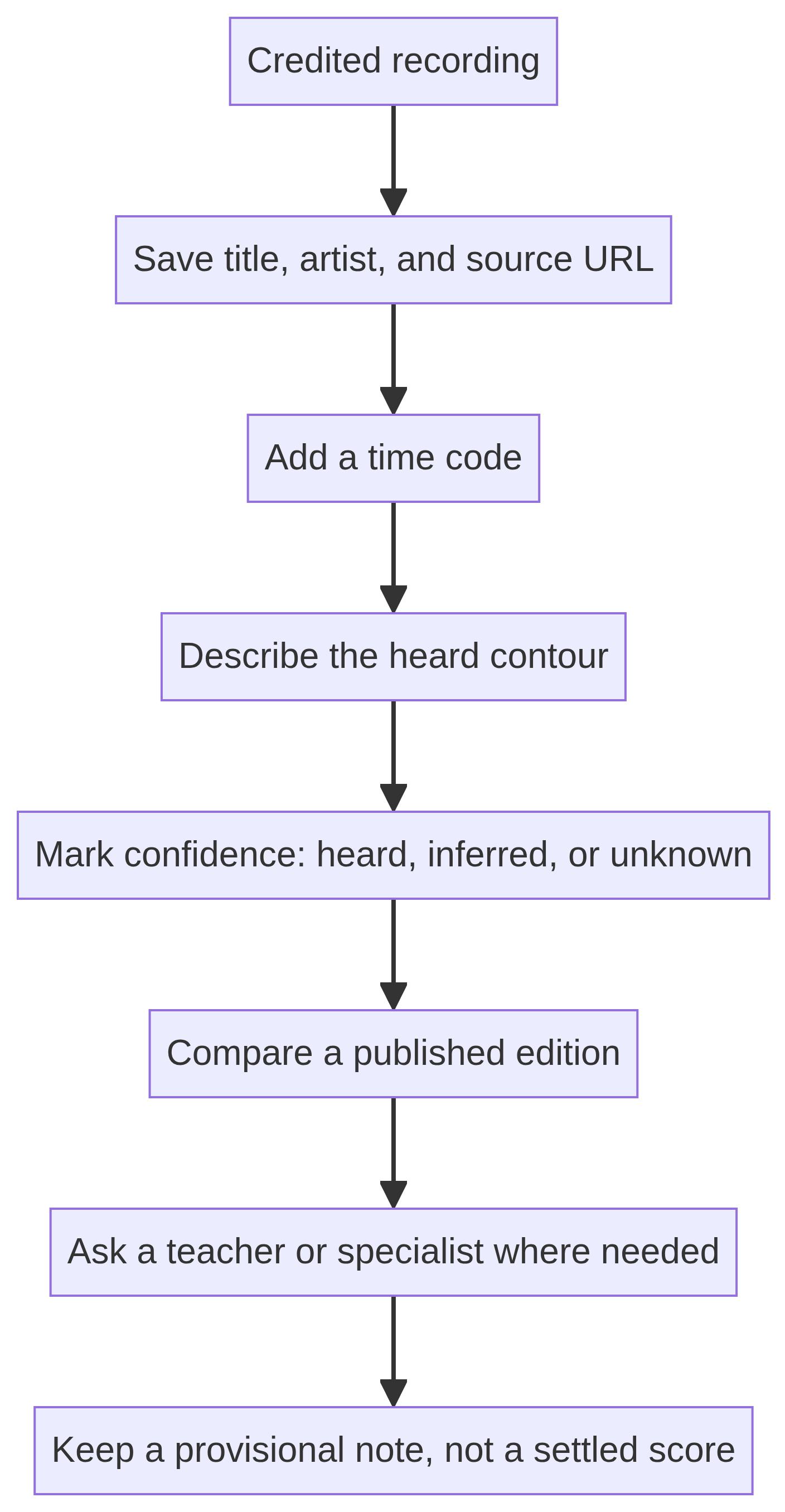
A short answer
You can write down what you hear, but you should first write down what kind of claim you are making. A useful first record of a Carnatic recording is usually a source link, a time span, a description of the sound, a possible phrase contour, and an uncertainty label. It is not automatically a publishable swara line. A recording can invite close attention, yet it may not disclose the tonic, the lineage, the intended gamaka, the composition's version, or the editorial basis needed for a definitive notation.
A careful listener can make notes that are valuable even when the notes do not name every swara. For example, a notebook can say that a short instrumental passage occurs from 00:42 to 00:49, rises toward a held upper sound, returns quickly, and is difficult to separate from an accompanying line. That observation gives another listener a place to start. It does not claim that a particular printed sequence is correct.
This distinction matters because Carnatic notation is a compact prompt rather than a complete substitute for learned performance knowledge. The Brill chapter on handwritten Karnatak notation explains that sargam notation can represent swaras, duration, and tala information, while gamaka is often not fully marked. It also describes notation as needing to be joined with knowledge acquired over time. ref-2 A listener who transcribes from audio is working with a different and sometimes thinner evidence trail than a teacher writing during a lesson or an editor preparing an authorised edition.
The need for restraint is not hypothetical. A September 2026 Rasikas.org thread records a listener asking whether an instrumental interlude could be decoded into swaras. A respondent said that the song had been retuned and that writing the swaras required someone well versed in Karnatak music. The thread is evidence of a live listener question and a community response. It is not musicological proof of the recording's history, raga, or correct notation. ref-1 Its useful lesson is modest: the wish to write down a phrase is understandable, while the authority of the result must remain visible.
This guide therefore treats transcription as documentation before declaration. It helps a listener produce notes that preserve where a phrase occurs, what was actually heard, what was inferred, and what should be checked. It does not teach a shortcut for extracting a complete score from compressed sound. For learning how established printed symbols work once an edition exists, see How to Read Carnatic Music Notation. For the earlier task of listening responsibly, begin here.
What this guide means by transcription
The word transcription can describe several different activities. A teacher may write material while teaching. A performer may make a personal memory aid. An editor may prepare an edition after comparing manuscripts, oral accounts, and recordings. A researcher may annotate sound for a particular analytical question. A listener may make a notebook entry after hearing a phrase online. These activities may all use swara letters, but they do not carry the same evidence or authority.
This guide is about the last activity. It concerns a listener who encounters a recorded phrase and wants a reliable way to describe it without claiming access to the teacher's lesson, the performer's intention, or an authorised score. The first goal is repeatability. Someone else should be able to open the same recording, go to the same time span, and understand the difference between your observation and your guess.
A listener's transcription has three layers. The first is record evidence. This includes the URL or file name, the uploader or label shown, the access date, the total duration, the selected time code, and any credits that appear with the recording. The second is audible observation. This might include a sustained sound, a rising contour, an entry by another instrument, a return to a recurring landing point, or uncertainty caused by overlap. The third is interpretation. This is where a listener may write a possible tonic, a tentative phrase shape, or a candidate swara label. Keeping these layers separate prevents a useful note from hardening into an unsupported fact.
A notation reader may already know that Romanised scores often use the syllables or letters for sa, ri, ga, ma, pa, da, and ni. The Brill chapter states that these sargam syllables can be spoken, sung, and written, and that their exact pitch position is defined by raga in context. ref-2 That background does not make every heard pitch immediately nameable. The letters point to relationships within a musical framework. A recording listener still needs reliable grounds for deciding which framework is present.
It helps to give every document a plain title that states its status. Instead of calling a file “Swaras of the interlude,” call it “Provisional listening notes for 00:42 to 00:49.” Instead of posting “notation,” post “time-coded contour notes, unverified.” These titles are not evasive. They are accurate descriptions of the evidence. They also make later correction easy, because a teacher or authorised source can add information without needing to undo a public declaration.
A careful transcription can be very small. You may document only four seconds. You may decide that a phrase is too dense for swara labels and record only its beginning and ending. You may identify two different lines but not their internal pitches. These are successful outcomes if they preserve a real observation and clearly state a boundary. Completeness is not the first measure of quality. Traceability is.
Why a recording is not a complete score
A recording captures audible sound at one moment. A score is a particular kind of written representation. Neither object contains everything a careful listener may want to know. A recording may make timing, timbre, attack, overlap, and broad melodic movement audible. A score may make a selected sequence of swaras, a tala organisation, or editorial signs visible. Both can be useful. Neither automatically explains the other without context.
The distinction is especially important when a listener sees a familiar string of letters and assumes that it records all performance detail. The existing Living Sabha notation guide explains that notation should be read as a cue for listening and learning rather than as a complete record of a performance. It specifically cautions that gamaka and oral instruction supply detail that written marks often do not fully capture. ref-3 A listener moving in the other direction, from sound to letters, should use at least the same caution.
The Brill chapter gives a concrete reason for this caution. It notes that gamaka, including oscillations, slides, and repeated articulations, is prominent in Karnatak music, while handwritten notation typically leaves gamaka markings absent. The chapter says that interpreting such notation requires additional knowledge of which gamakas belong in a raga and melodic context. ref-2 If a written note can omit audible detail, an audio recording can also leave an untrained listener unsure of the discrete swara targets beneath a moving sound.
Audio itself can conceal information. A platform may compress the file. A microphone may emphasise one instrument and soften another. A cut may begin after the phrase has already established its reference point. Stereo placement may make an accompaniment appear separate or fused. A video can show a hand movement without proving its pitch result. None of these observations require a claim that a given recording is defective. They simply explain why an honest notebook includes an “audio conditions” field.
A recording also does not identify every musical role by itself. A passage may be composed material, a response, a transition, an improvisatory development, a practice demonstration, or an excerpt edited from a longer performance. The listener should not assign one of those labels solely because the phrase feels free or familiar. If an uploader, programme, published score, or performer credit supplies a label, record it as a label from that source. If not, say “role not established from this clip.”
This is not an argument against listening closely. It is an argument for listening in stages. A score can be a strong comparison witness when its source and scope are clear. A recording can be a strong time-stamped witness for what that audio contains. Your note becomes stronger when it says which witness supports which statement. That habit also avoids turning a visual notation convention into an audible fact or an audible impression into an authorised edition.
Start with a source record
Before replaying the phrase, make a short source record. Copy the public URL if one exists. Save the recording title exactly as shown. Write the channel, label, account, or uploader only as it appears on the page. Add the date you accessed it, not an invented recording date. If the page presents performer, composition, raga, tala, or venue fields, copy them into a separate “supplied labels” line. Do not move those fields into your observations until they have been independently checked.
The source record should distinguish visible information from missing information. A useful entry might read: “Page title: as displayed. Uploader: as displayed. Performance date: not stated on page. Recording date: not established. Composition credit: supplied by uploader, not independently checked.” Such wording may look formal for a personal notebook, but it prevents a later reader from assuming that every label was confirmed.
Use an access date because online records change. A title can be corrected. A description can expand. A video can be removed or replaced. A platform can insert captions that were not visible earlier. The access date says only when you saw the record. It does not imply that you have archived, authenticated, or licensed the material.
If you work from a personal audio file, identify it without exposing private information. A file name, a short non-sensitive description, its duration, and the device or collection context may be enough. Do not publish another person's lesson recording or private rehearsal audio without permission. A transcription method does not create rights to share the sound, the score, or a performer's work.
The source record is also the right place to note an audible technical condition. Write “single close microphone,” “concert video with audience noise,” “speech over opening,” “audio begins mid-phrase,” or “two melodic lines overlap,” when those conditions are obvious. Do not use technical language merely to sound certain. A short description is enough if it helps another listener understand why a pitch, onset, or phrase edge is hard to hear.
The following table separates fields that can be copied from a recording page from fields that must remain observations or open questions.
| Field | What to enter | What not to infer |
|---|---|---|
| Source | URL, file name, uploader, access date | That the uploader is the original performer or rights holder |
| Time span | Start and end time, including seconds | That the clip starts at a musical beginning |
| Supplied labels | Credits, composition name, raga or tala labels as displayed | That every supplied label is independently verified |
| Audible facts | Sustained sound, overlap, pause, repeated figure | A complete swara sequence from one hearing |
| Interpretation | Possible tonic, contour, candidate target | Performer intention, lineage, or historical originality |
| Next check | Teacher, authorised edition, credited source, another recording | That further checking will guarantee one final answer |
A public forum can motivate a guide, but it should not be promoted into a source ledger for musical facts. The Rasikas.org thread used in this guide is useful because it documents a request posted on 5 September 2026 and subsequent replies on 6 and 7 September. It does not establish the work's authorship, raga, retuning history, or correct swaras. ref-1 In the same way, your own source record should say what a page visibly provides and avoid expanding its authority.
Make time codes before naming notes
Time codes are the backbone of a listener's note. They make a claim checkable without making it grand. If a phrase lasts seven seconds, write the beginning and end as precisely as the player allows. Use a consistent form such as 00:42.0 to 00:49.1. If the platform only shows whole seconds, write 00:42 to 00:49 and say that the granularity is limited.
Start by making a broad pass. Mark the moment where the sound you want to study begins, the moment it changes role or texture, and the moment it ends. Do not rewind every half second at first. The broad pass helps you distinguish a phrase from the material around it. It can also reveal that what felt like one line is actually a response across two instruments or voices.
Make a second pass with smaller marks. You might use A for the initial gesture, B for a sustained middle point, C for a quick turn, and D for the return or cadence. These letters are placeholders, not swara names. They allow you to describe the order of events before you decide whether a pitch label is defensible. A time-coded entry such as “A begins under the violin response” is often more useful than a row of uncertain letters.
A third pass can focus on the clearest anchors. Listen for a held note, a repeated arrival, a long silence, a hand-off between performers, or a point where the drone becomes more audible. An anchor is simply a place that you can find again. It is not automatically Sa, Pa, a phrase boundary, or a tala landing. Give it a neutral name until evidence supports more.
Avoid the temptation to correct the player speed and call the result definitive. Slowing playback can help you notice events, but it can also change the perceived texture of rapid movement and make a continuous ornament seem like a row of separate notes. If you use a slow pass, note the setting as a listening aid. Compare it with normal speed before writing a conclusion. The notebook should preserve the condition under which a detail was heard.
Time codes are also better than isolated screenshots. A still image of a waveform can show amplitude. It cannot by itself identify swaras. A video frame can show an instrument. It cannot prove an exact pitch or phrase function. Use visual material as a locator only when it genuinely helps another person find the sound. Do not let a visual impression take the place of an audible check.
A good time-coded note allows revision without embarrassment. Suppose a teacher later indicates that your B and C marks belong to one continuous gamaka. Your original time span remains useful. You can update the interpretation field while retaining a transparent record of what you first heard. That is the practical advantage of documentation over a premature finished score.
Listen for a phrase contour first
A contour describes direction and shape without asserting precise swaras. It can say that a phrase rises, settles, turns downward, repeats a point, leaps, glides, or circles around a central region. A contour note is deliberately less specific than notation. Its purpose is to give your ear a stable description before a familiar swara pattern pulls you toward a guess.
Use simple language. “Low entry, quick rise, held upper area, descending slide” is a useful contour. “Three short pulses followed by a longer settling sound” is useful too. If you want a graphic mark, use arrows or a hand-drawn line with a legend: upward slope for broadly rising movement, downward slope for broadly falling movement, wavy line for continuous motion, and dot for a marked arrival. Make clear that the drawing is a listening map, not pitch measurement.
Contour is particularly helpful when the tonic is not yet known. If you start by forcing every sound into sa, ri, ga, ma, pa, da, or ni, you may make an elegant but unsupported line. A contour lets you hold the question open. It also makes comparison possible across recordings that may use different absolute pitch levels.
Write what you can hear across repetitions. A single pass can be misleading. After three or four normal-speed hearings, ask whether the phrase really climbs in steps or whether it approaches one sound by a slide. Ask whether a supposed repeated note is truly the same pitch region or simply a similar timbre. Ask whether the apparent landing point belongs to the main line or to an accompaniment. These questions are not tests of your talent. They are ways to make the limits of the recording visible.
A contour note can include texture. You might write “main voice rises while violin sustains below,” “plucked attack masks onset,” or “percussion coincidence obscures the end.” This is important because a listener does not hear melody in a vacuum. The recording presents a layered event. Separating those layers may require a knowledgeable listener, a teacher, or a better source.
Do not draw a contour that pretends to be a scientific pitch trace. A hand-drawn line has no calibrated scale unless you have explicitly generated one using a documented method, and even then the trace needs musical interpretation. For ordinary listener work, a contour is a mnemonic sketch. Its strength is honesty. It says, “this is the direction I heard,” rather than “this graph proves the swaras.”
The phrase contour is also a useful bridge to How to Recognize a Raga. That guide can help listeners understand why a raga question requires more than a scale-shaped guess. In a transcription notebook, however, do not turn a contour into a raga label. Write the contour first, preserve the source, and seek a credited or taught context before naming a framework.
Treat the tonic as a documented hypothesis
Every swara label is relative to a tonic. A listener who does not know the tonic does not yet have a stable basis for naming the rest of the phrase. This is why “I think the first note is Ga” is weaker than “I hear this note as a possible resting point, but the tonic has not been established.” The second sentence identifies a useful perception without claiming a completed map.
The Brill chapter explains that Sa is placed at a pitch suitable for the vocalist or instrument, and that the remaining syllables ascend from that point. It also says that the precise pitch position of each syllable is defined by raga. ref-2 This supports two careful conclusions. First, swara letters are relational rather than simple fixed-frequency labels. Second, identifying a tonic is not enough by itself to settle every swara in a phrase.
Look for a stable reference only when the recording supplies one audibly or through a credible accompanying source. A drone may be clear. A sustained return may recur. A teacher may have named the shruti in a lesson. A credited score may state a reference. Record exactly which support you used. “Possible tonic heard in audible drone” is different from “tonic stated by teacher,” and both are different from “tonic assumed because a keyboard app suggested it.”
If you use a digital pitch display, describe it as a measurement aid, not a final authority. The device can report a frequency from its input. It cannot determine the composition's version, resolve gamaka into a unique swara sequence, identify raga from one fragment, or certify that your audio stream retained all relevant detail. Write the displayed reading and the conditions if it helps, then keep the musical conclusion provisional.
An especially common error is to map a recording directly onto a familiar keyboard. A keyboard may offer a convenient reference, yet Carnatic swara identity depends on relationship, context, and raga practice. A binary key label cannot settle the shape of a moving note. The existing notation guide similarly notes that the tonic is movable and that notation indicates relationships rather than absolute Hertz values. ref-3 A listener should therefore record the relationship they can support, not force the sound into a fixed Western key name.
A notebook can use three tonic statuses. Known means a reliable source stated it or a teacher confirmed it. Supported hypothesis means the audio and source context give a clear, repeatable basis, but the result is not independently verified. Unestablished means the recording does not provide enough evidence. The third category is not a failure. It is a correct finding when the available material is insufficient.
When the tonic remains unestablished, continue with time codes and contours. You can still describe relative high and low regions, returns, attacks, overlaps, and phrase length. Postponing labels protects you from a cascade of error. One uncertain tonic can make every later swara letter look more confident than the evidence allows.
Separate observation from swara labels
Once a phrase is time-coded and its contour is described, you may be ready to add possible swara labels. The word possible matters. A label belongs in an interpretation column, not in a column called “fact.” It should be accompanied by the basis for the label and by a confidence category.
Use a page layout with two visibly separate columns. In the left column, write observations such as “a sustained pitch region follows a quick upward glide” or “the phrase resolves near the recurring drone-like reference.” In the right column, write “candidate target: Pa, low confidence” or “possible return to Sa, requires confirmation.” This layout makes it hard to forget which part came from hearing and which part came from inference.
Do not turn every audible event into a separate letter. A glide may be one gesture. An oscillation may visit or suggest more than one pitch area without functioning as a clean list of stationary notes. An instrumental attack can have a transient that confuses a pitch detector or the ear. When the event is inseparable, write “continuous movement” or “ornamented approach” rather than constructing false steps.
A few labels can be more responsible than a long line. If two arrival points seem strong and the intervening motion remains unclear, note only those arrival points. If a phrase begins and ends clearly but the middle is covered by percussion, leave the middle blank. The blank is data. It says that the recording did not yield a defensible hearing under the conditions you used.
The practical notation conventions described by Karnatik show why an unlabelled audio phrase cannot simply be copied into a standard-looking score. The reference lists marks for relative register, extension, phrase ends, tala-cycle ends, and gamaka, among other functions. ref-4 A polished score therefore implies a set of decisions about more than a sequence of basic letters. If your evidence only supports a rough contour, present a rough contour.
You may find it helpful to use brackets and question marks in private notes. For example: “[upper target?]”, “(possible R2?)”, or “S? only if tonic assumption holds.” Define the convention at the top of the page. Do not copy the appearance of a scholarly edition unless you have its editorial evidence. Your own symbols should communicate uncertainty plainly rather than borrow prestige.
The correct response to an unresolvable passage is not necessarily to abandon the whole project. You can say: “00:46.2 to 00:47.4 contains a rapid ornamented movement. Individual targets are not assigned from this recording.” That statement gives a future teacher or researcher a precise place to listen. It also saves the next listener from mistaking your uncertainty for carelessness.
Hear gamaka without pretending to capture it
Gamaka is central to why audio-to-swara work needs humility. A listener may hear a note moving, shaking, approaching, leaving, or returning. That experience is real. It does not follow that the listener can split the motion into a universally agreed series of separate swaras by pausing the audio more often.
The Brill chapter states that gamaka includes oscillations, slides, and repeated articulations. It observes that gamaka markings are often absent from handwritten notation and that subtle variations can defy reduction to a stable set of symbols. ref-2 This is not a reason to stop listening for gamaka. It is a reason to record movement as movement when the source does not support a more exact reduction.
Begin with ordinary descriptions. Write “slow oscillation around a pitch area,” “rise joined to a sustained arrival,” “brief slide into the next sound,” “rapid repeated articulation,” or “shape obscured by another line.” These phrases avoid claiming a particular named gamaka or its correct execution. They also make your notes usable for later comparison.
If the recording has a clear version of the phrase elsewhere, cross-reference it by time code. Do not silently replace the difficult passage with the easier one. Write that a later repetition seems to provide a clearer hearing, then preserve both locations. Repetition may help a listener form a hypothesis, but it does not make the hypothesis verified. The two contexts may not be identical.
Do not make a slow-motion audio file your only witness. At reduced speed, a fluid oscillation can sound like a staircase. At normal speed, a fast turn can sound like one inflected target. Both perceptions can be partly shaped by playback. Compare normal and slowed listening, then write what remains stable across them. If the motion changes character radically with speed, raise the uncertainty level.
A pitch graph can be useful in specialist work, but a graph is not self-interpreting notation. It may follow an overtone, misread a noisy onset, break a continuous glide, or show a frequency contour without identifying its musical role. A listener should not paste a graph into a note and treat it as proof of swaras. If you use one, label it as a technical visualisation and seek musical guidance for any interpretation.
For a broader discussion of why ornament cannot be reduced to a simple note list, see What Is Gamaka in Carnatic Music?. This transcription guide does not attempt to name, teach, or standardise gamakas from an isolated clip. Its task is smaller: make the listener's uncertainty visible and leave room for informed correction.
Mark rhythm and phrase boundaries cautiously
A time-coded phrase has duration, but duration alone does not reveal tala. A listener may hear a recurring pulse, a clear percussion pattern, or a pause that feels like a section edge. These are valuable observations. They should not automatically become a tala name, an eduppu claim, or a count assignment.
Separate four ideas in your notebook: audible pulse, repeated grouping, likely phrase edge, and known tala information. Audible pulse means you can hear recurring beats or attacks. Repeated grouping means you hear a pattern that seems to recur. A likely phrase edge means a pause, breath, cadence, hand-off, or texture change seems to close a unit. Known tala information means a credible source actually states the tala or a teacher has confirmed it. The first three can be listener observations. The fourth is a sourced label.
Karnatik's notation-symbol reference lists vertical lines as phrase or tala-section endings and double vertical lines as tala-cycle endings in its own notation convention. ref-4 That tells readers how one written system uses marks. It does not allow a listener to impose those bars on any recording by ear. If you draw a vertical line in a personal sketch, label it “heard boundary” unless an authoritative source establishes a more specific function.
Clapping along can be a useful private listening exercise. It can help you notice where your sense of pulse changes. Yet it is not evidence that you have identified the composition's tala. If your clapping drifts, write that the grouping was not stable. If percussion is absent, do not manufacture a cycle simply because you expect one. A blank rhythm field is safer than a confident but unsupported tala label.
Phrase boundaries can be ambiguous even when the recording is clear. A vocalist may carry a line across a perceived beat. An instrumental response may begin before a previous sound decays. An edit may remove the preparation for a cadence. Describe what you hear: “brief silence,” “new instrument enters,” “sustained note fades,” or “repetition begins.” These descriptions remain useful even if a later source supplies a formal analysis.
Use time codes that align with your boundary decisions. If you divide a phrase into A, B, and C, write their times. A later reviewer can then disagree with your division precisely. This is more constructive than presenting a seamless row of swaras whose segmenting decisions cannot be inspected.
Listeners who want a foundation in keeping tala can consult How to Follow Tala. That page addresses listening for rhythmic organisation. This guide does not infer a particular tala from an uncertain interlude. It only shows how to document what a recording audibly provides.
Account for audio, editing, and instruments
A recording is an audio object with a production history, even when that history is unknown. The listener need not reconstruct it. The listener does need to avoid treating its surface as transparent. A close microphone can magnify finger noise. A room microphone can blur attacks. A phone recording can compress the quietest part of an ensemble. A platform may alter loudness or deliver a different stream at a different connection quality.
Make a simple “audio conditions” line. Write only what can be heard or seen directly: “main melodic line partly masked by violin,” “audience applause overlaps final second,” “clip begins after a cut,” “vocal and flute parts are hard to separate,” or “pitch is clearest during a sustained note.” These notes help explain why a conclusion is tentative. They do not accuse anyone of poor production.
Instrument identity affects what a listener can safely write. A plucked string, bowed string, voice, wind instrument, or electronic keyboard may produce different attacks and sustained shapes. Yet you should not infer technical intention from an isolated sound. It is sufficient to note that an onset is sharp, a line overlaps another, or a resonance continues after the initiating attack.
When two melodic sources move together, do not assume they are in exact unison. You may hear close alignment, a response, reinforcement, or a difference hidden by the mix. Mark the uncertainty. One line may be clearer than the other. If you transcribe only the clearer line, say so. If you cannot separate them, document the passage as a composite texture rather than inventing two independent scores.
Edits deserve a special warning. A video may cut from one part of a performance to another. A social clip may begin on the strongest moment. An uploaded audio file may combine takes. Unless the source identifies the edit, record the cut as a cut and do not infer that the musical phrase began or ended there. The time code remains useful, but its musical context is incomplete.
Headphones can reveal details that speakers miss, while speakers can restore an overall blend that headphones exaggerate. If a detail matters to your inference, listen in more than one ordinary playback condition when possible. Do not report this as laboratory verification. Write simply, “the upper line was clearer on headphones,” if that explains your note. If the result changes substantially, lower your confidence.
None of these precautions mean that recordings are unreliable in a general sense. They mean that a recorded phrase is a specific witness. Your notebook should describe the witness before it draws conclusions from it. That discipline is more useful than a claim that software, headphones, or a waveform can remove all ambiguity.
Versions, retuning, and source priority
The same text or composition title can appear in more than one musical setting or version. A listener should not assume that one recording represents an original, universal, or exclusive form. The September 2026 forum thread includes a respondent's statement that the linked song had been retuned. That statement belongs to the thread's conversation. It should not be repeated as a settled historical claim without appropriate corroboration. ref-1
For a listener's notebook, the practical response is straightforward. Record the version you actually heard. Copy the title as displayed. Note any supplied performer, album, programme, or raga field. Add “version relationship not established” unless a reliable source directly provides the relationship. This wording is not a judgment on the music. It is an accurate limit on the document.
Source priority helps when different witnesses disagree. An authorised edition, a teacher who knows the material in context, a documented lesson, and a credited performer statement may each answer different questions. A listener should not build a rigid hierarchy that pretends every source has equal scope. Instead, write the question first. Are you checking a printed swara sequence, a current performance, a label supplied by an uploader, or a historical claim? Seek a source suited to that question.
The public Guruguha page describes the Sangita Sampradaya Pradarsini as a 1904 Telugu publication containing musicological sections, composer biographies, raga descriptions, and notated compositions. It also says the English web edition is based on the original Telugu version and includes its gamaka symbols and svara notation. ref-5 That information can help a reader identify what the page presents. It does not establish that the text is the source for an unrelated recording, nor does it settle every present-day performance choice.
A source comparison should preserve disagreement rather than hide it. If an edition gives one sequence and your recording suggests a different surface shape, write both witnesses and their scopes. Do not alter the edition to match your ear. Do not alter your listening note to match a printed page. The difference may arise from version, ornament, tempo, edit, notation practice, or simple listener error. Your task is to make the question checkable, not to force agreement.
When someone says a piece has been “retuned,” ask what exactly is meant before using the word. It may refer to a current setting, a changed pitch reference, a broad conversational description, or a specific documented comparison. Do not use it as shorthand for originality, authenticity, or correctness. If no source defines the comparison, write “described as retuned in a forum response, not independently verified” or leave the term out.
This approach protects both music and listener. It avoids treating present sound as a museum object. It also avoids claiming that an older printed record automatically dictates the only legitimate audible version. For a broader listener framework on comparing versions, see Why the Same Carnatic Song Can Sound Different when available. In this guide, the immediate rule is simpler: label the witness, label the claim, and leave unresolved relationships unresolved.
Use an uncertainty system that another listener can read
Uncertainty is not an apology at the end of a confident transcription. It is part of the transcription itself. Give it a visible structure. A reader should be able to see which entries are directly observable, which are supported interpretations, and which require a teacher, edition, or credited source.
Use four categories. Observed means the note reports a repeatable audible event without specialised naming. “A sustained high region begins at 00:44.6” can be observed. Supported hypothesis means you have a stated basis but no independent confirmation. “Possible tonic heard in the drone” may fit here. Unresolved means the available recording does not allow a defensible decision. Verified from a named source means a teacher, authorised edition, or other named source provided the information, and the note identifies that source.
Do not call a statement verified merely because several commenters agree. Do not call it verified merely because a pitch app returns the same reading twice. Verification is not a feeling of confidence. It is a documented connection between a claim and a source able to support that claim. A short note such as “verified by teacher in lesson, date recorded privately” is more transparent than “confirmed.”
A confidence label should attach to the smallest relevant unit. Do not label the whole page “high confidence” if one central phrase remains uncertain. Write “time span high confidence, phrase boundary medium confidence, candidate target low confidence.” This lets a reader use the secure parts without mistaking the uncertain parts for settled fact.
Use uncertainty words consistently. “Possible” should not mean the same thing as “likely” on one page and something else on the next. Define them. For example, possible means “heard once or more but not sufficiently anchored”; supported means “repeatable across listening passes with a stated basis”; unestablished means “no adequate basis.” The labels are tools for clarity, not grades of musical worth.
Corrections should be appended, not concealed. If a teacher changes your candidate target, preserve the former wording with a date and add the new source. A correction trail shows learning. It also prevents copied notes from spreading an older conclusion without its update. This is particularly important if you share a notebook publicly or use it with other listeners.
A good uncertainty system makes requests easier. Instead of asking, “What are the swaras?” ask, “At 00:44.6, I hear a sustained arrival after a rising gesture. My tonic is unestablished. Could you identify whether this is a useful place to compare with an authorised source?” The second question gives a knowledgeable person enough context to respond carefully.
A notebook template for one recorded phrase
The following template is a documentation device, not an authoritative notation format. Its value is that it separates facts about the recording from interpretations about the music. It can be kept in a paper notebook, a plain text file, or a spreadsheet. Do not convert it into an engraved score unless your sources justify that next step.
| Field | Example of careful entry |
|---|---|
| Record ID | Public URL or local file name; accessed 19 September 2026 |
| Displayed title and credit | Copied exactly from page; independent verification not attempted |
| Selected passage | 00:42.0 to 00:49.1; clip begins before phrase context is clear |
| Audible setting | Main melodic line with overlapping accompaniment; audience noise after 00:48 |
| Segment A | 00:42.0 to 00:43.6; short entry, broadly rising contour; observed |
| Segment B | 00:43.6 to 00:45.5; extended moving sound; individual targets unresolved |
| Segment C | 00:45.5 to 00:49.1; repeated settling point; possible tonal anchor, low confidence |
| Tonic status | Unestablished from this clip |
| Swara labels | Not assigned; a comparison source is needed |
| Rhythm note | Repeated pulse is audible, but tala not identified |
| Next check | Ask a teacher or compare a credited edition with the same version clearly identified |
A template should not pressure you to fill every cell. “Not heard clearly,” “not stated,” and “not established” are legitimate entries. A complete-looking page with invented detail is less useful than a sparse page with honest limits.
Add a field for source scope when you consult another witness. Write “published symbol legend,” “teacher explanation,” “uploader description,” or “forum conversation.” This reminds you that different sources answer different questions. A symbol legend may tell you how a comma is used on that site. It does not tell you whether a sound in your video is a comma-like pause. A teacher may identify a phrase but may not be commenting on the upload's date or rights.
Add an exact quotation field only when you have a quotation you can reproduce accurately and attribute. Do not paraphrase a performer as if they had spoken your conclusion. If a page says “raga: X,” copy the label and identify the page. If a person says something in conversation, record only what you have permission to record and share.
The notebook can include a small contour drawing, but it should have a legend. A rising line means broadly rising movement, not calibrated pitch. A circle means a recurring audible point, not a confirmed swara. A dashed line means the sound is masked or unclear. This simple legend keeps visual notes from looking more precise than they are.
/manus-storage/carnatic-transcription-notebook_ff720ccc.png
Use a separate correction block at the bottom. Include the date of revision, what changed, why it changed, and the source of the correction. For example: “20 September 2026: Segment B previously described as three separate targets. Teacher listening session indicated one continuous ornamented gesture. Source: private lesson, not published.” This language does not turn the teacher's comment into public evidence, but it preserves the provenance of your learning.
The template is intentionally different from the site’s notation-reading guide. That guide explains how to interpret symbols after a score exists. This notebook begins before a score exists and may end without one. Its main output is a careful question, not a claim of editorial completion.
When to stop and seek verification
Stop when the next step would require knowledge you do not have. This is not a failure of attention. It is a responsible boundary. In audio transcription, the moment often arrives when a contour is audible but its targets are not, a likely tonic has no source support, two lines cannot be separated, or a phrase seems related to a known item but the version is unclear.
Seek verification when you would otherwise publish a complete swara sequence. A teacher, an authorised edition, or a credited source may help establish a starting point. Tell them exactly what you have: the recording link, time code, source labels, your neutral contour note, and the uncertainty you want help with. Do not ask them to validate a conclusion you have already presented as final.
Seek verification when gamaka carries the meaning of the phrase. A sequence of plain letters may erase the very movement that makes a passage recognisable. A knowledgeable guide can explain whether an audio event is best approached as a target, an ornamented approach, a linked phrase, or something that should not be separated in a beginner's notation at all.
Seek verification when you want to name raga, tala, composition, composer, language, version, or lineage. These are not labels a listener should assign from surface resemblance. A recording title can be a starting lead. It is not automatic proof. The source record you created will make the request more efficient because it tells the reviewer what has and has not been established.
Stop rather than guess when your evidence is compressed audio alone. Use the audio to make a time-coded listening note. Do not issue an authoritative transcription from that condition alone. A clearer source, a credited edition, or oral instruction may change what can responsibly be written.
If no verification is available, publish or keep the document as a listening record. You can still say that you heard a striking gesture at a specified time. You can still invite someone with relevant knowledge to identify a source. You should not fill the gap with invented labels because silence feels incomplete.
A useful next step may be the guide What Is a Kriti?, which gives context for understanding a composed form without turning every recording into a score. The point is not to move every listener toward performance. It is to help a listener recognise when a question concerns the identity, structure, or transmission of material rather than only a row of notes.
How to share a provisional note responsibly
Sharing can make a listening question easier to solve, but it can also spread an error quickly. The safest public post begins with the source and time code, not with a confident swara line. State whether the clip is publicly available and whether you are linking to it rather than copying audio. Respect the recording owner's platform and any permissions that apply.
Use a clear status sentence. For example: “These are provisional listening notes, not an authorised notation.” Then list the exact passage, what you heard, the tonic status, and what you are asking. Avoid a title that implies official publication, such as “definitive swaras” or “correct notation,” unless you truly have an authorised source and can name it.
Credit sources precisely. If a phrase was identified by a teacher, obtain permission before naming the teacher publicly. If a page supplied a title or credit, say that the page supplied it. If you compared an edition, give its full link and explain that the match to the recording is not established unless it has been checked. Do not attach a famous name to a note because it appears to be a likely fit.
Invite correction in a bounded way. Ask for a source, a time-coded explanation, or a version comparison. Do not ask strangers to pronounce a broad verdict on correctness without context. A well-framed question encourages evidence. It also protects a knowledgeable responder from being quoted as if they had certified more than they actually said.
If someone offers a swara sequence in a comment, preserve the comment's status. “A commenter proposed the following sequence” is different from “the swaras are.” Ask whether the commenter is referring to this performance, an edition, a lesson, or another version. If the answer is unclear, keep the proposal separate from your own observed record.
Do not use a provisional note to judge a performer. A difference between your expectation and the audio may come from your tonic assumption, a version difference, gamaka, mix, tempo, or a mistake in listening. It does not establish an error by the artist. Listener documentation should increase care, not turn into unsupported evaluation.
Never promise that a transcription post will bring indexing, ranking, visibility, or citation by an artificial intelligence system. Those outcomes are not controlled by a notebook, a page, or a correct time code. The reason to document carefully is simpler: it makes the musical question clearer for human readers and for your future self.
Compare witnesses without flattening differences
Comparison can improve a listening note, but only when the documents being compared are kept distinct. A recording, a printed notation, a video description, a lesson memory, and a forum post are not five copies of the same evidence. Each is a witness with a particular date, purpose, medium, and limit. The listener's work is not to make every witness agree. It is to record what each one can honestly contribute to the question.
Begin with an identity check. Does the comparison source name the same composition title that appears with the recording? Does it name a performer, a setting, a raga, a language, or a version that is compatible with the recording? Is there a clear reason to think the printed phrase and the audible phrase occupy the same section? A title alone may be too weak. Titles can be abbreviated, translated, misspelled, reused, or attached broadly to related material. Write “possible comparison only” until the match is established.
Then compare one claim at a time. A source may help with a swara sequence but not with an exact time code in a video. A recording may show a current audible phrase but not explain its textual source. A source description may identify the artist but not establish the pitch relationships in a four-second passage. Put separate questions in separate rows: “Does this source identify the composition?” “Does it identify the same version?” “Does its phrase resemble the time-coded audio?” “What remains unanswered?” This prevents a partial match from becoming an implied total match.
A difference is a result, not a defect. Your recording may include a continuous movement where a printed row has discrete letters. It may be faster or slower. An accompaniment may obscure one point. The audio may be a different setting. The notation may be a learning cue rather than a record of every surface feature. The existing notation guide notes that written notation and oral instruction have complementary roles and that gamaka is not fully captured by a fixed script. ref-3 It is therefore unsurprising when a careful comparison produces both overlap and difference.
Use a small comparison ledger rather than rewriting one witness to resemble another.
| Question | Recording witness | Comparison witness | Careful conclusion |
|---|---|---|---|
| Identity | Displayed title copied from page | Title printed in source | Same title is a lead, not proof of the same version |
| Location | 00:42.0 to 00:49.1 in this upload | Section or line reference if supplied | Exact musical equivalence remains to be checked |
| Shape | Broad rise, moving middle, repeated settling point | Written sequence or descriptive wording | Similarity may support a question, not final identity |
| Detail | Ornamented movement is hard to divide | Score may omit or mark a gamaka differently | Do not force one representation into the other |
| Status | Current recording observation | Named publication or teaching source | State what each source can and cannot establish |
The table is not a grading system. It does not decide which witness is more authentic. It ensures that the reader can see why the comparison has a limit. If an authorised score and a teacher's instruction identify a relation, record that relation and the source. If the relation is not known, do not use the table to imply it.
Do not use audio comparison as an occasion to declare a performer “wrong” or an edition obsolete. A difference can arise because you have misheard the tonic, because the recording is incomplete, because the notation offers a compact cue, because the phrase is ornamented, or because the two sources document different versions. The evidence available to a listener may not distinguish these possibilities. Your conclusion should be no stronger than that evidence.
It is useful to preserve negative findings. “No clear edition found for this exact upload” is a valuable result. “A score with the same title was found, but the link to this passage is unestablished” is valuable too. These statements save later listeners from repeating the same unfounded leap. They also make a future confirmation more meaningful because it can state exactly which gap has been closed.
If you consult a historical or editorial collection, describe it accurately. The Guruguha page says that its English web edition of the Sangita Sampradaya Pradarsini is based on the original Telugu version and includes gamaka symbols and svara notations as given in that edition. ref-5 That is a statement about the page's edition. It does not identify any random clip, decide how a current performer realised a phrase, or relieve a listener of checking whether the materials are actually comparable.
The same discipline applies to a teacher's explanation. A teacher may provide the most useful guidance for a phrase, but the listener should record the scope of the exchange. Was the teacher identifying the tonic, correcting a contour, explaining an ornament, or pointing to an edition? Was the comment about this exact recording or about a related taught version? Permission may also determine whether the explanation can be shared. A notebook may say “private clarification, not quoted publicly” without weakening its own record.
Comparison becomes most useful when it leaves a clean audit trail. Preserve the source link, date, time code, page or line reference, and the wording of your conclusion. Write additions rather than overwriting previous notes. A reader can then see whether a later source truly answered the earlier question. This is a modest practice, but it keeps the listener's work open to correction and protects the music from a false appearance of finality.
A careful listening workflow from first hearing to follow-up
The following workflow is deliberately slow. It is designed to prevent the first attractive guess from becoming the document's permanent answer. It can be completed over several short sessions rather than in one long attempt.
First hearing: locate the question. Listen without stopping. Write why the passage caught your attention. Is it an instrumental interlude, a return, a response, a short motif, or simply an unfamiliar sound? Use ordinary language. At this stage, do not write swaras, raga labels, or historical claims.
Second hearing: make the source record. Copy the link or file identity. Copy only visible labels. Add access date and total duration. Mark a broad time span. If the clip opens in the middle of a phrase, say so. This creates the stable frame for everything that follows.
Third hearing: segment without naming. Divide the passage into two to four time-coded parts based on audible change. Use A, B, C, and D. Describe contour, duration, texture, and overlap. If a boundary is unclear, draw a dashed division or write “possible boundary.”
Fourth hearing: test repeatability. Listen at normal speed again. Ask whether your segments and descriptions still make sense. Change them if needed. Do not treat a revised boundary as a mistake. It is evidence that the note is being tested rather than merely copied from first impression.
Fifth hearing: examine anchors. Listen for a drone, sustained arrival, repeated reference, or another support for a tonic hypothesis. If nothing reliable appears, mark tonic unestablished. Do not continue to swara labels simply because a form asks for them.
Sixth hearing: add limited interpretations. If you have a stated basis, add one or two candidate targets. Use brackets, question marks, and confidence labels. Do not label continuous movement as many stationary notes. Preserve what is observed in a separate column.
Seventh step: compare only like with like. If you consult a score, another recording, or a source page, first establish whether it names the same work, version, passage, and context. A title match alone is not enough. Record the comparison witness and the question it can answer. If the relation remains unclear, do not merge the documents.
Eighth step: ask for help with a bounded question. Send the link, time code, notebook excerpt, and desired check to a teacher or knowledgeable source. Ask, for example, whether a proposed tonic is plausible or whether a moving sound should be treated as one ornamented gesture. Do not demand a complete transcription from someone who lacks the context.
Ninth step: revise transparently. If new evidence appears, update the interpretation and add a correction note. Keep the original time code and source record. A revision is not evidence that the earlier note was useless. It is evidence that the notebook was built to learn.
Tenth step: decide the document's status. It may remain a personal note, become a provisional shared question, or gain a verified reference through an appropriate source. Do not force every note into the final category. The workflow succeeds when its status matches its evidence.
This process is also a way to listen more attentively. It asks you to notice source context, phrase shape, sound layers, and uncertainty. It does not turn listening into a test of whether you can instantly name every note. For more ways to approach a performance as a listener, see How to Listen to Carnatic Music.
What this guide does not claim
This guide does not claim that a listener can recover complete authoritative swaras from any online clip. It does not claim that slow playback, pitch software, a waveform, or a keyboard can replace a teacher, an authorised edition, or a careful source comparison. These tools can assist observation. They do not remove the need for musical and documentary context.
It does not claim that every recording has one timeless version, one original tuning, or one notation that settles all performance detail. It does not use a forum response as historical proof. The Rasikas.org material is cited only for the dated reader question and the stated response within that conversation. ref-1
It does not name raga, tala, composer, language, lineage, performer intention, or historical status from an unverified phrase. It does not treat the sound of a moving gamaka as a ready-made row of discrete swaras. It does not judge a performer by comparing an audio clip to a listener's expectations.
It does not duplicate a notation-reading lesson. Readers who have a score and need help understanding its symbols should use How to Read Carnatic Music Notation. Readers who need an orientation to a musical phrase's ornamented life should use What Is Gamaka in Carnatic Music?. This page begins earlier, with the responsible act of writing down what can and cannot be supported from a recording.
Finally, this guide does not guarantee a correction, an answer from a teacher, publication, ranking, indexing, or AI citation. Its promise is more limited and more durable: a time-coded, source-aware notebook can make an uncertain listening question clear enough to revisit, compare, and discuss without concealing what remains unknown.
Frequently Asked Questions
Can I write swaras from a Carnatic recording if I am a beginner?
You can write listening notes as a beginner. Start with the source, time code, broad contour, audible texture, and questions. You may add a possible swara label only when you state its basis and confidence. Do not present a complete sequence as authoritative without a suitable check. A good beginner note often has fewer labels and better documentation.
Is a YouTube title enough to identify the raga or composition?
A title is a label supplied by that page. Copy it into the source record and distinguish it from independently verified information. A title may be useful for finding an edition or asking a teacher a focused question. It does not by itself prove the version, raga, authorship, tala, or notation of the exact passage you hear.
Should I use a pitch-detection app to find the swaras?
You may use a pitch display as a listening aid. Record what it displayed and under what audio conditions. Do not treat the display as a complete musical reading. It cannot independently establish the tonic, raga context, gamaka interpretation, phrase function, or authoritative swara sequence. Use it to notice a question, then seek context.
Why not slow the recording down and write every sound I hear?
Slow playback can reveal detail, but it can also make continuous movement sound like separate steps. Compare normal and slowed hearings. If you cannot identify stable targets across those conditions, write “continuous or unclear movement” rather than a long row of letters. The goal is a trustworthy record, not the maximum number of symbols.
What should I do when two instruments overlap?
Record the overlap first. Write which line seems clearer, where the overlap begins, and whether the sources can be separated reliably. If they cannot, do not assign a complete swara line to either one. Ask a teacher or find a clearer recording, score, or credited demonstration if the distinction matters.
Can a forum answer be used as proof that a song was retuned?
No. A forum answer can be cited as evidence that a participant made that statement in that discussion. It should not be used as proof of a work's history or definitive version relationship without corroboration. In a notebook, preserve the statement's source and status rather than repeating it as a settled fact.
When is it appropriate to call my note a transcription?
Use the term with a status label. “Provisional time-coded transcription,” “contour transcription,” or “listening transcription with unverified swara labels” tells readers what the document is. Reserve stronger labels such as authorised notation for a source that actually authorises the notation and can be named.
What is the most useful question to ask a teacher?
Give the exact time span and your observed description. Then ask one bounded question: “Is this a continuous ornamented gesture or several targets?” “Is there a reliable tonic reference here?” or “Is there an edition for this exact version?” A focused question respects the teacher's time and produces a clearer correction trail.