
A short answer
In the sophisticated system of Carnatic music, gamaka is the term used to describe the melodic movement, inflexion, or ornament that is applied to a musical note or the transition between two notes. It is a concept that often eludes a simple definition because it encompasses a wide range of musical phenomena, from a subtle slide to a vigorous oscillation. However, one point remains central in all professional and academic discussions: gamaka is not merely a decorative addition to a melody. It is not an optional "extra" that a performer adds to make a piece sound better. Instead, it is considered fundamental to the very identity of a raga. A raga, the melodic framework of Indian classical music, is not just a collection of notes in a fixed scale. It is a living musical entity defined by the interaction of four key elements: svara (the notes themselves), gamaka (the specific movements applied to those notes), motif (the recurring melodic seeds), and phrase (the larger musical units that give the raga its structure and flow).ref-1
For a listener who is new to the tradition, gamaka might first be perceived as a slide, a shake, a dip, or a gentle oscillation. These sounds are what give Carnatic music its distinctive, fluid character. However, these movements are never random or arbitrary. They follow strict, raga-specific rules and patterns that have been refined over centuries of performance and pedagogy. These patterns give each raga its unique emotional character and structural integrity. Without the presence of gamaka, the music would lose its characteristic expressive depth, and a raga would become indistinguishable from a simple, flat scale. Understanding how to hear and appreciate gamaka is therefore the most important step in moving from merely hearing individual notes to truly hearing the raga itself. It is the movement in the sound that carries the identity of the music.ref-2
The distinction between a "note" and a "svara" is crucial here. In many Western musical contexts, a note is a discrete point of pitch. In Carnatic music, a svara is often a pitch that is inherently tied to a specific movement. When a performer sings or plays a svara, they are not just hitting a target pitch; they are executing a specific melodic gesture that belongs to that svara within the context of a particular raga. This is why the study of gamaka is so central to the training of every Carnatic musician. It is also why it is such a rewarding area of focus for the attentive listener. By learning to notice these movements, a listener gains a much deeper insight into the grammar and the beauty of the music.
The concept of movement in sound
To truly understand the role of gamaka, one must first reconsider the fundamental nature of a musical note as it is understood in the Carnatic tradition. In many global musical systems, a note is treated as a fixed, static point of pitch. The music is then built by moving from one of these fixed points to another in a series of discrete steps. In Carnatic music, however, the approach is different. While the underlying pitch positions, known as svaras, are the essential building blocks, the way a performer reaches a pitch, how they stay on it, and how they move away from it is what defines the musical experience. This movement is what we call gamaka.
Beyond fixed pitches and static sounds
Imagine, for a moment, a journey between two distant cities. The cities themselves are the fixed points on a map, the destinations that provide the structure for the trip. But the journey itself: the winding turns of the road, the steady climbs over mountain passes, and the smooth descents into valleys: is what makes the experience memorable and unique. In the world of Carnatic music, the svaras are like those cities. They provide the necessary landmarks and the structural framework. But the gamakas are the paths that connect them. A performer does not simply jump from one note to another as if they were stepping on stones in a stream. Instead, they glide, they linger, they oscillate, and they curve the sound.
This movement is not an afterthought or a stylistic choice made by the performer in the moment. It is baked into the very concept of the svara within a raga. A svara in a particular raga may always be rendered with a specific type of movement. For example, a note that is played as a flat, steady pitch in one raga might be played with a heavy, wide oscillation in another raga, even if both ragas share the exact same pitch position on a tuner. This differentiation is what allows the listener to identify the raga and feel its specific mood. The movement is the message.ref-2
The continuity and fluidity of the musical line
One of the most striking and beautiful features of gamaka is its ability to create a profound sense of continuity in the music. Instead of a series of discrete, separated steps, the music feels like a single, unbroken, flowing line of sound. This is particularly evident in vocal music, where the human voice can transition seamlessly between pitches, and on instruments like the violin or the veena, which are designed to produce smooth, curved transitions.
For the listener, this continuity creates a sense of emotional resonance and organic flow. The movement of the sound mirrors the natural movement of human expression, which is rarely flat or static. It is not just a technical feat of vocal or instrumental control; it is a way of communicating the very essence of the raga. When a performer executes a gamaka correctly, it feels as though the raga is not just being performed, but is actually coming to life in the room. The sound seems to breathe, to pulse, and to move with a life of its own.
The physics and psychology of melodic movement
From a technical perspective, gamaka involves the manipulation of pitch, time, and intensity. A slide (known as a jaru) is a movement where the pitch changes continuously from one svara to another. An oscillation (known as kampita) is a movement where the pitch fluctuates around a central svara. The speed, width, and shape of these movements are all carefully controlled to match the requirements of the raga.
But beyond the physics, there is a psychological component to how we hear gamaka. Our ears are naturally drawn to movement. A static sound can quickly become background noise, but a sound that moves and changes commands our attention. In Carnatic music, the constant presence of gamaka keeps the listener's mind engaged and active. We are always following the curve of the line, anticipating the next movement, and feeling the tension and release that the gamakas create. This is why a Carnatic performance can feel so intense and immersive, even when the tempo is slow. The movement in the sound creates a constant sense of musical narrative and emotional development.
The role of the drone in perceiving movement
To appreciate the movement of gamaka, one must also appreciate the stillness of the drone, usually provided by the tanpura. The drone provides a constant, unchanging reference point of the tonic pitch (the shadja). Against this static background, every movement of the melody becomes clearly audible. The drone is the canvas upon which the performer paints the moving lines of the raga.
When a performer executes a gamaka, the listener hears it in relation to the drone. A slide that moves away from the tonic creates a sense of increasing tension, while a movement that returns to the tonic provides a sense of resolution. The subtle oscillations of a gamaka are heard as variations against the pure, steady sound of the tanpura. Without the drone, the movements of gamaka would lose their context and their impact. The relationship between the static drone and the moving melody is one of the most fundamental and beautiful aspects of the Carnatic listening experience. It is the contrast between stillness and movement that makes the music so powerful.
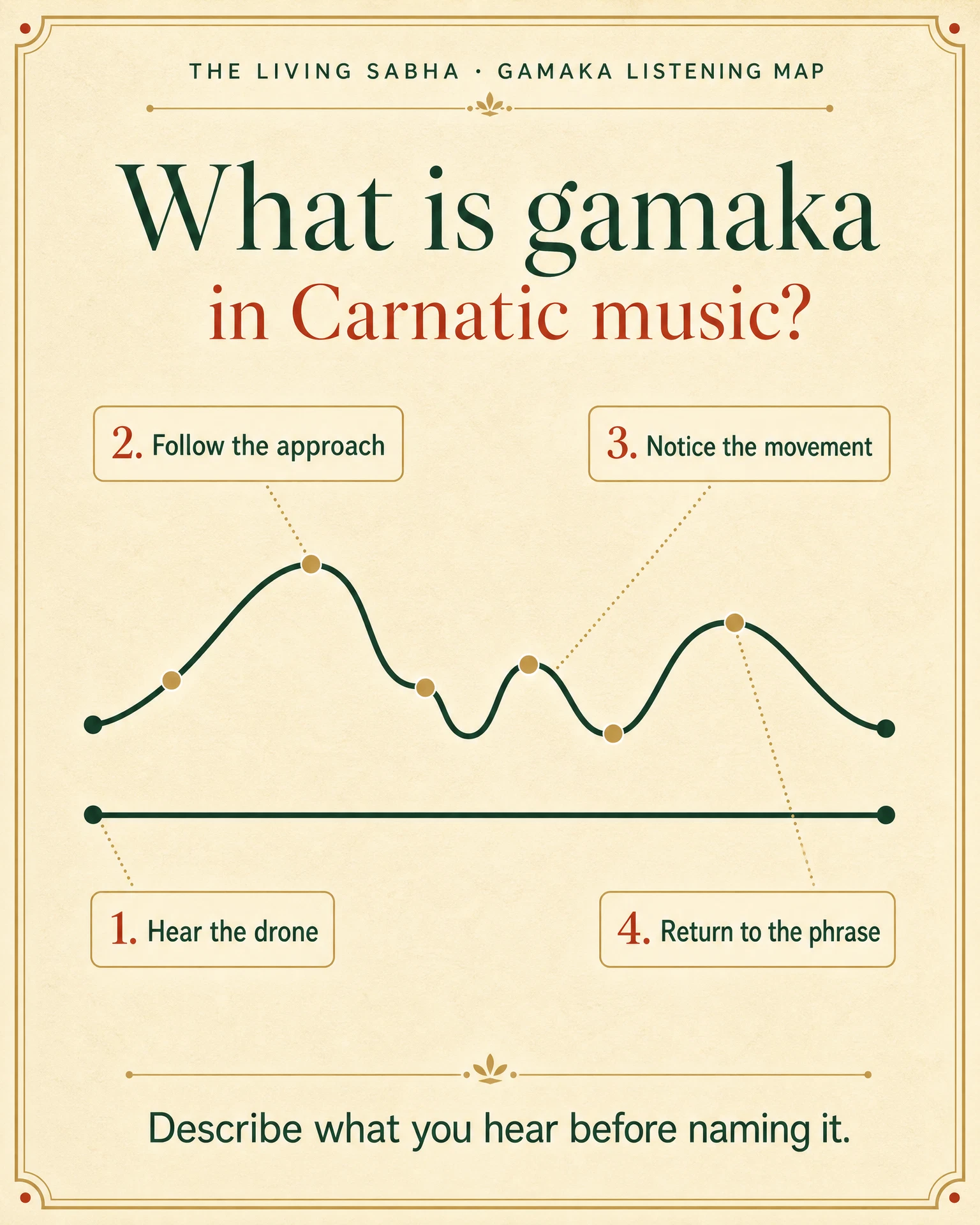
A listening test: follow the route into a note
To understand gamaka, one must first reconsider the nature of a musical note. In many musical systems, a note is treated as a fixed point of pitch. In Carnatic music, while the underlying pitch (svara) is important, the way a performer reaches that pitch, stays on it, or moves away from it is what defines the music. This movement is gamaka.
Beyond fixed pitches
Imagine a journey between two cities. The cities are the fixed points, but the journey itself: the turns, the climbs, and the descents: is what makes the trip memorable. In Carnatic music, the svaras are the cities, and the gamakas are the paths between them. A performer does not just jump from one note to another; they glide, they linger, and they oscillate.
This movement is not an afterthought. It is baked into the very concept of the svara. A svara in a particular raga may always be rendered with a specific type of movement. For example, a note that is played flat in one raga might be played with a heavy oscillation in another, even if they share the same pitch position. This differentiation is what allows the listener to identify the raga.ref-2
The continuity of sound
One of the most striking features of gamaka is its ability to create a sense of continuity. Instead of a series of discrete steps, the music feels like a single, flowing line. This is particularly evident in vocal music and on instruments like the violin or the veena, which can produce smooth transitions between pitches.
For the listener, this continuity creates a sense of emotional resonance. The movement of the sound mirrors the movement of human expression. It is not just a technical feat; it is a way of communicating the essence of the raga. When a performer executes a gamaka correctly, it feels as though the raga is coming to life.
A short listening notebook
Choose a passage of no more than twenty seconds and hear it three times before writing anything down. On the first hearing, listen for the point at which the melody seems to settle. On the second, notice whether the arrival sounds direct, sliding, or gently oscillating. On the third, notice whether the same movement returns when the phrase comes back. These are descriptions of what reaches your ear, not labels you have to get right.
Write one sentence for each hearing. For example: “The phrase seemed to arrive from above,” “the middle note did not stay still,” or “the return had the same curve but a different pace.” Avoid naming a gamaka merely because a chart or a video has supplied a term. A careful observation is more useful than a confident but borrowed label. If the passage remains unclear, stop there. The point is to train attention, not to turn listening into an exam.
This small notebook also protects the listener from a common shortcut. A scale chart can tell you which pitch positions may be available, but it cannot substitute for the sound of a phrase in time. Return to the recording, keep the drone in view, and compare only what you can actually hear. That modest method respects the larger relationship among svara, gamaka, motif, and phrase described in the scholarly source desk.ref-1
Why a scale is not a raga
A common misunderstanding for beginners, and even for some seasoned listeners, is the idea that a raga is defined solely by its scale: the arohana (ascending) and avarohana (descending) patterns of notes. In this view, if you know the notes that a raga uses, you know the raga. While it is true that the scale provides the basic melodic framework and the boundary within which the music moves, it is the gamaka that provides the raga with its unique and recognizable identity. The scale is the skeleton; the gamaka is the flesh, the skin, and the spirit.
The inherent limits of the scale-based view
A scale, by its very nature, is a static list of pitches. It is like a list of ingredients for a recipe. It tells you what is in the dish, but it doesn't tell you how to prepare those ingredients, how to combine them, or how to season them. Two ragas might share the exact same set of notes in their scale: a situation that occurs frequently in the Carnatic system: yet they sound completely different to the listener. This difference is not due to the notes themselves, but to the way those notes are treated with gamaka.
For example, consider a particular svara that appears in two different ragas. In the first raga, that note might always be a steady, resting point, a place of calm and stability. In the second raga, the same note might always be approached with a quick slide from a higher pitch and then immediately oscillated with a narrow, fast shake. These nuances are not captured in a simple scale notation. This is why public forums and beginner discussions are often filled with questions from listeners who are confused as to why two ragas sound so different despite having the same notes. The answer almost always lies in the specific gamakas that are characteristic of each raga.ref-1
The interaction of svara and gamaka in performance
Raga identity is what musicians and scholars call an emergent property. It is not something that exists in any one note or any one movement. Instead, it arises from the complex and dynamic interaction between several key elements: 1. Svara: The fundamental pitch positions that provide the basic melodic material. 2. Gamaka: The specific movements, inflexions, and ornaments applied to those notes and the transitions between them. 3. Motif: The small, recurring melodic seeds or "signatures" that are characteristic of a raga. 4. Phrase: The larger musical units and sentences that define the raga's structural flow and development.
A raga is not a static object that can be fully described on a piece of paper. It is a living musical entity that exists only in the act of performance. The gamaka is the breath that gives the raga its life. When a performer sings or plays a raga, they are not just navigating a scale; they are weaving together these elements in a way that creates a recognizable and emotionally resonant identity. The listener recognizes the raga not by checking the notes against a mental list, but by feeling the characteristic movements and motifs that the performer creates.ref-1
| Element | Role in Raga Identity | Listener's Perspective |
|---|---|---|
| Svara | Provides the basic pitch framework and melodic range. | The "what" of the music: the notes being used. |
| Gamaka | Provides the movement, character, and emotional texture of the notes. | The "how" of the music: the way the notes move and feel. |
| Motif | Provides recognizable melodic seeds and signature patterns. | The "signatures" that make a raga immediately identifiable. |
| Phrase | Provides the structural flow, context, and logical progression. | The "story" of the music: how one idea leads to the next. |
The role of gamaka in raga identity
The relationship between gamaka and raga identity is so close that, in many cases, they are considered to be inseparable. You cannot have the raga without its characteristic gamakas, and the gamakas themselves have no meaning outside the context of the raga. In a very real sense, the gamaka is the raga.
Defining the character and function of a note
In the Carnatic tradition, a note is rarely, if ever, just a note. It is always a svara with a specific, raga-defined gamaka. This is what allows for the incredible variety and depth of the hundreds of ragas that exist in the system. By changing the way a note is oscillated, approached, or left, a performer can completely change the mood and the identity of the music.
This is why computational studies of Carnatic music, such as those published by the IEEE, focus so heavily on the analysis of gamaka. By using sophisticated algorithms to analyze the melodic inflexions in a recording, researchers can identify which raga is being performed with a high degree of accuracy. The way a note is rendered: its duration, its pitch contour, the speed and width of its oscillation, and its relationship to the notes that come before and after it: provides a wealth of information that defines the raga's identity. For the machine, as for the human listener, the movement is the key to recognition.ref-2
The synthesis of motif and phrase
Gamaka does not exist in isolation. It is always part of the larger motifs and phrases that make up a raga's vocabulary. A motif is a small, recurring musical idea that acts as a signature for a raga. These motifs are almost always defined by a specific and unique combination of svaras and gamakas. When a listener hears a raga, they are not just hearing a sequence of individual notes; they are hearing these recurring motifs that their ear has learned to recognize.
The gamaka within the motif is what makes it distinctive. A slide that curves in a particular way, or an oscillation that settles on a specific pitch, is what makes the motif recognizable as belonging to a specific raga. Similarly, the way phrases are constructed: the logical and aesthetic way that one note leads into another: is governed by the rules of gamaka for that specific raga. This is why the identity of a raga is considered to be the interaction of all these elements: svara, gamaka, motif, and phrase. They work together to create a unified and coherent musical world.ref-1
The emotional and aesthetic impact of raga identity
Beyond the structural and technical aspects, the role of gamaka in raga identity is also deeply emotional and aesthetic. Each raga is said to have its own bhava, or emotional essence. This bhava is communicated primarily through the gamakas. A raga that is meant to evoke a sense of devotion or peace might use slow, gentle, and sustained gamakas. A raga that is meant to be energetic or heroic might use fast, sharp, and vigorous movements.
The listener does not need to be a musicologist to feel this emotional impact. The movements of the sound speak directly to the listener's feelings. When a performer masters the gamakas of a raga, they are able to communicate its emotional essence with profound clarity. This is why a performance of a raga can be such a moving experience. The gamaka is not just a technical detail; it is the medium through which the performer and the listener share the emotional world of the raga. It is the movement that touches the heart.
Melodic inflexions and note differentiation
One of the primary functions of gamaka in the Carnatic system is to differentiate the treatment of notes, especially when those notes appear in ragas with similar or even identical pitch structures. This is a crucial aspect of the music's grammar, as it allows for a vast array of ragas to be distinguished from one another using a relatively small set of basic svaras. The differentiation is achieved through what researchers call melodic inflexions: subtle but significant variations in pitch, timing, and intensity that are applied to a note.ref-2
The sophisticated nuance of melodic inflexion
A melodic inflexion, in the context of gamaka, is not a random or decorative change. It is a precise and intentional modification of the sound that gives a svara its specific "flavor" or "character" within a raga. These inflexions can take many forms, including: - A subtle, almost imperceptible rise in pitch at the very end of a sustained note. - A gentle, curved dip in pitch at the beginning of a note as the performer approaches it from below. - A sustained, rhythmic oscillation that fluctuates around the central pitch of the svara. - A quick, sharp flick of the pitch that adds a sense of energy or accent to a phrase.
These inflexions are not just for aesthetic appeal; they serve a deep structural purpose. They help to anchor each svara within the raga's melodic framework and to signal its relationship to the other notes in the phrase. For example, a svara that acts as a dominant or "anchor" note in a particular raga might be rendered with a more prominent and sustained gamaka to highlight its importance. Conversely, a svara that is used primarily as a passing note might be treated with a much more subtle and fleeting inflexion. The study of these inflexions is a major focus of computational musicology, as they provide the data necessary to identify and distinguish between different ragas and performance styles.ref-2
The power of differentiation in similar ragas
The most powerful and clear demonstration of the role of gamaka is found in the differentiation of ragas that share the exact same scale or pitch inventory. In these cases, the notes themselves are identical in their basic pitch positions, yet the ragas sound completely different to the listener. This is because the gamakas applied to those notes are distinct.
Consider two ragas that both use the same seven notes in their scale. In the first raga, a particular note might always be rendered with a wide, slow, and heavy oscillation that creates a sense of gravity and depth. In the second raga, the same note might be treated as a flat, steady pitch that is only occasionally touched by a narrow, fast shake. These differences in movement are immediately apparent to an attentive listener, even if they do not have the technical vocabulary to name the specific gamakas being used. This is what musicians often refer to as the "magic" of Carnatic music: the ability to create an almost infinite variety of musical worlds from a limited set of basic notes, all through the artful application of movement.ref-2
The structural integrity of movement
It is also important to note that these movements are not just applied to individual notes in isolation. They are part of the larger melodic contour of the raga. The way a performer moves from one note to the next is just as important as the way they treat the notes themselves. A slide between two notes in one raga might be slow and curved, while in another raga, the same transition might be quick and direct.
This structural integrity means that the gamakas are not just ornaments that can be added or removed at will. They are an integral part of the raga's DNA. If you were to remove the gamakas from a performance, the raga would essentially disappear, leaving behind only a dry and meaningless sequence of pitches. The movement is what gives the music its shape, its direction, and its meaning.
Historical and pedagogical perspectives
The study and classification of gamaka have a long and distinguished history within the Carnatic tradition. From the earliest musical treatises to the modern classroom, gamaka has been recognized as a central pillar of the music's structure and pedagogy.
Distinguishing gamaka from simple decorative shakes
One of the most important points emphasized in historical and pedagogical discussions is the distinction between a true gamaka and a simple decorative shake or vibrato. While a shake is a basic physical movement that can be applied to any sound to give it a bit of texture, a gamaka is a sophisticated and rule-bound musical concept.
According to resources that quote historical materials from the University of Madras, gamaka is considered a fundamental part of the music's very structure. It is not something that is added to a pre-existing melody; it is the material from which the melody is constructed. This distinction is vital for both students and listeners. It encourages a deeper appreciation for the intentionality and the complexity behind every movement heard in a performance. A gamaka is not just a "shake"; it is a precise musical gesture that carries the history and the grammar of the raga.ref-3
The central role of gamaka in musical pedagogy
For a student of Carnatic music, the mastery of gamaka is one of the most significant milestones in their training. It is often said that a student truly begins to "understand" a raga only when they can correctly execute its characteristic gamakas. This process requires not only technical proficiency on their instrument or voice but also a deep internalisation of the raga's aesthetic and structural rules.
Gamakas are not taught in isolation. Instead, they are introduced as an integral part of the basic exercises (alankaras), the pedagogical compositions (varnams), and the concert repertoire (kritis) that students practice every day. By learning how to render specific gamakas in the context of these pieces, students begin to understand the "logic" of the raga. They learn which movements are allowed, which are required, and how the movements should be shaped to reflect the raga's character. This pedagogical approach ensures that the tradition of gamaka is passed down from teacher to student with its structural and aesthetic integrity intact.ref-3
The evolution of gamaka classification
Over the centuries, various scholars and musicians have attempted to classify and categorize the many different types of gamakas. While the specific names and numbers of these categories have varied over time: with some systems identifying ten basic gamakas (dashavidha) and others identifying fifteen (panchadasha): the underlying goal has always been the same: to provide a systematic way of understanding and teaching the movements that define the music.
These classifications are not just academic exercises. They provide a common language for musicians to discuss their art and for teachers to guide their students. For the listener, knowing that these classifications exist can provide a sense of the incredible depth and sophistication of the tradition. It shows that the movements they hear are not random, but are part of a highly organized and deeply considered musical system. The history of gamaka is the history of the music itself.ref-3
Vocal and instrumental perspectives in history
The historical study of gamaka also highlights the different ways that movement is produced in vocal and instrumental music. While the musical concept of a gamaka remains the same across all mediums, the physical means of producing it are quite different. Vocal pedagogy focuses on the subtle control of the breath and the vocal apparatus to create smooth and precise inflexions. Instrumental pedagogy, on the other hand, focuses on the specific techniques required by each instrument: such as the sliding of the fingers on the violin or the pulling of the strings on the veena.
This historical focus on the physicality of gamaka reminds us that Carnatic music is a deeply embodied tradition. The movements of the sound are the result of the physical movements of the performer. This connection between the body, the instrument, and the musical idea is a central theme in the historical and pedagogical literature of the tradition. It is one of the things that makes the performance of gamaka so compelling to watch as well as to hear.ref-3
| Pedagogical Stage | Role of Gamaka | Goal for the Student |
|---|---|---|
| Basic Exercises | Introduction to simple slides and oscillations. | Developing basic pitch control and flexibility. |
| Varnams | Practice of raga-specific gamaka patterns in a structured form. | Internalizing the "grammar" and characteristic movements of different ragas. |
| Kritis | Application of gamaka in expressive, lyrical compositions. | Learning to use movement to communicate the emotional essence (bhava) of the raga. |
| Improvisation | Spontaneous creation of melodic lines using the rules of gamaka. | Achieving creative mastery and a deep, personal connection to the raga identity. |
The listener's experience: How to hear gamaka
For many listeners, especially those who are new to the tradition, the concept of gamaka can initially seem like a complex and mysterious subject, shrouded in technical jargon and ancient history. However, the truth is that gamaka is a deeply intuitive and visceral part of the musical experience. You do not need a degree in musicology to appreciate the beauty and the power of these movements. With a bit of patience and a few simple listening strategies, anyone can learn to hear, identify, and enjoy the incredible world of gamaka.
Developing an ear for the "in-between" spaces
The first and most important step in hearing gamaka is to shift your focus away from the notes themselves and toward the spaces between the notes. In many other musical traditions, the "correct" way to hear a melody is to focus on the arrival at each pitch. In Carnatic music, the "correct" way is to focus on the journey between the pitches.
Try to listen for what happens in the "in-between" spaces. Instead of waiting for the next note to arrive, pay attention to how the performer gets there. Notice the subtle slides, the graceful dips, and the way the sound seems to curve and bend. You might find it helpful to close your eyes and imagine the sound as a physical object moving through space. Does it move in a straight line, or does it take a more winding path? Is the movement smooth and continuous, or does it have a more jagged, rhythmic quality? By focusing on these details, you are already beginning to hear the essence of gamaka.
Identifying the characteristic "breath" of a raga
As you spend more time listening to a particular raga, you will start to notice that certain movements and inflexions seem to return again and again. These are the raga's "breath": the characteristic gamakas that give the raga its unique life and identity. Just as every person has a unique way of breathing and speaking, every raga has a unique way of moving through its svaras.
When you hear a raga that you find particularly beautiful or recognizable, try to identify the specific movements that make it so. Is there a particular slide that always seems to occur at a certain point in the scale? Is there a specific way of shaking a note that gives the raga its emotional depth? By identifying these signature movements, you will develop a much deeper and more personal connection to the music. You will start to hear the raga not as a collection of notes, but as a living entity with its own personality and its own way of moving.ref-1
Listening for the relationship between svara and movement
Another useful listening strategy is to pay attention to the relationship between the central pitch of a svara and the gamaka that is applied to it. In many cases, the gamaka will fluctuate around the svara, sometimes moving above it, sometimes below it, and sometimes touching it only briefly.
Ask yourself: - How much of the sound is spent on the central pitch, and how much is spent on the movement? - Does the movement feel like it is pulling away from the svara, or is it circling around it? - How does the intensity of the sound change as the movement progresses?
By asking these questions, you will begin to appreciate the incredible precision and control that the performer must exercise to execute a gamaka correctly. You will also begin to see how the gamaka is not just an ornament, but a way of exploring and expanding the meaning of the svara itself.
Common misconceptions: Shakes vs. Gamaka
One of the most common and persistent misconceptions about gamaka is that it is simply a "shake," a "vibrato," or a "trill." While these terms are sometimes used as a convenient shorthand in casual conversation, they do not even begin to capture the full scope and sophistication of what gamaka actually is. To truly appreciate the music, it is essential to understand the fundamental differences between these concepts.
The profound intentionality of gamaka
A shake or a vibrato, in many other musical contexts, is often a general, expressive effect that a performer applies to a note to give it more warmth, depth, or emotion. It is a stylistic choice that can be applied to almost any note at the performer's discretion. In contrast, a gamaka is a specific, intentional, and rule-bound movement that is deeply tied to the identity and the grammar of a raga.
A Carnatic performer does not just "shake" a note because they feel like it. They execute a specific movement, at a specific speed, with a specific width, and in a specific relationship to the neighboring notes, because that is what the raga requires. The intentionality behind a gamaka is much higher than that of a simple vibrato. Every movement is a deliberate musical statement that must conform to the aesthetic and structural rules of the raga. This is why the study of gamaka is so rigorous and why its correct execution is considered a mark of true musical mastery.ref-3
The structural role of movement in raga identity
Another common misconception is that gamaka is an optional "decoration" or an "ornament" that is added to a pre-existing melody. In this view, you could take a melody, remove all the gamakas, and still have the same melody, just in a simpler form. In the Carnatic tradition, however, this is simply not true. Gamaka is structural, not decorative.
Think of gamaka as the mortar between the bricks of a grand building. The bricks (the svaras) provide the basic material and the structural support, but the mortar (the gamaka) is what holds them together, fills the gaps, and gives the building its final shape and character. You cannot have the building without the mortar, and you cannot have the raga without the gamaka. If you were to remove the gamakas from a raga, you would not be left with a simpler version of the raga; you would be left with something else entirely: a dry, flat scale that lacks all the essential features that make the raga recognizable. The movement is not an addition to the music; it is the music itself.ref-1
The difference between physical movement and musical concept
Finally, it is important to distinguish between the physical movement of the performer and the musical concept of the gamaka. While a gamaka is produced through a physical movement: such as the oscillation of a finger on a string or the modulation of the vocal cords: the gamaka itself is a musical idea.
A simple shake is a physical action. A gamaka is a musical gesture that carries meaning, history, and grammar. This is why pedagogical resources, such as those from the University of Madras, take such care to distinguish between the two. By understanding that gamaka is a sophisticated musical concept, the listener can begin to appreciate the intellectual and artistic depth of the tradition. It is not just about the physical ability to shake a note; it is about the musical intelligence required to know how to shake it, when to shake it, and why.ref-3
| Concept | Simple Shake / Vibrato | Carnatic Gamaka |
|---|---|---|
| Definition | A general, expressive fluctuation of pitch. | A specific, rule-bound melodic movement or inflexion. |
| Intentionality | Often a stylistic choice made by the performer. | A structural requirement defined by the rules of the raga. |
| Role | Decorative; adds texture and warmth to a note. | Fundamental; defines the identity and character of the raga. |
| Context | Can be applied to many different notes and styles. | Deeply tied to the specific grammar of each individual raga. |
| Complexity | Generally a simple, repeating physical movement. | A sophisticated musical gesture involving pitch, time, and intensity. |
Technical aspects of movement
While this guide is primarily written for the listener, a basic understanding of the technical and physical aspects of how gamakas are produced can greatly enhance your appreciation of the music. The production of gamaka is a remarkable feat of physical control and musical intelligence, requiring the performer to manipulate pitch, time, and intensity with extreme precision.
The diverse physicality of vocal and instrumental rendering
One of the most fascinating aspects of gamaka is how the same musical concept is translated into different physical actions depending on the medium of performance. Whether it is the human voice, a stringed instrument like the violin or the veena, or even a wind instrument, the goal is always the same: to create the specific melodic inflexion required by the raga. However, the means of achieving this goal are quite diverse.
In vocal music, gamakas are produced through the subtle and highly coordinated movements of the vocal cords, the throat, and the breath. A singer must be able to modulate their pitch continuously and accurately, often at high speeds. This requires years of dedicated practice to develop the necessary flexibility and control. The voice is perhaps the most natural medium for gamaka, as it can produce smooth, curved transitions between pitches with unparalleled ease.
On stringed instruments, the techniques are different but equally sophisticated. On the violin, which has become a staple of Carnatic music, gamakas are primarily produced through the sliding of the fingers along the strings and the use of continuous bowing to sustain the sound. The violinist must be able to mimic the fluid, vocal-like movements of the raga while maintaining the technical requirements of the instrument. On the veena, a traditional Indian lute, gamakas are often produced by pulling the strings sideways across the frets, which increases the tension and raises the pitch. This technique allows for a wide range of expressive oscillations and slides that are characteristic of the instrument's sound.
Despite these physical differences, the underlying musical concept remains consistent. A slide on a violin and a slide in a vocal performance are heard as the same gamaka because they follow the same melodic rules and serve the same structural purpose within the raga. This universality of the gamaka concept is evidence of its fundamental importance in the Carnatic tradition.ref-3
The critical role of time, duration, and intensity
It is a common mistake to think of gamaka as being only about pitch. In reality, the elements of time and intensity are just as important in defining a movement. The duration of a gamaka: how long it takes to move from one pitch to another, or how long a particular oscillation is sustained: is a key factor in its character.
For example, a slow, heavy, and sustained oscillation (often referred to in technical terms as kampita) creates a very different emotional and structural effect than a quick, light, and fleeting shake. The slow movement might evoke a sense of solemnity or depth, while the fast movement might add a sense of brilliance or excitement. The performer must be able to control the speed and the rhythm of the movement with absolute precision to match the requirements of the raga.
Intensity, or volume, also plays a crucial role. A slide that begins softly and gradually increases in volume as it reaches its destination creates a sense of growing tension and anticipation. Conversely, a movement that starts with a strong accent and then fades away can create a sense of resolution or release. The subtle manipulation of these dynamics is what gives gamaka its incredible expressive power and allows the performer to communicate the fine nuances of the raga's emotional essence. By paying attention to these details, the listener can begin to appreciate the true depth and complexity of the music.ref-2
The computational view of gamaka
In recent decades, the study of gamaka has moved beyond the traditional realms of performance and pedagogy and into the field of computational musicology. Researchers are now using sophisticated digital tools and algorithms to analyze, model, and understand these complex musical movements in ways that were previously impossible. This work provides a fascinating new perspective on the structure and the identity of Carnatic music.
Analyzing melodic contours and pitch trajectories
A primary focus of computational research is the analysis of melodic contours: the precise trajectories of pitch over time in a recording. By using specialized software to track the fundamental frequency of a performance, researchers can create detailed visual representations of gamakas. These "pitch graphs" reveal the hidden structure of the movements that our ears perceive as slides and shakes.
This research has provided scientific confirmation for many of the traditional views on gamaka. For example, computational analysis has shown that gamakas are not just random or idiosyncratic variations made by individual performers. Instead, they are highly structured, consistent, and rule-bound patterns. Even when performed by different musicians on different instruments, the fundamental pitch trajectories of a specific gamaka in a specific raga remain remarkably similar. This provides strong evidence for the idea that gamakas are a central and objective part of the raga's identity, rather than just a subjective matter of style.ref-2
The challenge and promise of automated raga identification
One of the most ambitious goals of computational musicology is the development of systems that can automatically identify a raga from a digital recording. Because gamaka is so central to raga identity, it is the primary focus of these identification systems. A machine cannot identify a raga simply by looking at a list of notes; it must be able to "hear" and analyze the movements.
Researchers are training machine-learning algorithms to recognize the specific melodic inflexions, motifs, and phrases that characterize different ragas. This is a highly complex task, as it requires the system to distinguish between the essential movements of the raga and the personal stylistic choices of the performer. However, significant progress is being made. These systems are becoming increasingly accurate, and they are already being used in applications such as music retrieval, archiving, and even as tools for music education.
Deepening our understanding of musical structure
Beyond its practical applications, the computational study of gamaka is also helping to deepen our theoretical understanding of Carnatic music. By providing a precise and objective way to describe and compare movements, this research is uncovering new insights into the grammar and the logic of the raga system. It is helping to clarify the relationship between svara and gamaka, and to show how the different elements of raga identity: motif, phrase, and movement: work together to create a unified musical whole.
For the listener, the computational view offers a new way to appreciate the music. It shows that the beautiful and expressive movements we hear are also part of a highly sophisticated and mathematically precise system. It reminds us that Carnatic music is not only a profound art form but also a complex and fascinating field of study. The machine's perspective, while different from our own, can help us to see the music with fresh eyes and to appreciate its beauty in a new light.ref-2
| Research Focus | Computational Method | Contribution to Knowledge |
|---|---|---|
| Melodic Contours | Pitch tracking and trajectory analysis. | Confirms the structural consistency and rule-bound nature of gamaka. |
| Raga Identification | Machine learning and pattern recognition. | Demonstrates the central role of movement in defining raga identity. |
| Note Differentiation | Statistical analysis of pitch inflexions. | Shows how subtle variations in movement distinguish similar ragas. |
| Style Analysis | Comparison of pitch trajectories across performers. | Helps to distinguish between raga-essential and performer-specific movements. |
Listening practices and exercises
Developing a deep and nuanced ear for gamaka is a journey that takes time and practice. However, you can begin to see results almost immediately by incorporating a few simple and focused listening exercises into your routine. The goal of these practices is not to turn you into a technical expert overnight, but to help you become a more attentive and appreciative listener. By narrowing your focus and asking specific questions, you can start to peel back the layers of the music and discover the incredible detail that lies within every movement.
The "One-Note" challenge: A study in focus
One of the most effective ways to train your ear is to focus all of your attention on a single svara. Choose a high-quality recording of a raga that you find particularly engaging. As you listen, identify one note that seems to be a recurring point of emphasis or expression. It might be a note that is sustained for a long time, or one that is always rendered with a prominent oscillation.
Every time that specific note appears in the performance, try to focus exclusively on the gamaka being applied to it. - Analyze the entry: How does the performer arrive at the note? Is it a direct hit, or is there a subtle slide from above or below? - Observe the stay: What happens while the performer is on the note? Is it a steady, flat pitch, or is there a rhythmic oscillation? If there is an oscillation, pay attention to its speed and its width. Does it stay constant, or does it change over time? - Track the exit: How does the performer leave the note? Do they drop off quickly, or do they glide smoothly into the next svara?
By repeating this exercise with different notes and different ragas, you will begin to appreciate the incredible variety and precision that goes into the treatment of every single svara. You will also start to notice that the same note can be treated in many different ways, depending on its role in the raga.
The "Comparison" exercise: Understanding individual expression
Carnatic music is a tradition that values both strict adherence to raga rules and individual artistic expression. The "Comparison" exercise is a great way to explore this balance. Find two different recordings of the exact same raga, preferably by different performers or on different instruments (for example, a vocal version and a violin version).
Listen to how the two performers render the same characteristic motifs and phrases of the raga. - Compare the gamakas: Do they use the same types of movements? Are the slides and oscillations similar in shape and timing? - Notice the differences: Where do the performers differ in their approach? Does one performer use a faster oscillation, while the other prefers a slower, more sustained movement? Does one performer emphasize a particular slide that the other treats more subtly? - Evaluate the impact: How do these individual choices change the overall feeling and character of the raga for you? Does one version feel more energetic, while the other feels more contemplative?
This exercise will help you to see that while the fundamental rules of the raga are consistent, there is still plenty of room for individual interpretation and creativity. It will also help you to develop a more sophisticated and personal taste in music.
The "Silent Singing" practice
Even if you are not a singer, you can use your internal "voice" to help you understand gamaka. As you listen to a performance, try to "sing along" in your mind. Focus on mimicking the curves and the movements of the melody as accurately as possible. Imagine the physical sensation of the sound moving in your throat or on your fingers.
This practice helps to internalize the melodic contours of the raga and makes you more sensitive to the subtle inflexions of the gamaka. You will find that when you try to "sing" a movement in your head, you become much more aware of its precise shape and timing. It is a powerful way to bridge the gap between hearing the music and feeling it.
A three-hearing notebook for gamaka
Keeping a listening notebook is a wonderful way to track your progress and to build a deeper, more conscious relationship with the music. The goal is not to write a technical analysis, but to record your honest observations and questions. By listening to the same piece three times and focusing on different aspects each time, you can gain a much richer understanding of the role of gamaka.
First hearing: Capturing the overall emotional landscape
On your first hearing of a new piece or a new raga, try to resist the urge to analyze. Instead, simply let the music wash over you and focus on the overall emotional landscape and mood. - Describe the atmosphere: Does the raga feel bright, joyful, and energetic? Or does it feel somber, meditative, and deep? - Note the general movement: Does the music feel like it is constantly moving and shifting, or are there long periods of stillness and stability? - Record your initial reaction: What is your general impression of the performance? What emotions does it evoke in you?
Write down a few plain sentences in your notebook. For example: "The raga felt very serious and heavy. There was a lot of slow, deep movement that made me feel calm."
Second hearing: Focusing on the mechanics of movement
On your second hearing, shift your attention to the specific gamakas and motifs that you hear. - Identify the points of movement: Where do you notice the most prominent slides, shakes, and oscillations? Are there specific svaras that seem to be the focus of the performer's attention? - Look for patterns: Can you identify any recurring melodic seeds or signature motifs? How are these motifs defined by the gamakas? - Observe the transitions: Pay close attention to how the performer moves between notes. Notice the slides and the curved transitions that create the sense of continuity.
In your notebook, try to be as specific as possible. For example: "I noticed a very long, slow slide from the fifth note down to the second note. This movement returned several times in the opening section."
Third hearing: Connecting movement to identity and meaning
On your third hearing, try to synthesize your observations and connect the movements you've noticed to the identity and the meaning of the raga. - Analyze the raga identity: How do the specific gamakas you've identified contribute to the raga's unique character? What would the raga sound like if these movements were changed or removed? - Reflect on the performance: How did the performer's choice of gamakas enhance your understanding of the raga? What did you learn about the raga from this specific rendering? - Formulate new questions: What are you still curious about? What aspects of the gamaka or the raga do you want to explore further?
Your notebook entries for the third hearing should reflect a deeper level of engagement. For example: "The slow, wide oscillation on the third note seems to be the heart of this raga's identity. It creates a sense of longing that defines the entire performance. I wonder if this same note is treated differently in other ragas that use the same scale."
By using this three-hearing approach, you will find that your listening becomes much more active, informed, and rewarding. You will start to see the music not as a mystery to be solved, but as a rich and beautiful world to be explored.
The relationship between gamaka and tala
While gamaka is primarily a melodic concept, it exists within the rhythmic framework of the tala. The relationship between these two elements is one of the most dynamic and exciting aspects of Carnatic music. The movement of the melody must always be coordinated with the cycle of the rhythm.
The interplay of melodic and rhythmic cycles
A tala is a repeating rhythmic cycle that provides the time framework for the music. As the performer executes the gamakas of the raga, they must also remain aware of where they are in the tala cycle. This creates a fascinating interplay between the fluid, curved movements of the melody and the steady, pulse-based structure of the rhythm.
For example, a performer might time a long, slow slide so that it arrives at a key svara exactly on the first beat of the tala cycle (the samam). Or they might use a series of quick, rhythmic gamakas to create a sense of syncopation against the steady pulse of the rhythm. This coordination requires a high degree of skill and creates a sense of structural unity in the performance.
How tala influences the shape of gamaka
The tala can also influence the shape and the timing of the gamakas themselves. In a slow-tempo tala, the performer has more time to explore the subtle nuances of a movement, allowing for wider oscillations and longer slides. In a fast-tempo tala, the gamakas must be more compact and direct to fit within the shorter time intervals.
The listener can pay attention to this relationship by trying to follow the tala pulse while also focusing on the melodic movements. Notice how the performer uses the gamakas to highlight the key beats of the rhythm, and how the rhythm provides a sense of grounding for the fluid melody. This dual focus will give you a much more complete and satisfying listening experience.
The ethics of listening: Respecting the tradition
As you read more closely into the study of gamaka, it is important to maintain a sense of respect for the tradition and its practitioners. Carnatic music is a deeply rooted and highly sophisticated art form that has been preserved and refined over many centuries.
The role of the Guru-Shishya relationship
The mastery of gamaka is traditionally passed down through the Guru-Shishya parampara: the relationship between a teacher and a student. This oral transmission is the only way to learn the nuances of the ragas. As a listener, it is important to recognize that your understanding is different from the practical knowledge of a trained musician.
Approach the music with humility and a willingness to learn. Avoid making overconfident claims or trying to "correct" a performer based on a limited understanding. The beauty of the tradition lies in its depth, and there is always more to discover.
Supporting the living tradition
The best way to respect the tradition is to support its practitioners. Attend concerts, listen to credited recordings, and engage with the music in a sustained way. By being an attentive listener, you play a role in the continued health of the tradition. Your engagement helps ensure that the art of gamaka will be cherished for generations.
Listening to Carnatic music is a form of participation in a great cultural conversation. By learning to hear the movement in the sound, you are joining that conversation and becoming a part of the living tradition of the raga.
Source desk
This guide is built upon a foundation of high-quality, verified research and educational materials. The aim is to provide the listener with a reliable and evidence-led introduction to the complex subject of gamaka. The following sources have been instrumental in shaping the content and the claims made in this guide.
| Source | Type | Key Contribution to the Guide |
|---|---|---|
| University of Pompeu Fabra Repository ref-1 | Academic Conference Paper | Provides the theoretical framework for understanding raga identity as the interaction of svara, gamaka, motif, and phrase. This source is the basis for our discussion on how movement defines the character of a raga. |
| IEEE Xplore Publication ref-2 | Technical Research Paper | Offers a detailed analysis of melodic inflexions and the computational identification of gamaka. This source provides the scientific evidence for the structural consistency and rule-bound nature of melodic movements. |
| CarnaticStudent.org Resource ref-3 | Educational Resource (quoting University of Madras) | Supplies the historical and pedagogical context for the distinction between a true gamaka and a simple decorative shake. This source informs our discussion on the history and the teaching of gamaka. |
By relying on these diverse sources: academic, technical, and educational: we are able to offer a comprehensive and balanced perspective on gamaka that respects both the tradition's history and its modern scientific study.
What this guide does not claim
In the spirit of honest and responsible listening, it is important to be clear about the limits of this guide. While we have aimed for depth and accuracy, there are several things that this guide does not claim to do: - No technical performance manual: This guide is written for the listener, not the practitioner. It does not provide the technical instructions or the physical exercises necessary to perform gamakas on any instrument or with the voice. - No exhaustive list of gamakas: The Carnatic system contains a vast number of named gamakas, each with its own specific rules and nuances. This guide does not attempt to list or define every one of them. - No "correct" interpretation: Music is a living art, and different performers may interpret the same raga and its gamakas in slightly different ways. This guide does not claim that any one artist's rendering is the only "correct" or "authentic" version. - No replacement for a Guru: The study of Carnatic music is a lifelong journey that is best undertaken with the guidance of a qualified teacher. This guide is intended to supplement, not replace, the deep and personal learning that happens in the Guru-Shishya relationship. - No historical finality: The history of gamaka is long and complex, with many different theories and classifications emerging over the centuries. This guide provides a summary of the most widely accepted views but does not claim to be the final word on the subject's historical evolution.
By acknowledging these limits, we hope to encourage a more humble and curious approach to listening. The goal is to open a door to the world of gamaka, not to close it with a set of final answers.
Frequently asked questions
Q: Is gamaka the same as vibrato in Western classical music? A: While there are similarities, the concepts are different. Vibrato is an expressive effect applied to a note for texture. Gamaka is a structural, rule-bound movement essential to a raga's identity. A performer cannot omit a gamaka; it is a required part of the raga's grammar.
Q: Can a listener identify gamakas without musical training? A: Yes. Any attentive person can learn to hear the movements that define a raga. The key is focusing on the "in-between" spaces. By using the listening practices in this guide, you can develop a sophisticated ear for gamaka over time.
Q: Why do some ragas sound similar if they have different gamakas? A: Some ragas share the same scale, making them sound similar initially. However, the gamakas applied to those notes are distinct. One raga might use a slow oscillation while another uses a fast shake. As your ear becomes attuned to these differences, the ragas will sound more distinct.
Q: Do all instruments produce gamakas in the same way? A: No. Each instrument has its own physical means of production. A singer uses the voice, a violinist slides on strings, and a veena player pulls strings. However, the musical concept remains the same across all mediums. The linked masterclass is used only as attributable practitioner context for listening and learning, not as a universal model ref-5.
Q: Is the study of gamaka still relevant today? A: It remains relevant for performers, listeners, and researchers. Digital raga-recognition research studies ornamentation as part of melodic identity, although it does not replace learning with a teacher ref-4. Movement in sound remains at the heart of Carnatic music.
Concluding thoughts: The beauty of movement
As we reach the end of this guide, it is worth reflecting on the beauty and power of gamaka. In a world that often values speed and fixed answers, gamaka reminds us of the importance of movement and nuance. It shows that the most meaningful things are often found in the "in-between" spaces: in the curves and oscillations of the sound.
For the listener, studying gamaka is a path to a deeper connection with the music. It is a way of moving beyond the surface melody into the heart of the raga. By learning to hear the movement, you are not just learning a skill; you are developing a new way of perceiving the world. You learn to appreciate the beauty of a curved line and the depth of a living tradition.
We hope this guide has provided the tools to continue your exploration of gamaka. Whether you are a long-time fan or a newcomer, there is always more to discover in the world of melodic movement. The next time you listen to a raga, take a moment to focus on the "in-between" spaces and let the movement of the sound carry you away. The raga is waiting to be heard.
References
- Pompeu Fabra research repository on raga identity and phrase
- IEEE study of melodic inflexions and computational gamaka identification
- CarnaticStudent pedagogical context for gamaka
- Carnatic Raga Recognition study
- Sudha Ragunathan Carnatic Music Masterclass
ref-1 University of Pompeu Fabra Repository. "Raga identity through the interaction of svara, gamaka, motif, and phrase." https://repositori.upf.edu/items/66551730-fbd2-4d9a-ba20-3060472d04bc
ref-2 IEEE Xplore. "Melodic inflexions and computational identification of gamaka in Carnatic music." https://ieeexplore.ieee.org/document/7346662/
ref-3 CarnaticStudent.org. "Gamaka in Vocal and Instrumental Music: Historical and Pedagogical Context." https://www.carnaticstudent.org/gamaka-in-vocal-and-instrumental-music/
ref-4 Indian Journal of Science and Technology. "Carnatic Raga Recognition." Scholarly discussion of ornamentation in raga identification. https://indjst.org/download-article.php?Article_Unique_Id=INDJST1716&Full_Text_Pdf_Download=True
ref-5 Sudha Ragunathan. "Carnatic Music Masterclass." Attributable practitioner teaching context for listening and learning. https://www.youtube.com/watch?v=mFow3Up_ba4