
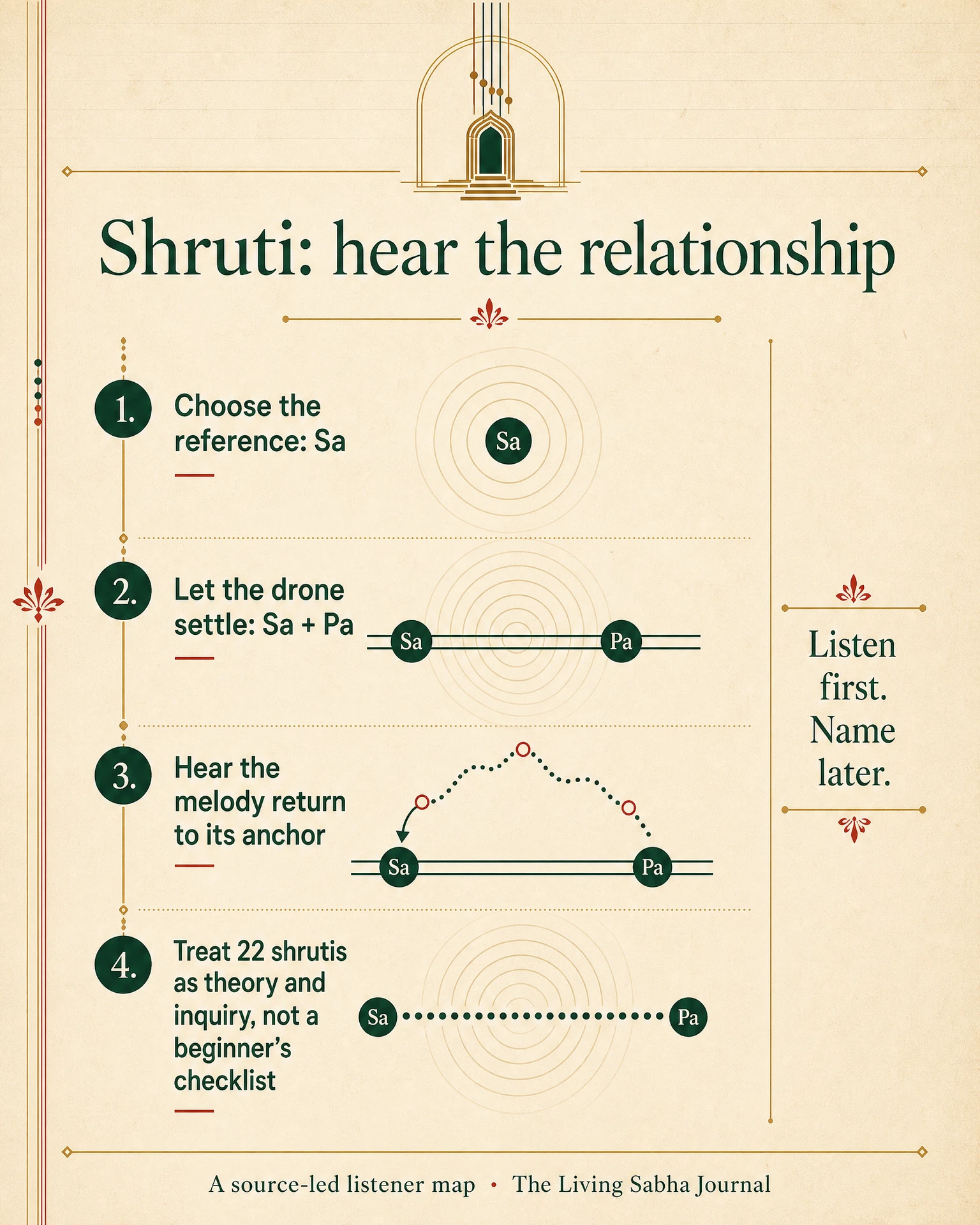
A short answer
In the context of Carnatic music, the word shruti carries two primary meanings that every listener should distinguish. The first and most practical meaning refers to the foundational reference pitch, often called the tonic, which serves as the anchor for an entire performance. When a musician speaks of setting the shruti, they are choosing the specific frequency that will represent the note Sa, the starting point for all other melodic movement. The second meaning involves the theoretical study of microtones, specifically the 22-shruti system, which explores the fine gradations of pitch that exist between the primary notes of a scale. For a listener, the most important realization is that shruti is not a static list of notes to be memorized, but a dynamic relationship between a constant drone and the melodic phrases that dance above it. ref-3
It is helpful to begin with a modest claim. Shruti is the literal and metaphorical floor upon which the music stands. Without a stable shruti, the complex structures of raga and tala would lack a point of reference, making it impossible for the listener to perceive the intended emotional and technical nuances of the composition. However, shruti is not a universal constant like the speed of light. It is a choice made by the performer, influenced by their voice or instrument, the requirements of the raga, and the setting of the concert. A listener who understands this relative nature of pitch can begin to appreciate the subtle tension and resolution that defines the Carnatic musical experience.
For a new listener, the best first question is not, "Can I identify every microtonal variation?" It is, "Can I hear the relationship between the singer's voice and the continuous sound of the drone?" This guide provides the tools to build that awareness, moving from the basic concept of the tonic to the more complex discussions surrounding microtonal theory and empirical measurements of pitch.
The meaning of setting the shruti
When a Carnatic musician says, "set the shruti," they are performing an act of calibration that defines the entire musical space for the duration of the performance. This process is both technical and artistic. Technically, it involves choosing a fundamental frequency, typically expressed in terms of a Western pitch equivalent for convenience, such as C, C-sharp, or D. Artistically, it involves ensuring that this chosen pitch allows the musician to navigate the full range of the ragas they intend to perform, ensuring that the highest and lowest notes remain within a comfortable and expressive reach.
The pedagogical explanation provided by Tejas Mallela describes shruti as the foundational pitch, with Sa as the starting point from which all other notes are placed. ref-3 This choice is not arbitrary. For a vocalist, the shruti is determined by their natural vocal range, often referred to as their "base." A male vocalist might set his shruti at a lower frequency, such as C or D, while a female vocalist might choose a higher frequency, such as G or G-sharp. Instrumentalists, such as those playing the flute or the veena, have their shruti determined by the physical characteristics of their instrument, though they may still have some flexibility in tuning.
The act of setting the shruti is also a communal one. In a typical concert, the main performer, the accompanists, and the drone instrument must all be perfectly aligned to the same reference pitch. If the violinist is slightly sharper than the vocalist, or if the drone drifts during the performance, the resulting dissonance can be distracting for both the performers and the audience. This is why you will often see musicians carefully adjusting their instruments or the electronic shruti box before the first composition begins. They are establishing the shared reality of the performance.
It is important to note that once the shruti is set, it remains constant. Unlike Western classical music, which may modulate from one key to another within a single work, Carnatic music stays rooted in its chosen tonic. Every note played or sung is heard in relation to that fixed Sa. This constancy is what allows the listener to develop a deep sensitivity to the intervals of the raga. When a note deviates even slightly from its expected position, the listener perceives it not as a change in key, but as a specific melodic color or an expressive ornament.
The foundational Sa: Understanding the tonic
The note Sa, short for Shadja, is the heart of the shruti system. In Carnatic music, Sa is more than just the first note of a scale. It is the absolute reference point, the zero coordinate from which all musical distance is measured. Every other note, from the perfect fifth (Pa) to the most complex microtonal variation, derives its identity from its relationship to Sa. If Sa were to change, every other note would change with it, effectively altering the entire musical landscape.
This concept of a relative tonic is a fundamental distinction between Carnatic music and many Western musical traditions. In Western music, an A is defined as 440 Hz. In Carnatic music, Sa is whatever frequency the performer has chosen as their shruti. If the performer chooses 220 Hz as their Sa, then their Pa will be 330 Hz. If they choose 261 Hz (middle C) as their Sa, then their Pa will be approximately 392 Hz. The ratio remains the same, but the absolute frequencies shift. This is why we speak of Carnatic music as being based on relative pitch rather than absolute pitch.
For the listener, the challenge and the beauty of the system lie in internalizing this Sa. During the opening moments of a concert, the drone instrument, usually a tambura or an electronic shruti box, will play a repetitive pattern that emphasizes Sa and Pa. The listener's job is to let this sound settle into their consciousness. Once the Sa is firmly established in the ear, the listener can begin to hear the other notes not as isolated sounds, but as movements toward or away from that home base.
The importance of Sa is also reflected in the way students are taught. Early exercises in Carnatic music focus heavily on "Sa-adhana," or the practice of holding the note Sa steadily and accurately against the drone. As noted in the Acharyanet introductory lessons, early exercises are designed to work toward swara-sthana accuracy and voice control, with the shruti serving as the constant benchmark for success. ref-4 A student who can maintain a perfect Sa is considered to have a strong foundation for all future learning.
| Concept | Definition | Listener's Focus |
|---|---|---|
| Sa (Shadja) | The foundational tonic note, chosen by the performer as the reference pitch. | The "home" sound that remains constant throughout the performance. |
| Pa (Panchama) | The perfect fifth, the second most stable note in the drone. | The primary supporting pillar that provides a sense of stability. |
| Shruti (Tonic) | The act of selecting and maintaining the reference frequency. | Noticing the alignment between the performers and the drone. |
| Relative Pitch | The system where notes are defined by their distance from Sa, not by absolute frequency. | Hearing intervals and relationships rather than naming fixed pitches. |
This table summarizes the core elements of the tonal foundation. By focusing on these elements, a listener can move beyond the surface level of the melody and begin to hear the underlying structure that gives Carnatic music its unique character. The next step in this journey is understanding the instrument that makes this foundation audible: the tambura.
/manus-storage/shruti-pitch-relation_9c7e2527.png
The tambura: The listener's guide to the drone
The tambura, also spelled tanpura, is perhaps the most recognizable instrument in Indian classical music, yet its role is often misunderstood by those new to the tradition. It is not a melodic instrument in the conventional sense, as it does not play tunes or participate in the rhythmic interplay of the concert. Instead, it is a dedicated drone instrument, designed to produce a continuous, shimmering wall of sound that reinforces the chosen shruti. For the listener, the tambura is the primary tool for internalizing the tonic and understanding the harmonic context of the raga.
A traditional tambura is a long-necked lute with four or five metal strings. It has no frets, and the strings are not pressed down during performance. Instead, they are plucked in a steady, rhythmic sequence, usually starting with the string tuned to the lower Pa, followed by the two middle strings tuned to the upper Sa, and finally the lowest string tuned to the base Sa. This sequence creates a cyclical pattern that emphasizes the most stable intervals of the musical system. The result is not just a single note, but a rich spectrum of overtones that fill the acoustic space.
The magic of the tambura lies in its bridge, which is slightly curved and has a small thread, known as the jeeva or jivari, placed between the string and the bridge surface. This thread causes the string to graze the bridge as it vibrates, creating a complex series of harmonics and a characteristic "buzzing" sound. For the listener, this means that the tambura does not just sound like a simple sine wave. It sounds like a chorus of voices, containing within it the frequencies of many other notes. A sensitive listener can often hear the major third (Ga) or the natural seventh (Ni) emerging from the drone, even when those notes are not being explicitly played.
In contemporary settings, the traditional wooden tambura is often supplemented or replaced by an electronic shruti box or a mobile application. While these digital tools provide a portable and reliable reference, they often lack the acoustic complexity and the organic variability of a physical instrument. The electronic drone is often a simplified representation of the tambura's sound, focusing on the primary frequencies but missing the subtle interplay of overtones created by the jivari. However, for the practical purpose of setting the shruti and providing a stable foundation, these tools are indispensable in modern performance and practice.
| Feature | Traditional Tambura | Electronic Shruti Box |
|---|---|---|
| Sound Generation | Physical strings and a resonant gourd. | Digital synthesis or recorded samples. |
| Harmonic Richness | High: produces a wide spectrum of natural overtones. | Variable: depends on the quality of the synthesis. |
| Stability | Sensitive to temperature and humidity. | Extremely stable and consistent. |
| Listener Experience | Immersive and organic; requires attentive tuning. | Functional and convenient; provides a clear reference. |
For the listener, the tambura serves as a constant reminder of the "home" pitch. In a long alapana (melodic improvisation), the performer may wander far from the tonic, exploring the highest reaches of the raga. The continuous sound of the tambura ensures that the listener never loses their sense of orientation. When the performer finally returns to the Sa, the resolution is felt deeply because the drone has been present the entire time, maintaining the expectation of that return. This relationship between the moving melody and the static drone is the essence of the Carnatic listening experience.
Relative pitch versus absolute pitch
To fully appreciate the role of shruti, one must understand the distinction between relative pitch and absolute pitch. In the Western musical tradition, pitch is often treated as an absolute value. A piano is tuned to a standard where A4 is 440 Hz. If a singer performs a piece in the key of G major, the note G has a specific, fixed frequency. If the piece modulates to D major, the entire scale shifts to a new set of fixed frequencies. The listener is expected to recognize these shifts and understand the relationships between the keys.
In Carnatic music, the system is entirely relative. There is no concept of a fixed A or C that applies to every musician. Instead, each performer chooses their own Sa based on their vocal or instrumental requirements. Once that Sa is chosen, every other note in the raga is defined by its mathematical and aesthetic relationship to that Sa. For example, the note Pa is always a perfect fifth above Sa, regardless of whether Sa is 200 Hz or 300 Hz. The interval remains constant, but the absolute pitch varies from one performer to another.
This relative system has several implications for the listener. First, it means that you cannot rely on a fixed pitch memory to identify notes. You cannot say, "That note is 440 Hz, so it must be Sa." Instead, you must listen to the drone and say, "That note is a perfect fifth above the drone, so it must be Pa." This requires a different kind of ear training, one that focuses on intervals and the "color" of notes in relation to a tonic rather than their absolute position on a frequency scale.
Second, the relative system allows for a high degree of personalization. A male singer with a deep bass voice and a female singer with a high soprano voice can both sing the same raga using the same swara names, even though their actual frequencies are completely different. The raga's identity is preserved through the ratios between the notes, not the notes themselves. This flexibility is what allows Carnatic music to be so inclusive of different voices and instruments.
Third, the relative system places a greater emphasis on the drone. Because there is no absolute reference, the drone becomes the only way to define the musical space. Without the tambura, the listener would have no way of knowing which note is Sa and which is Ri. The drone provides the context that makes the melody intelligible. This is why the tambura is started before the music begins and continues until the very last note has faded away. It is the beginning and the end of the musical experience.
For the listener, practicing relative pitch awareness can be a rewarding exercise. Start by listening to a single note in the drone (the Sa) and then try to hum the same note. Then, listen for the Pa in the drone and hum that. Once you can comfortably identify these two pillars, you can begin to listen for the notes of the raga as they appear in the melody. Notice how each note creates a specific kind of tension against the drone. A Shuddha Rishabha (a small second) will sound very dissonant and tense, while a Chatusruti Rishabha (a major second) will sound more stable. This tension and resolution are the building blocks of musical emotion in the Carnatic system.
Swarasthanas: Regions rather than fixed points
A common misconception among students and listeners is that the swarasthanas, or the positions of the notes, are precise, mathematical points on a frequency scale. While theory often assigns specific ratios to each note, the reality of performance is much more fluid. An empirical study by Serrà, Koduri, Miron, and Serra titled Assessing the tuning of sung Indian classical music provides fascinating insights into this reality. ref-1 The researchers analyzed a large dataset of sung Carnatic and Hindustani recordings to determine how accurately performers adhered to theoretical tuning models.
The study found that in practice, swarasthanas are better understood as regions rather than fixed points. When a singer performs a note, they do not hit a single frequency and stay there. Instead, the pitch fluctuates, influenced by the requirements of the raga, the use of gamakas (ornaments), and the expressive intent of the performer. The researchers observed that the "clouds" of pitch data for each swara often overlapped, suggesting that the identity of a note is determined not just by its central frequency, but by its movement and its context within a phrase.
Interestingly, the study also found that Carnatic interval patterns in the examined recordings were closer to 5-limit just intonation than to the equal temperament used in Western music. Just intonation is a system where intervals are based on simple whole-number ratios, which are derived from the natural overtone series. This makes sense in a tradition centered on a continuous drone, as notes tuned to simple ratios will harmonize more perfectly with the harmonics of the tambura. Equal temperament, which divides the octave into twelve equal parts, is a compromise designed to allow for modulation between keys, a requirement that does not exist in Carnatic music.
However, the most significant finding for our discussion of shruti is that the researchers found no strong quantitative evidence for a distinct 22-shruti scale in the recordings they examined. While the 22-shruti model is a cornerstone of Indian musical theory, the empirical data suggests that in actual performance, musicians do not necessarily use 22 distinct, fixed pitch positions. Instead, they use a more flexible system where the 12 primary swarasthanas are treated as the main anchors, with microtonal variations occurring as part of the expressive movement of the raga.
For the listener, this finding is liberating. It suggests that you do not need to possess a "microtonal ear" that can distinguish between 22 different frequencies to appreciate the music. Instead, you should focus on the character of the movement. When a performer uses a microtonal variation, it is often not a static note, but a specific way of approaching or leaving a swara. The "shruti" in this sense is the subtle shade of the note, a quality that is felt as much as it is heard. The Serrà et al. study reminds us that music is a living practice, and while theory provides a useful map, the territory itself is far more complex and beautiful.
| Theoretical Concept | Empirical Observation (Serrà et al.) | Listener's Takeaway |
|---|---|---|
| Fixed Swarasthanas | Notes are sung as regions or clouds of pitch. | Focus on the movement and context, not just a single point. |
| Equal Temperament | Intervals are closer to just intonation. | The music harmonizes with the natural overtones of the drone. |
| 22 Fixed Shrutis | No evidence of 22 distinct, fixed positions in recordings. | Microtones are expressive variations, not a rigid checklist. |
| Tuning Accuracy | Pitch fluctuates for expressive and melodic reasons. | Appreciate the fluidity and the use of ornaments (gamakas). |
This empirical perspective helps to bridge the gap between the abstract rules of the classroom and the vibrant reality of the concert hall. It encourages the listener to trust their own ears and to appreciate the subtle, human variations that make each performance unique. As we move into the discussion of the 22-shruti model, we should keep this sense of fluidity in mind, treating the theory as a guide to the possibilities of pitch rather than a set of unbreakable laws.
The 22-shruti model: Theory and empirical observation
The 22-shruti model is one of the most sophisticated and debated aspects of Indian musicology. It proposes that the octave, rather than being divided into twelve semitones as in the Western chromatic scale, is composed of twenty-two distinct microtonal intervals. These intervals are the "shrutis," a word derived from the Sanskrit root shru, meaning "to hear." In this context, a shruti is the smallest interval of pitch that the human ear can perceive and that can be used meaningfully in music.
The origins of this system trace back to ancient texts, most notably Bharata Muni's Natyashastra, composed between 200 BCE and 200 CE. Bharata described a method for identifying these 22 intervals using two identical veenas (stringed instruments). By tuning one veena to a standard scale and then subtly shifting the pitch of the strings on the second veena, he demonstrated that 22 distinct steps could be identified within an octave. This experiment, known as the Sarana Chatushtaya, remains a foundational concept in Indian music theory, even as its practical application has evolved over two millennia.
In the 22-shruti system, the 12 primary swarasthanas (the positions of the seven notes Sa, Ri, Ga, Ma, Pa, Dha, Ni, including their variants) are seen as the main anchors. The remaining 10 shrutis are microtonal variations that exist between these anchors. For example, while there are two primary versions of the note Ri (Rishabha) in the 12-note system, Shuddha Rishabha and Chatusruti Rishabha, the 22-shruti system identifies four distinct variations of Ri, each with a slightly different mathematical ratio to the tonic Sa.
| Note Category | Number of Shrutis in Theory | Mathematical Significance |
|---|---|---|
| Shadja (Sa) | 1 | The fixed starting point; no variations. |
| Rishabha (Ri) | 4 | Fine gradations between the minor and major second. |
| Gandhara (Ga) | 3 | Variations within the minor and major third. |
| Madhyama (Ma) | 3 | The perfect fourth and its augmented variants. |
| Panchama (Pa) | 1 | The fixed perfect fifth; generally no variations. |
| Dhaivata (Dha) | 4 | Fine gradations between the minor and major sixth. |
| Nishada (Ni) | 6 | A wide range of variations for the seventh note. |
This theoretical framework provides a map of the potential pitch space available to the musician. However, as the Serrà et al. study noted, there is a significant difference between this theoretical map and the empirical reality of performance. ref-1 In a concert, a musician does not typically think, "Now I will sing the 14th shruti." Instead, they think in terms of the raga's identity and the specific gamakas (ornaments) that define it. The microtonal nuances emerge naturally from the way a note is approached, shaken, or held in relation to the other notes in a phrase.
This leads to a central question for the listener: should the 22-shruti model be presented as a fixed checklist for beginners? The evidence ledger suggests that the answer is no. ref-3 Presenting the 22 shrutis as a set of rigid, static points can be confusing and counterproductive for a new learner. It is far more useful to view the model as a way of describing the expressive possibilities of pitch. When a listener hears a particularly poignant or "sharp" version of a note in a raga like Todi, they are experiencing the practical application of microtonal theory, even if they cannot name the specific shruti being used.
Dr. S. Sowmya, a renowned Carnatic vocalist and scholar, has often discussed the relevance of the 22 shrutis in contemporary practice. In her lecture-demonstrations, she emphasizes that microtones are not just abstract numbers but are essential to the "life" of a raga. ref-5 She demonstrates how the same swarasthana can take on different microtonal shades depending on the raga. For instance, the Gandhara (Ga) in Raga Sahana is distinct from the Gandhara in Raga Sankarabharanam, even though both might be classified as the same swarasthana in a simplified 12-note system. These subtle differences are what give each raga its unique emotional character, or bhava.
For the listener, the goal is not to count the 22 shrutis, but to develop a sensitive ear that can notice these shades. This process begins with the realization that pitch in Carnatic music is a continuum, not a series of steps. A note is not just a destination; it is a journey. The way a singer slides from one note to another, the specific width of a vibrato (kampita gamaka), and the way a note is sustained against the drone all contribute to the listener's perception of shruti.
The debate between theory and practice is not a sign of a broken system, but of a vibrant and evolving tradition. Theoretical models like the 22 shrutis provide a language for scholars to analyze and preserve the music, while the empirical reality of performance ensures that the music remains a living, breathing art form. As a listener, you can appreciate both. You can respect the ancient wisdom of the Natyashastra while also trusting the evidence of your own ears, which tell you that the beauty of Carnatic music lies in its fluid, expressive, and deeply human approach to pitch.
Listening to the drone: Practical support
For many listeners, especially those coming from musical traditions that do not use a continuous drone, the sound of the tambura can initially seem like background noise. However, in Carnatic music, the drone is the foreground. It is the context that makes the melody meaningful. Developing the ability to listen through the drone to the melody, and simultaneously with the drone to the intervals, is a key skill for any attentive listener.
The first step in this process is to learn to hear the individual components of the drone. As discussed earlier, a standard tambura is tuned to Pa - Sa - Sa - Sa (lower). When you hear the drone, try to isolate these notes in your mind. Can you hear the high, clear Sa? Can you hear the steady, grounding Pa? Once you can identify these pillars, you will have a stable frame of reference for everything else that happens in the concert.
Practical listener support involves more than just identifying notes; it involves developing a physical and psychological relationship with the sound. Here are some techniques to help you engage more deeply with the shruti:
-
The "Humming" Technique: During the start of a concert, or when listening to a recording, try to hum the note Sa along with the drone. Do not worry about being loud; just feel the vibration in your own throat. This physical connection helps to "lock" the pitch into your consciousness. If you find your humming is clashing with the drone, you are slightly off-pitch. Adjust until your voice blends perfectly with the tambura. This is the same exercise that students use to develop shruti shuddhi (pitch purity).
-
Identifying the "Beats": When two sounds are slightly out of tune, they create a rhythmic pulsing known as "beats." If a singer is slightly sharper or flatter than the drone, you will hear this pulsing. A perfectly tuned note will sound smooth and still. By listening for the presence or absence of these beats, you can begin to judge the pitch accuracy of a performance without needing a digital tuner.
-
Focusing on the Overtones: As you become more comfortable with the drone, try to listen for the notes that are not being played. Because of the way the tambura is constructed, it produces a rich series of harmonics. If you listen closely, you might hear a faint, high-pitched Ga or Ni emerging from the shimmer. These are the natural intervals of the universe, and hearing them can be a meditative and profound experience.
-
Using the Drone as a Mirror: When a performer sings a phrase, listen to how it reflects off the drone. A note that is consonant with the drone (like Pa) will feel like it is reinforcing the sound. A note that is dissonant (like a sharp Ri) will feel like it is pushing against the drone. This sense of "push and pull" is what creates the emotional narrative of the raga.
| Listening Stage | Action | Objective |
|---|---|---|
| Orientation | Identify the Sa and Pa in the drone. | Establish a stable mental reference point. |
| Physicalization | Hum the Sa along with the tambura. | Internalize the tonic through physical vibration. |
| Refinement | Listen for "beats" or dissonance. | Develop a sensitivity to pitch accuracy and purity. |
| Deep Listening | Notice the natural overtones (Ga, Ni). | Appreciate the harmonic richness of the system. |
The tambura drone also has a significant psychological effect. The continuous, repetitive nature of the sound can induce a state of focused relaxation, often compared to the effects of meditation. This "shruti-consciousness" allows the listener to move past the distractions of the daily world and enter the specific aesthetic space of the concert. In this state, the listener is not just consuming music; they are participating in a shared experience of sound and silence.
It is also important to recognize the limitations of the listener's role. While developing a good ear is valuable, it should not be used to become a "pitch police officer" who critiques every minor fluctuation in a performance. As the Serrà et al. study reminds us, pitch in actual performance is fluid and expressive. ref-1 A slight deviation from a theoretical shruti might be a deliberate artistic choice or a natural part of a gamaka. The goal of practical listener support is to enhance your own enjoyment and understanding, not to impose rigid standards on the artist.
By treating the drone as a supportive friend rather than a background noise, you can transform your listening experience. The shruti becomes a constant companion, guiding you through the complexities of the raga and providing a sense of peace and stability. Whether you are listening to a world-class vocalist in a prestigious sabha or practicing your own basic exercises at home, the drone is the foundation of your musical journey.
Training and the ear: How experience affects perception
One of the most intriguing questions in the study of shruti is whether the ability to perceive and maintain perfect pitch is an innate talent or a skill that can be developed through training. A 2016 study by Sanju, Nikhil, and Kumar, titled Effect of Carnatic Vocal Music Training and Experience on Cortical Auditory Evoked Potentials, offers scientific evidence that musical experience significantly alters the way the brain processes sound. ref-2
The researchers compared 20 trained Carnatic vocal musicians with 20 non-musicians, measuring their cortical auditory evoked potentials (CAEPs) in response to specific sound stimuli. CAEPs are brain signals that reflect the central auditory system's response to sound. The study found that the musicians showed distinct differences in these measures compared to the non-musicians. Specifically, the musicians exhibited enhanced neural representation of sound, which the authors interpreted as evidence that long-term musical training affects central auditory processing.
For the listener, this study has several important implications. First, it suggests that the "ear" for shruti is not a static gift. Through consistent exposure and training, the brain actually becomes more efficient at processing the subtle nuances of pitch and interval. This means that a listener who feels they "cannot hear the difference" between notes can, over time, develop a much more refined sense of pitch. The brain is plastic, and the disciplined study of Carnatic music is one way to reshape it for better auditory perception.
Second, the study highlights the importance of active listening. The musicians in the study did not just have better ears; they had brains that were tuned to pay attention to specific features of sound. In Carnatic music, this means paying attention to the relationship between the melody and the drone. By consciously focusing on the shruti, a listener is engaging in a form of mental training that can lead to measurable changes in how they experience music.
Third, the research provides a scientific basis for the pedagogical emphasis on long-term practice. The differences observed in the musicians were the result of years of dedicated training. This reinforces the traditional view that there are no shortcuts to mastering shruti. It is a journey of gradual refinement, where the ear and the brain work together to internalize the foundational tonic and the complex intervals of the ragas.
However, it is vital to avoid turning these group findings into a diagnostic promise for individuals. The study shows that, on average, musicians have different auditory processing patterns, but it does not claim that every person who trains will achieve the same results, nor does it imply that a lack of training makes one "tone deaf." The listener should use this information as encouragement: your ears are capable of growth, and every hour spent in attentive listening is a step toward a deeper understanding of shruti.
Pedagogical approaches to pitch accuracy
In the traditional Carnatic system, the teaching of shruti begins on the very first day of lessons and continues throughout a musician's entire life. The pedagogical approach is not just about learning where the notes are, but about developing an unwavering internal reference for the tonic. This process is beautifully described in the introductory curriculum of platforms like Acharyanet, which outlines the journey from beginner to intermediate levels. ref-4
The earliest exercises for a student involve Sa-adhana, the practice of singing the note Sa for long durations against the drone of the tambura. The goal is to make the student's voice merge so perfectly with the drone that the two become indistinguishable. This is not as easy as it sounds. It requires intense concentration, breath control, and a constant process of self-correction. A teacher will listen for the slightest "beat" or dissonance and guide the student to adjust their pitch until the sound is pure.
As the student progresses, they move on to basic scales (sarali varisais) and more complex patterns, always with the drone present. The pedagogical focus remains on swara-sthana accuracy. Each note in the scale must be placed correctly in relation to the Sa. If a student's Ri is slightly flat, the teacher will not just say "it's wrong," but will often demonstrate the correct interval and ask the student to hear the tension against the drone. This "hearing-first" approach is central to the tradition.
| Pedagogical Stage | Focus Area | Common Exercises |
|---|---|---|
| Foundational | Shruti Shuddhi (Pitch Purity) | Sa-adhana; holding the tonic against the drone. |
| Elementary | Swara-sthana (Note Positions) | Sarali and Jantai Varisais in Raga Mayamalavagowla. |
| Intermediate | Gamaka (Ornaments) | Alankaras and Varnams with specific focus on oscillations. |
| Advanced | Manodharma (Improvisation) | Alapana and Kalpanaswara while maintaining pitch stability. |
Another critical aspect of pedagogy is the use of Akara (singing with the vowel "ah") versus Swara (singing with the names of the notes). Singing in Akara is considered a higher level of difficulty because the student lacks the mental "hook" of the note names. They must rely entirely on their internal sense of pitch and the relationship to the drone. A student who can sing a complex phrase in Akara without losing the shruti is considered to have achieved a significant level of mastery.
The role of the teacher in this process is irreplaceable. While digital tools can provide a reference, a teacher provides the human feedback that is essential for understanding the expressive nuances of pitch. They can explain why a note might be sung slightly "low" in a particular raga for emotional effect, a distinction that a tuner might simply mark as "flat." This oral tradition ensures that the subtle knowledge of shruti is passed down from generation to generation, preserving the unique character of the Carnatic system.
For the listener, understanding these pedagogical methods provides a window into the discipline required to perform this music. When you hear a vocalist sustain a long, steady note, you are hearing the result of hundreds of hours of Sa-adhana. When you hear a violinist execute a perfect slide between two notes, you are hearing the result of years of swara-sthana training. Appreciating the effort behind the sound enhances the listener's own experience and respect for the art form.
Practitioner perspectives on microtones
While theorists and scientists provide valuable frameworks, the ultimate authority on shruti is the practitioner. For a professional Carnatic musician, shruti is not a concept to be analyzed; it is a reality to be lived. The practitioner's perspective is often more fluid and intuitive than the theoretical models might suggest.
Dr. S. Sowmya's lecture-demonstrations on the relevance of the 22 shrutis today provide a perfect example of this practitioner-led understanding. ref-5 She argues that while the 22-shruti system is a useful theoretical tool, it should not be used to limit the creativity of the artist. Instead, the artist uses their "ear" and their "heart" to find the correct shade of a note for a given raga and a given moment. The "correct" shruti is the one that brings the raga to life.
Practitioners often distinguish between sthayi swaras (static notes) and sanchari swaras (moving notes). A static note, like the Sa or the Pa, must be perfectly aligned with the drone. However, a moving note, especially one involved in a gamaka, may never actually "land" on a fixed frequency. Its identity is defined by the range and speed of its oscillation. In this context, the "shruti" is the entire space covered by the movement, not just a single point within it.
Another important practitioner perspective is the concept of shruti-bheda, or the shifting of the tonic. This is an advanced technique where a musician, while singing a raga, mentally shifts the Sa to another note (such as the Ma or the Pa). This creates a temporary new raga within the existing one. For the listener, this is a moment of great excitement and challenge. To follow a shruti-bheda, you must be able to hold the original shruti in your mind while simultaneously perceiving the new, temporary tonic. It is the ultimate test of pitch awareness.
The practitioner also understands the physical and environmental factors that affect shruti. A singer's voice might be "heavy" in the morning and "light" in the evening. The humidity in a concert hall can affect the tension of the strings on a violin or a veena. A seasoned performer knows how to adjust to these variables, ensuring that the music remains in tune even when the conditions are not ideal. This practical wisdom is something that cannot be learned from a book; it must be gained through years of performance experience.
For the listener, engaging with the practitioner's perspective means looking for the "intent" behind the pitch. Instead of asking, "Is that note mathematically correct?", ask, "What is the performer trying to convey with that specific shade of the note?" This shift from technical analysis to aesthetic appreciation is the hallmark of a mature listener. It allows you to experience the music as the performer does, as a living, breathing expression of human emotion and creativity.
Listener exercises for pitch awareness
To move from passive listening to active engagement with shruti, you can try these specific exercises. They are designed to be accessible to anyone, regardless of their musical background, and can be practiced with any recording of Carnatic music.
Exercise 1: The Tonic Anchor
Choose a recording that begins with a clear tambura drone. Before the music starts, spend two minutes just listening to the drone. Try to identify the low Sa and the high Sa. Once the music begins, your goal is to never lose track of that low Sa. Even when the singer is performing fast passages or moving into the higher octave, keep one part of your attention anchored to that low, steady sound. If you lose it, stop, wait for a pause in the music, and find it again in the drone.
Exercise 2: The Consonance Check
As you listen to a composition, pay attention to the moments when the singer or instrumentalist lands on a long, sustained note. Ask yourself: does this note feel like it "belongs" with the drone? Does it sound like it is reinforcing the tambura's sound, or is it creating a sense of tension? Notes like Pa and the upper Sa should sound very consonant. Notes like the Shuddha Rishabha (the "low" Ri) will sound dissonant. Try to label these moments simply as "restful" or "tense."
Exercise 3: Following the Violin
In a vocal concert, the violin often repeats the phrases sung by the vocalist. Use this as a learning opportunity. Listen to the vocalist's phrase first, and then listen to how the violinist interprets the same notes. The violin, being a fretless string instrument, can often make the microtonal slides and ornaments (gamakas) more visible and audible. See if you can hear the "pitch-path" that the violinist takes to reach a note. Does it match what you heard from the singer?
Exercise 4: The Silent Hum
This is a more advanced version of the humming technique. While listening to a concert, mentally "hum" the Sa without making any sound. Try to feel the pitch in your mind. Every few minutes, check your mental pitch against the actual drone. Are you still in tune? This exercise builds a strong internal reference for the tonic, which is the foundation of all pitch perception.
| Exercise | Goal | Level |
|---|---|---|
| Tonic Anchor | Maintain awareness of the reference pitch. | Beginner |
| Consonance Check | Distinguish between stable and tense intervals. | Beginner |
| Following the Violin | Notice microtonal movement and gamakas. | Intermediate |
| Silent Hum | Build an internal pitch reference. | Advanced |
These exercises are not meant to be a chore. They are a way to deepen your connection to the music. As you practice them, you will find that you start to notice things you never heard before, the subtle way a singer "touches" a note, the shimmering overtones of the tambura, and the profound sense of peace that comes from being perfectly in tune with the shruti. This is the true reward of being an active listener in the Carnatic tradition.
Shruti in the concert hall: A listener's etiquette and experience
Attending a live Carnatic concert offers a unique opportunity to experience shruti in its most vibrant and challenging environment. Unlike a studio recording, where the conditions are controlled and the drone is perfectly mixed, a concert hall is a dynamic space where the acoustics, the audience, and the physical state of the performers all play a role in the perception of pitch. For the listener, navigating this environment requires both a sensitive ear and an understanding of the tradition's etiquette.
The first thing a listener will notice upon entering a concert hall is the sound of the drone. In many cases, the tambura or shruti box is started well before the performers take the stage. This is not just a technical preparation; it is a way of "charging" the space with the foundational tonic. As a listener, you should use this time to settle your own mind and align your hearing with the drone. Avoid loud conversation or distractions during this period. Instead, let the sound of the Sa and Pa become your primary focus.
Once the concert begins, the relationship between the performers and the shruti becomes a central part of the drama. You may see the main artist signaling to the accompanists or the person playing the tambura to adjust the volume or the tuning. These are not signs of a failed performance, but of a commitment to pitch purity. A slight change in temperature or humidity can cause a wooden instrument to go out of tune, and the performers must be vigilant in correcting it. As a listener, observing these adjustments can deepen your appreciation for the technical demands of the art form.
Etiquette in the concert hall also involves respecting the "shruti-space" of others. Avoid humming loudly or tapping your feet in a way that might distract fellow listeners from the drone. The goal is to create a collective environment where everyone can focus on the subtle nuances of the music. If you are using a digital device to follow the tala or look up raga information, ensure that the screen brightness is low and the sound is muted. The most important contribution you can make as an audience member is your attentive, silent presence.
| Aspect | Concert Hall Experience | Listener's Role |
|---|---|---|
| Acoustics | Sound may vary depending on where you sit. | Choose a seat where the drone and melody are well-balanced. |
| Tuning | Performers may make adjustments during the concert. | Observe the process as a sign of dedication to pitch purity. |
| Atmosphere | The drone creates a meditative and focused space. | Contribute to the collective focus through silent attention. |
| Interplay | The relationship between voice, violin, and drone is live. | Notice how the live environment affects the clarity of intervals. |
Finally, remember that your own perception of shruti can change during a concert. As your ears become fatigued, you may find it harder to maintain the internal reference for the tonic. This is a natural phenomenon. If you feel your focus slipping, take a moment to close your eyes and return your attention solely to the drone. By re-anchoring yourself to the Sa, you can refresh your hearing and continue to enjoy the melodic journey of the raga.
The difference between tuning and pitch
In the context of shruti, it is helpful to distinguish between the concepts of tuning and pitch. While they are related, they represent different aspects of the musical experience. Tuning is a technical process of adjustment, while pitch is an aesthetic and perceptual reality. Understanding this distinction can help a listener navigate the complexities of microtonal theory and performance practice.
Tuning refers to the physical act of setting an instrument or a voice to a specific frequency. When a violinist turns a peg or a singer practices Sa-adhana, they are engaged in tuning. The goal of tuning is to ensure that the fundamental reference points, the Sa and the Pa, are stable and accurate. Tuning is often measured against an external standard, such as a shruti box or a digital tuner. It is a prerequisite for a successful performance, but it is not the music itself.
Pitch, on the other hand, is the way a note is actually heard and experienced in the context of a raga. As the Serrà et al. study demonstrated, performed pitch is often fluid and expressive, moving within a region rather than staying on a fixed point. ref-1 A note might be perfectly "in tune" according to a tuner, but if it lacks the correct microtonal shade or the appropriate gamaka for the raga, it will sound "out of pitch" to a trained ear. Pitch is about the relationship between notes and the emotional character (bhava) they convey.
For the listener, this means that "perfect tuning" is just the beginning. The real beauty of Carnatic music lies in the expressive use of pitch. A singer might deliberately sing a note slightly flat to create a sense of longing, or use a wide, slow oscillation to convey a feeling of grandeur. These are not errors in tuning; they are sophisticated choices in pitch. By distinguishing between the two, a listener can move beyond a simple "correct or incorrect" mindset and begin to appreciate the artistry of the performer's melodic choices.
| Concept | Nature | Primary Goal | Measurement |
|---|---|---|---|
| Tuning | Technical and Physical | Stability and Accuracy of the Tonic | External (Tuner, Shruti Box) |
| Pitch | Aesthetic and Perceptual | Expressive Nuance and Raga Identity | Internal (Ear, Bhava, Tradition) |
This distinction also explains why different performers can sound so different even when singing the same raga at the same shruti. Their basic tuning might be identical, but their approach to pitch, their choice of microtonal shades, the width of their gamakas, and the way they sustain notes, is unique to their artistic vision. As a listener, your goal is to develop an ear that can appreciate both the technical foundation of tuning and the creative heights of pitch expression.
A three-hearing notebook for shruti
Just as a traveler keeps a journal to record the sights and sounds of a new country, a listener can use a three-hearing notebook to document their introduction to the world of shruti. The goal of this notebook is not to create a technical analysis of the music, but to build a personal record of your own evolving perception. By returning to the same recording or performance three times, you can notice how your ear becomes more sensitive to the foundational tonic and the subtle microtonal shades of the raga.
On the first hearing, focus entirely on the setting and the stability. Record the basic details of the performance: the name of the artist, the raga, the tala, and the medium (live, studio, or field recording). Most importantly, note the quality of the drone. Does it feel prominent or subtle? Does the singer's voice seem to sit "on top" of the drone or "inside" it? Write down your initial impression of the shruti, whether it feels grounding, bright, or perhaps even slightly challenging to find. This first entry establishes your baseline.
On the second hearing, choose one recurring note or phrase to follow. It could be the foundational Sa, the perfect fifth Pa, or a particularly prominent note in the raga. As you listen, pay attention to how this note interacts with the drone each time it appears. Does it always sound the same, or do you notice slight variations in its shade? If the note is part of a gamaka, try to describe the "shape" of the movement in your own words. "It slides from above," "it shakes gently," or "it hits the note and then pulls away." These observations help you move from hearing a general melody to perceiving specific pitch relationships.
On the third hearing, focus on the emotional impact of the shruti. How does the relationship between the melody and the drone affect your mood? Does the constancy of the Sa provide a sense of peace, or does the tension of a dissonant note create a feeling of excitement? Note any moments where you felt a particularly strong sense of "shruti shuddhi", where the music felt perfectly in tune and resonant. Finally, write down one question that this performance has raised for you. "Why does the Ri sound so different here than in the last raga I heard?" or "How does the violinist manage to match the singer's pitch so closely?"
| Hearing | Focus Area | Objective |
|---|---|---|
| First | Setting and Stability | Establish a baseline and identify the drone's character. |
| Second | Recurring Note/Phrase | Notice the interaction between specific notes and the drone. |
| Third | Emotional Impact | Connect pitch relationships to aesthetic and emotional experience. |
This notebook is a private tool for your own growth. There are no wrong answers, and you do not need to show it to anyone else. Its value lies in the act of paying attention. Over time, you will find that your notes become more detailed and your ear more refined. You will start to hear the "inner life" of the notes that was previously hidden, and the shruti will become a source of endless fascination and beauty.
The role of the drone in different ragas: A listener's guide to tonal texture
While the drone itself remains constant in its tuning (usually Pa-Sa-Sa-Sa), its perceptual character can change dramatically depending on the raga being performed. This is one of the most subtle and beautiful aspects of the Carnatic system. Because the drone contains a rich spectrum of overtones, different ragas will "activate" different parts of that spectrum, creating a unique tonal texture for each performance. A listener who is sensitive to this interplay can experience the raga not just as a melody, but as a specific kind of harmonic environment.
In a raga like Sankarabharanam, which uses a major-scale-like structure with a natural Gandhara (Ga) and a natural Nishada (Ni), the drone often feels very "bright" and "consonant." The notes of the raga align closely with the natural overtones of the tambura, creating a sense of resonance and stability. The listener might feel that the music is reinforcing the drone, building a grand and harmonious structure on top of the foundational Sa. The shruti in this context acts as a supportive and celebratory anchor.
In contrast, a raga like Todi, which uses a flat Rishabha (Ri), a flat Gandhara (Ga), a flat Dhaivata (Dha), and a flat Nishada (Ni), creates a very different relationship with the drone. These "flat" notes are dissonant with the primary overtones of the tambura, creating a sense of tension, longing, or even melancholy. The music seems to "pull away" from the drone, exploring the dark and complex spaces between the primary intervals. The listener might perceive the drone as a haunting presence, a constant reminder of the "home" that the melody is struggling to reach.
Ragas that omit the note Pa, such as Madhyamavati or Hindolam, also create a unique tonal experience. Even though the note Pa is present in the drone, it is not used in the melody. This creates a subtle "ghost" presence of the fifth, a frequency that the ear hears in the tambura but never finds in the song. This absence can create a sense of openness or mystery, as the listener's expectation for the fifth is never fully met by the performer. The shruti in these ragas feels less like a solid pillar and more like a shimmering, translucent veil.
| Raga Type | Relationship with Drone | Listener's Perceptual Experience |
|---|---|---|
| Consonant (e.g., Sankarabharanam) | Aligns with natural overtones. | Bright, stable, resonant, and celebratory. |
| Dissonant (e.g., Todi) | Pulls away from primary overtones. | Tense, longing, complex, and haunting. |
| Pa-omitted (e.g., Hindolam) | The fifth is heard in drone but not melody. | Open, mysterious, and tonally unique. |
| Vakra (e.g., Sahana) | Zig-zag patterns create shifting tension. | Dynamic, unpredictable, and texturally rich. |
For the listener, paying attention to this "tonal texture" is a way to deepen your understanding of raga bhava. The emotion of a raga is not just in the tune; it is in the way the tune interacts with the shruti. By noticing how the drone feels, whether it is bright, dark, solid, or ghostly, you can gain a more intuitive sense of the raga's identity. This level of listening moves beyond the intellect and enters the realm of pure sound and feeling, which is where the true heart of Carnatic music resides.
Frequently asked questions
1. What does "shruti" mean in a practical sense?
In a practical concert setting, shruti refers to the reference pitch or tonic chosen by the performer. It is the "Sa" that remains constant throughout the performance, providing a foundation for all other notes. ref-3
2. Is there a "correct" shruti for men and women?
There is no universal rule, but practical rules of thumb exist. Male vocalists often set their shruti between C and D (1 to 2 in the numerical system), while female vocalists often choose G to A (4 to 5.5). However, these are choices based on individual vocal range, not fixed laws. ref-3
3. How is a reference Sa different from a swara?
A reference Sa is the fixed tonic, the starting point for the entire musical system. A swara is a note within a raga that has a specific relationship to that Sa. While Sa is a swara itself, its role as the shruti makes it the anchor for all other swaras.
4. What is the role of the tambura?
The tambura is a dedicated drone instrument that provides a continuous sound of the Sa and Pa. It helps the performer stay in tune and helps the listener internalize the reference pitch, making the melodic intervals of the raga intelligible. ref-3
5. Why are there 22 shrutis in theory but only 12 swarasthanas in common use?
The 12 swarasthanas are the primary anchors of the scale, similar to the keys on a piano. The 22 shrutis are microtonal variations that exist between and around these anchors. While we use 12 names for convenience, the music itself uses the finer gradations of the 22-shruti system for expressive purposes. ref-1
6. Can a listener really hear all 22 shrutis?
Most listeners, and even many musicians, do not perceive 22 distinct, static notes. Instead, we hear the microtones as "shades" or "colors" of the primary notes. The 22-shruti model is a theoretical map of what is possible, but in practice, pitch is more fluid and expressive. ref-1
7. Does training improve your sense of shruti?
Yes. Scientific studies have shown that long-term musical training, such as in Carnatic music, affects the brain's central auditory processing, making it more sensitive to subtle differences in pitch and interval. ref-2
8. What is "shruti shuddhi"?
Shruti shuddhi means "pitch purity." It is the ability to sing or play a note so that it perfectly aligns with the reference pitch, creating a clear, resonant sound without any dissonant "beats." It is considered the foundation of good musicianship. ref-4
9. What should I do if I can't hear the drone?
If the drone seems like background noise, try the "humming" technique. Hum the note Sa along with the tambura until you can feel the vibration in your throat. This physical connection will help you anchor your hearing to the tonic.
10. How do gamakas relate to shruti?
Gamakas are the ornaments or oscillations that define a raga. They often involve moving between different shrutis. Instead of being static points, the microtones are experienced as part of the movement and character of the gamaka. ref-5
11. Why do musicians adjust their tuning during a concert?
Instruments made of wood and gut strings are sensitive to changes in temperature and humidity. Even a small shift can cause them to go out of tune. Musicians adjust their instruments to maintain shruti shuddhi and ensure the music remains pure.
12. Is the electronic shruti box as good as a real tambura?
An electronic shruti box is a convenient and stable tool, but it often lacks the rich natural overtones of a physical tambura. For a listener, a real tambura provides a more immersive and harmonically complex experience. ref-3
13. Can I use a digital tuner to check a performer's pitch?
While a tuner can measure frequency, it cannot measure the aesthetic "correctness" of a note in a raga. A note might be slightly flat or sharp for expressive reasons, which a tuner would mark as an error but a trained ear would recognize as a beautiful nuance.
14. What is "shruti-bheda"?
Shruti-bheda is an advanced technique where a musician mentally shifts the tonic to another note, creating a temporary new raga. It is a sophisticated play with pitch perception that requires a very strong internal sense of shruti.
15. How can I practice pitch awareness at home?
Use the listener exercises described in this guide, such as the "Tonic Anchor" and the "Consonance Check." Spend time every day just listening to a drone and trying to hum or mentally hold the pitch. Consistency is the key to developing a refined ear.
What this guide does not claim
This guide does not claim to be a definitive scientific or historical treatise on the 22 shrutis. It does not provide a medical diagnosis for pitch perception or a guaranteed method for achieving perfect pitch. It also does not replace the need for a qualified teacher in the study of Carnatic music. The information presented here is intended to support the listener's journey, providing a source-led framework for understanding one of the most beautiful and complex aspects of the tradition.
The practical value of this guide lies in its limitations. By focusing on what can be observed and experienced, rather than on abstract dogmas, it encourages a more honest and attentive relationship with the music. Shruti is a living reality, and the best way to understand it is to listen, patiently, deeply, and with an open heart.
References
- J. Serrà, P. Koduri, M. Miron and X. Serra, Assessing the Tuning of Sung Indian Classical Music, 2011
- R. K. Sanju, J. Nikhil and A. U. Kumar, Effect of Carnatic Vocal Music Training and Experience on Cortical Auditory Evoked Potentials, 2016
- Tejas Mallela, Introduction to Shruti: The Foundational Pitch, Sunadam, 2016
- Acharyanet, Beginner to Intermediate: The Journey of Learning Carnatic Music
- Dr. S. Sowmya, Relevance of 22 Srutis/Microtones Today